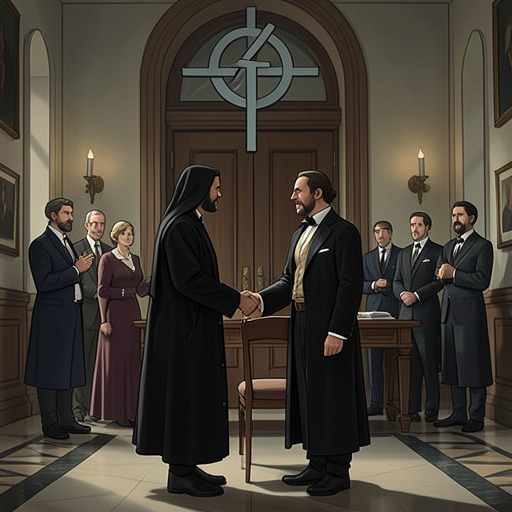
Bjorn of the House of Leshire
The Vampire Prince’s BrideBjorn of the House of Leshire enters the story as one of the two men presented to Cheryl at the Queen’s Temple, but he quickly becomes more than a candidate for her hand. A noble prince in sleek ruby-red nanite armor, he represents hereditary authority, ceremonial power, and the possibility of reform from within the ruling order. His decisive significance lies in the reversal of his original claim: he expects Cheryl to have one king, then chooses to make room for Maskin and to build a new political structure around Cheryl’s own choice.
Identity and Introduction
Bjorn is introduced beside Maskin after Priest Quincy tells Cheryl that she is “the kings' problem.” The contrast between the two men immediately establishes Bjorn’s social position. He wears the fitted ruby-red armor of the noble houses, whose nanites detect incoming pressure and thicken at points of impact. The armor is both protective technology and public display, emphasizing his muscular, lithe build and his status among the aristocratic houses. His midnight-blue skin identifies him as a pureblooded Temadian, or as close to pureblooded as contemporary genetic manipulation permits.
Bjorn’s appearance is matched by his manner. When Maskin is named the “Hero of the Apdratee invasion,” Bjorn treats the title as an insult, asking what Maskin is doing at the shrine. The question exposes the rivalry between noble prince and warrior-slave, while also revealing Bjorn’s confidence that Cheryl’s future belongs within the traditions of royal selection. He assumes that the central issue is which man will possess the queen’s rose, and at first he sees Maskin as a competitor who must be excluded.
Conflict with Maskin and Cheryl’s Choice
Bjorn’s relationship with Maskin is initially governed by antagonism. Maskin dresses for battle even on the shrine grounds, where blasters are forbidden and only technology available when the shrine was founded may be used. Bjorn’s ceremonial nanite armor and Maskin’s scarred, heavy battle armor therefore embody two competing forms of authority: noble legitimacy and proven martial force. Their conflict is not merely personal. It reflects the division between the established houses and the warrior-slave caste, as well as the question of who can claim political power in a society where women are scarce and royal marriage is tightly controlled.
Bjorn also reveals the limits of his early thinking about Cheryl. He believes that the queen should have one king and insists that if she wants another man, the possibility of lovers can be discussed only after marriage. His position is shaped by a social order in which women commonly have male harems because genetic manipulation has made sons far more common than daughters. Yet the queen is treated as an exception: she is expected to have one king, and Bjorn initially intends to be that king. His certainty that Maskin cannot occupy that place shows how quickly a supposedly reform-minded prince can reproduce the structures he hopes to govern.
Cheryl’s intervention forces Bjorn to confront that contradiction. After both men have been injured and healed, she tells them that if one has her, the other must have her as well, always together. She forbids them from being alone with her and makes their future conditional on ending their fights. Her declaration is not presented as a decorative romantic preference; it becomes the boundary that determines whether either man can remain part of her life. Bjorn wants to strike Maskin, but he restrains himself because he understands that Cheryl has made her choice and attached a consequence to their violence.
Reform and the Two-King Proposal
Bjorn’s political convictions emerge most clearly when Cheryl questions the system that denies queens the right to choose their kings. He tells her that the injustices of their society are reprehensible and that the kingdom needs a king who will create change rather than pursue expansion or increase his own wealth. The statement is especially important because it defines his ambitions as political rather than merely romantic. He does not describe kingship as a prize or a source of personal luxury; he imagines it as a responsibility to reform an unjust society.
The revelation becomes a turning point when Maskin admits that he sought kingship for almost exactly the same reason. Their mutual surprise opens the possibility that the noble prince and the warrior-slave are not ideological opposites after all. Although they arrive from radically different social positions, both want authority in order to change the conditions that produced their rivalry. Cheryl recognizes the emergence of respect between them even while they remain trapped in the acolyte kitchen, with warriors hunting them for reasons they do not yet know. Their shared reformist purpose begins to transform conflict into alliance.
Bjorn then makes the decisive argument against the tradition that requires one of the men to disappear. He rejects the idea that a priest, rather than the Gods or Cheryl herself, should determine whether one king must die. He argues that if they truly want to usher in a new era, they should begin with their own arrangement: Cheryl may have two kings. This is the moment when his reform becomes concrete. Instead of asking Cheryl to choose between the two men, he chooses to challenge the institution that makes the choice necessary.
His promise to find a way for the three of them to remain together extends beyond private affection. Bjorn takes responsibility for making the new arrangement politically possible, pledging to do everything in his power to protect it. The promise joins intimacy to governance: the future kingdom will become a test of whether personal consent, social reform, and royal legitimacy can coexist.
Shared Rule and Political Transformation
Bjorn’s conversion from sole claimant to co-king is completed when he accepts Cheryl’s condition that neither man may possess her separately. The arrangement requires him to surrender exclusivity, restrain his hostility, and recognize Maskin as an equal participant rather than an obstacle. It also changes the meaning of kingship. Bjorn no longer imagines the crown as a singular office attached to a single male body; he begins to see it as a burden that can be shared.
When Quincy is forced to swear service to Cheryl and both kings, Bjorn understands that the old religious authority has been placed under the new order. The priest promises that any rebellion against Cheryl or her kings will bring divine punishment. Bjorn remains aware that Quincy’s sincerity is uncertain, so he accepts surveillance as part of the political settlement rather than treating the oath as complete security. His response shows a practical side that balances his idealism: institutional change requires vigilance, not only declarations.
Bjorn’s interior realization gives the transformation its clearest expression. He had expected kingship to let him change the world, but he had never imagined sharing the burden with a queen and a fellow king. With Cheryl and Maskin beside him, reform becomes genuinely possible. The crown is no longer a symbol of individual supremacy. It becomes a collective responsibility, and Bjorn’s willingness to share it is the condition that allows the new political arrangement to survive.
Character Development and Narrative Significance
Bjorn’s arc is a movement from possessive tradition toward collaborative sovereignty. He begins with aristocratic confidence, a sharp antagonism toward Maskin, and an assumption that Cheryl’s royal future must conform to the one-king model. He does not abandon his status or his desire to rule, but he changes what ruling means. His ambition becomes inseparable from the need to dismantle the injustice that gives his own position its privilege.
The character’s development also depends on his capacity to recognize an unexpected common ground with Maskin. Their armor, backgrounds, and public reputations mark them as competitors, yet their stated reasons for seeking the crown reveal parallel political commitments. Bjorn’s eventual respect for Maskin does not erase the earlier violence between them; instead, it gives that violence a new interpretation. The rivalry becomes the pressure through which both men discover that the society they wish to reform has trained them to fight over a system neither fully accepts.
Bjorn therefore functions as the bridge between established power and social transformation. His noble identity gives him access to the authority of the houses, while his willingness to challenge royal tradition allows Cheryl’s choice and Maskin’s claim to enter the political order. His ending is not a withdrawal from kingship but its redefinition: he becomes one of two kings, accepts the queen’s terms, and treats shared rule as the first practical step toward a new era.