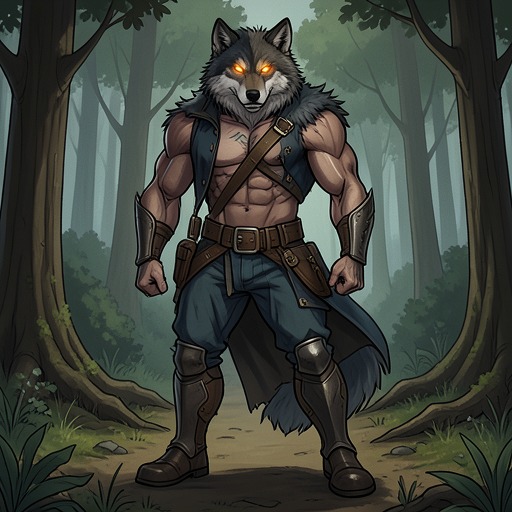
Cain Samson
The Vampire Prince’s BrideCain Samson occupies the decisive intersection between public celebrity and concealed supernatural power. To the world he is an exceptionally successful hockey player; beneath that public identity he is a Dragon Shifter whose anger can release a destructive, fire-bearing form. His story is therefore not simply one of hidden identity. It is a struggle over whether the dragon within him will remain an instrument of his will or become the force that governs him, and whether intimacy can turn that dangerous nature from a source of isolation into a shared bond.
Identity and Public Life
Cain is introduced through the eyes of Michelle Handsworth, his attorney, who is accustomed to demanding sports clients but still recognizes him as unusually imposing. He is six feet five, heavily muscled, marked by a crooked nose broken repeatedly, and has long blond hair that falls into his eyes. His physical presence matches his public stature: he is one of the best hockey players in the world, has won three Stanley Cup championships, and captained the gold-winning U.S. Olympic Hockey Team. His habitual lateness and cocky grin suggest a man accustomed to entering a room on his own terms, while his wealth and fame make him Michelle’s most prominent client.
Cain’s celebrity also shapes his social behavior. He arrives twenty minutes late to meetings, treats his professional confidence as part of his charm, and turns contract business into an opportunity to pursue Michelle. After signing a contract, he invites her to a party at his home to celebrate, promises that her name will be placed at the top of the guest list, and insists that she will be welcomed among the many hockey players attending. His professional world is therefore also the setting in which his attraction becomes visible: the contract gives him relief from paperwork, but the celebration gives him an excuse to draw Michelle closer.
The Hidden Dragon
Michelle recognizes almost immediately that Cain is not an ordinary human. Before she sees him during their first meeting, the hairs at the back of her neck rise and she smells smoke, although nobody else notices anything unusual. Her ability to perceive auras lets her distinguish the supernatural beneath ordinary appearances. Cain’s aura is unlike any human aura she has encountered: greens, reds, and yellows swirl together around him, accompanied by the scent of burning, and the power within it is beyond her ability to name.
This concealed nature makes Cain a figure of divided visibility. To ordinary observers he is a handsome, powerful athlete; to Michelle he is an unknown force disguised as a man. The contrast is not merely decorative. His public image depends on mastery, fame, and physical discipline, while his aura foreshadows heat, violence, and a form of life that cannot be contained by human categories. The same body that performs athletic strength in public carries a more dangerous strength that Michelle can sense before she understands it.
Cain’s connection to Michelle is complicated by what he does not initially reveal. Their meetings are marked by flirtation, but Michelle remains wary because she knows that something powerful is hidden behind his human appearance. When Cain later asks whether she is going out with Brock Thaddeus, his usual charm disappears. He sits beside her, traces a water stain on the bar, and confronts her directly. The question exposes jealousy and emotional vulnerability, but it also places his secrecy beside hers: Cain fears losing Michelle even while the truth of his nature remains concealed from her ordinary surroundings.
Rage, Transformation, and Loss of Control
Cain’s central crisis emerges when anger overwhelms his human restraint. He imagines burning something, allowing fire to consume and transform him, reverting to his true form, and flying over the city while smoke and destruction spread below. The impulse is presented as immediate and elemental rather than as a calculated decision. Fire is both his power and the imagined release from the burden of controlling it.
Yet Cain is not wholly surrendered to that impulse. He recalls meditation training and deliberately counts to ten, breathing deeply while imagining his long body rising from the ground on powerful wings. His effort to remain human is an effort of agency: he insists internally that he will not transform and that he, rather than the dragon, is the master of his anger. The scene establishes the conflict in its clearest terms. Cain’s danger does not arise because he lacks awareness of the dragon; it arises because awareness and discipline may not always be enough to contain it.
That balance fails. When Michelle encounters the dragon, the creature is consumed by anger, confusion, and rage, while Cain remains buried inside it and trapped as the dragon takes control. Michelle touches the dragon’s snout and asks who it is, offering trust and help. The creature’s reaction to the name Cain is painful: recognizing him does not immediately restore his humanity, but instead provokes the dragon to rear back, scream, beat its wings, and rise into the air. Cain’s transformation thus creates a literal separation between the man Michelle knows and the being that now controls his body.
Relationships and Consequences
Michelle is the first person shown to perceive Cain’s supernatural identity without reducing him to it. Her aura-sight makes her wary, but her response to the transformed dragon is not simple fear. She approaches, touches him, and tries to reach the person hidden beneath the rage. Her intervention gives the relationship a different value from Cain’s earlier flirtation: attraction becomes recognition, and recognition becomes an attempt to recover a self that has been displaced by power.
Cain’s relationship with Brock Thaddeus is defined by rivalry and eventual supernatural connection. Cain’s jealousy becomes explicit when he learns that Michelle is seeing Brock, and the question carries more emotional force because Cain’s ordinary confidence has disappeared. Brock is not merely an obstacle in Cain’s pursuit of Michelle; he becomes part of the crisis that reveals what Cain is and what his power can do to another person.
The aftermath transforms Brock permanently. After the encounter involving Cain, Brock’s fever breaks, his shaking stops, and his skin returns to a healthy color. His aura, however, is no longer human. The bright, innocent light that had surrounded him is replaced by the same burning yellows and angry reds associated with Cain. The consequence is not recovery to normality but initiation into Cain’s hidden world: Brock becomes a Dragon Shifter. Cain’s supernatural identity therefore spreads through intimacy and crisis, changing the status of another human rather than remaining a secret contained within one exceptional athlete.
The broader narrative places Cain’s hidden nature within a world where identity, custody, and access to nonhuman power are frequently contested. Other episodes depict people treated as threats, commodities, or restricted dependents, including the United Species’ prohibition of the Fifth Cycle Festival and the Human-Vampire Relations Bureau’s claim that removing humans from vampire custody may be treated as a hostile act. Cain’s story participates in that larger pattern without becoming identical to it: his conflict is less about formal imprisonment than about the unstable boundary between a socially legible human identity and a powerful nonhuman self that others cannot see.
Change and Narrative Significance
Cain begins as a controlled public figure whose lateness, fame, money, and athletic achievements make him appear almost invulnerable. The revelation of the dragon reverses that impression. His greatest threat is not an external opponent but the possibility that anger will convert him into a destructive creature and imprison the human consciousness inside its body. His meditation and breathing show the discipline required to resist that fate, while his transformation shows the limits of discipline when rage gains command.
The story does not resolve Cain by erasing the dragon. Instead, the ending makes the supernatural identity more visible and more consequential. Brock survives, but survival means becoming a Dragon Shifter; Cain’s aura becomes a model that another transformed person now shares. Cain’s significance lies in this contradiction. He is both the celebrated athlete who performs mastery before the public and the dangerous hidden being who must learn, or force himself, to live with an immense power that cannot be made harmless. Through him, the narrative treats transformation not as a simple fall from humanity but as a contested expansion of identity, one that can threaten others, provoke desire, and create new forms of belonging.