Cheryl
The Vampire Prince’s BrideCheryl is the human temple slave selected to become queen of the Demante System, but her importance lies in the way she overturns the institution that claims to define her. Raised for a reproductive and ceremonial role, she enters the succession ritual expecting to meet one king. Instead, she is confronted with two warriors and eventually asserts that her crown, her marriage, and the future of the system cannot be determined without her consent. Her choice of both Bjorn of the House of Leshire and Maskin turns a supposedly passive queen into the central political force of the Demante succession.
Identity and Background
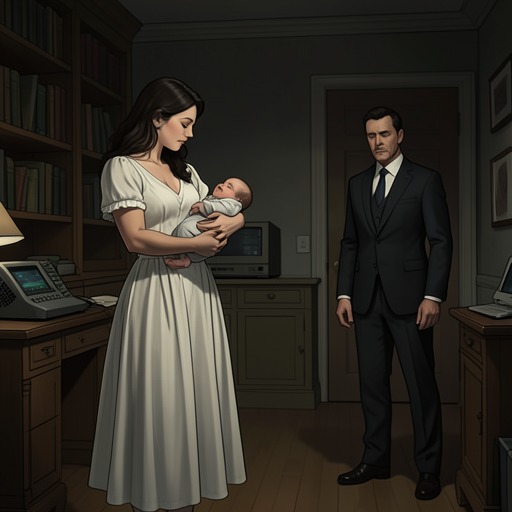
Cheryl was purchased from Earth as a baby and raised in the temple with the expectation that she would become the next queen of the Temadian people. She has known this destiny since childhood, but that knowledge initially means preparation for obedience rather than freedom. The Temadians are a male-built society whose women disappeared eons earlier; for centuries, the population maintained itself by stealing women from other systems. Cheryl therefore embodies the system's dependence on an abducted human body, even while she is elevated above the society as its queen.
Her life in the temple is controlled in intimate as well as political ways. The acolytes decide what she wears and eats, while Priest Quincy repeatedly criticizes her weight and tells her that a queen should be regal rather than round. Cheryl recognizes that she weighs more than expected, but she refuses to treat that judgment as a measure of her worth. She also anticipates marriage and motherhood with genuine excitement. She is eager to see the world, meet her husband, and leave the priest behind, while privately imagining what her king and wedding night might be like. Her desires are therefore present before her political awakening; the story does not create her capacity for choice so much as give her the crisis in which she can finally exercise it.
The Succession Ritual and the Impossible Choice
The day of Cheryl's elevation begins as a sacred public ceremony. The previous king has died, and the widow-queen is ready to transfer the crown to the temple slave chosen to succeed her. Acolytes prepare Cheryl beneath the warm light of sun rods, and Priest Quincy leads her onto a hovering stone platform. The platform rises above the chanting crowd and carries her from the temple to the palace, presenting her body to the population as the visible vessel of dynastic continuity.
The ritual immediately breaks its own promise. Cheryl expects a single king at the foot of the palace steps, but she sees two men. Bjorn of the House of Leshire appears in the ruby-red nanite armor of the noble houses, while Maskin stands as a warrior-slave who has fought his way into contention. Cheryl is not given an explanation that makes the choice manageable; she is simply told to choose. The demand exposes the violence beneath the ceremony. A woman whose clothing, food, education, and future have always been selected for her is suddenly required to make an irreversible decision between two lives while everyone watches.
Her first response is refusal. Tears burn in her eyes, her hands shake, and she tells Quincy that she cannot choose. When he insists that the Gods will decide, Cheryl briefly appears to accept the limitation of her office: she is only the queen, not the authority who determines the king. Yet this apparent submission becomes the starting point of her rebellion. The ritual's language of divine will conceals a human power struggle, and Cheryl gradually recognizes that the demand to choose one man is itself an imposed political decision.
Choosing Two Kings
Cheryl's relationship with Bjorn and Maskin develops through the tension between rivalry and mutual attraction. Maskin enters the shrine expecting that the most practical course would be to claim Cheryl repeatedly and secure a child, because the succession system treats pregnancy as proof of legitimacy. Instead, he sees her fear and refuses to treat her as an instrument. He wants her to like him rather than fear the moments when they are joined. This response distinguishes him from the institution that produced him, but it does not erase the danger surrounding Cheryl or the rivalry between the two warriors.
After the men are healed, Cheryl takes both of their hands and leads them toward her cabin. There she makes the decision that defines her. She declares that if one of them has her, the other must have her as well, always together, and that neither man will be alone with her. She also sets a clear condition: if they fight again, she will reject them both. This is not merely a romantic arrangement. Cheryl converts her personal boundary into a rule governing the future kings, compelling the two competitors to share power rather than resolve succession through violence.
Her position becomes even more forceful when the danger escalates. Fearing that surrendering herself might save the warriors, Cheryl realizes that the men attacking them may intend to kill one claimant so that the other can become king. She rejects that logic outright. She insists that she is the person with the final say in who her king will be, refuses to let an unnamed lord determine her fate, and declares that she will not be queen unless both Bjorn and Maskin are her kings. Her language marks a decisive transformation: the woman once expected to bow to tradition now uses the title of queen as the basis of authority.
Defying Quincy and Rewriting Legitimacy
Cheryl's open confrontation with Priest Quincy completes her separation from the temple's version of her identity. When Quincy treats the shedding of blood as a crime committed by the queen, Cheryl answers that if it is criminal for a queen to shed blood, then it must be criminal for anyone to shed blood. She admits that she killed a man, but explains that she did so to defend herself and her kings. The admission is important because she neither denies the violence nor accepts the priest's right to define it for her.
She then reconstructs the history of the succession dispute. When Bjorn and Maskin were presented, she could not choose because her real choice was both. Quincy nevertheless insisted that she select one or the other and announced that the Gods would decide by determining which warrior first placed a child in her. Cheryl identifies the fraud in that declaration: Quincy knew that warrior-slaves could not have children, so the supposed divine test was designed to eliminate Maskin and choose a king on the priest's own terms. Cheryl's accusation turns fertility from a sacred test into evidence of political manipulation.
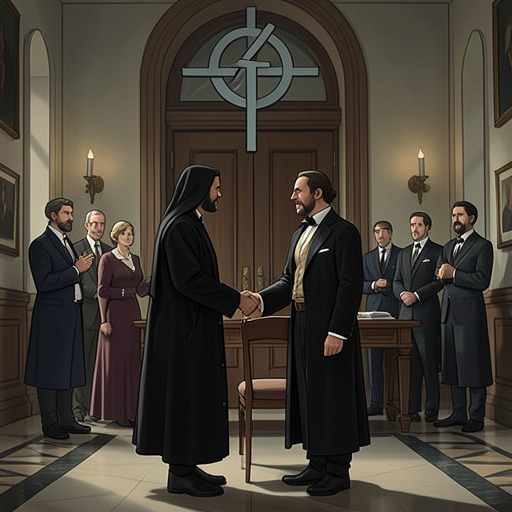
In the confrontation, the warrior-slaves part to let Cheryl pass. She goes to Bjorn's side, takes his hand, and publicly aligns herself with both men. The gesture makes her claim visible before the community that once saw her as a slave. Her authority is not granted by Quincy; it is enacted through speech, bodily movement, and the refusal to let religious procedure speak in her place. Cheryl's arc thus gives a formerly controlled woman her own political language. She does not escape the history of slavery that made her queen, but she uses the office to challenge the hierarchy that still calls her a slave.
Pregnancy, Shared Inheritance, and Narrative Significance
Cheryl's pregnancy confirms that her attempt to create a three-person royal structure is not only symbolic. After visiting the fertility temple, she announces that she is pregnant and that the DNA scans show the cloning plan worked. The child will carry the DNA of all three parents: Cheryl, Bjorn, and Maskin. This result overturns the premise Quincy used against Maskin and gives biological form to Cheryl's political choice.
The pregnancy also changes the meaning of succession. Under the old arrangement, Cheryl's body would be used to validate a single king, and the first child would settle the contest. Under Cheryl's arrangement, the child becomes evidence that both warriors belong to the royal future and that the queen's will can generate a different inheritance structure. Reproduction no longer functions solely as a mechanism by which men determine which man will rule; it becomes the consequence of Cheryl's decision to refuse exclusion.
Cheryl's story is structured as a passage through sacred institutions that she ultimately repurposes. The temple, the hovering coronation platform, the palace, the fertility temple, and the shrine all claim the power to transform a slave into a queen, a warrior into a king, or a pregnancy into proof of divine legitimacy. Cheryl passes through those ritual spaces but does not remain the person they define. Her decisive act is not to abandon ceremony altogether. It is to expose the human choices hidden inside ceremony and place consent, mutuality, and shared rule at the center of the new order. By the time her three-parent pregnancy is revealed, the former temple slave has become the queen who determines what kingship, marriage, and succession will mean.