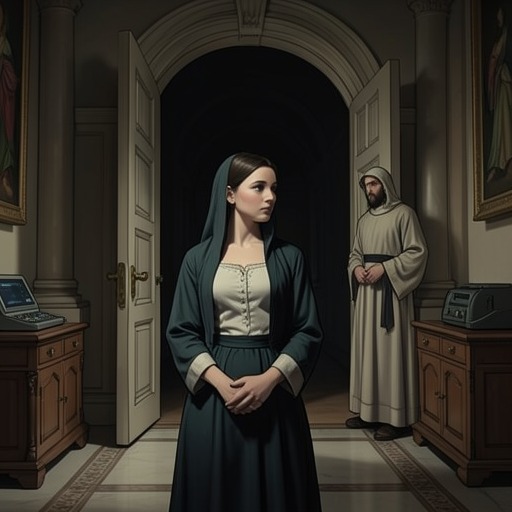
Cheryl Chooses Both Kings
The Vampire Prince’s BrideCheryl Chooses Both Kings marks the moment when Cheryl converts an apparent royal succession into a three-person union. After being publicly escorted from the temple toward the palace, she discovers that two men—not one—are waiting to receive her. The resulting choice rejects the expectation that she must belong exclusively to a single king and instead makes both Bjorn and Maskin responsible for honoring her will.
Causes and Background
Cheryl’s choice emerges from a political and ceremonial system that treats her as a queen whose future is bound to royal reproduction. Priest Quincy frames her departure in terms of her duty to provide her king with children, describing a future of producing “beautiful, dark blue babies.” The ceremony therefore presents marriage not simply as a private attachment but as the completion of a public succession arrangement. Cheryl is taken from the temple amid cheers, carried on a hovering stone platform from the temple steps to the palace, and displayed before a crowd that chants her name.
The ceremony prepares Cheryl to meet a single king at the bottom of the palace steps. Instead, she sees two men. That visual contradiction turns the procession into a crisis of expectation: the public ritual promises one royal partner, while the reality before her offers two competing candidates. The surprise does not erase the political stakes. Cheryl remains the queen, and her decision will determine how royal authority, partnership, and future offspring are organized.
The Choice at the Cabin
The immediate decision occurs after the conflict between Bjorn and Maskin has apparently been contained. Both men have been healed, and Cheryl is well enough to walk with them to her cabin. She takes each of their hands, making the movement itself a visible sign that neither man has been excluded. Their silent walk carries the tension of the earlier rivalry, especially in Maskin’s rigid arms, but Cheryl refuses to let that rivalry decide her future.
At the cabin step, Cheryl pulls her hands away and states the condition of their relationship. She declares that if one of them has her, the other must have her as well, and that they will always be together rather than meeting her separately. The choice is explicitly conditional: if either man fights the other again, both will lose her. Her trembling hands and pale face show the cost of making the declaration, but her resolve is unmistakable. She enters the cabin and shuts the door, leaving the terms with the two men rather than asking them to negotiate them for her.
From Rivalry to Agreement
Bjorn and Maskin initially remain opponents. After Cheryl leaves, Bjorn wants to strike Maskin, but Cheryl’s warning restrains him. Maskin follows as Bjorn walks away, and the two men confront the new reality outside the cabin. Maskin acknowledges that Cheryl has made her choice, while Bjorn answers that he will claim his queen and is willing to share her if that is what she wants.
Their agreement does not dissolve their rivalry. Maskin immediately preserves a private claim, insisting that Cheryl’s “rose” belongs to him, while Bjorn counters that he may reach her first. The exchange keeps competition alive even after the larger conflict has been redirected into cooperation. Cheryl’s decision has therefore changed the value at stake: the men can no longer pursue victory by eliminating one another, but they still compete within the framework she has imposed.
Ritual, Authority, and Social Order
The event is structured as a threshold between identities. Cheryl leaves the temple as an institutionally assigned queen, crosses a public ceremonial space on a hovering platform, and reaches the palace expecting the completion of a single-king succession. Instead, the discovery of two waiting men places her in a liminal position where the established arrangement no longer provides an answer. She then creates the answer herself at the cabin, converting uncertainty into a new social rule.
Her decision also reverses the usual direction of royal power. The ceremony appears to deliver Cheryl to a king, but Cheryl ultimately determines the conditions under which either man may have royal access to her. The men may be warriors and potential kings, yet her acceptance is the organizing principle of the union. The prohibition against fighting is equally important: Cheryl links intimacy, political legitimacy, and peace, making continued partnership dependent on the end of male rivalry.
Consequences and Significance
The immediate consequence is the formation of a shared relationship among Cheryl, Bjorn, and Maskin. Cheryl chooses both men rather than allowing one to defeat or replace the other, and both men accept that her preference governs the arrangement. Their agreement creates the basis for a dual-kingship order in which the two rivals must coexist as partners rather than treating one another as obstacles.
The choice is significant because it challenges the single-king model already embedded in the ceremony and in the expectations surrounding Cheryl’s reproductive role. It also makes consent and conditions part of the political structure: Cheryl is not merely selected for a royal future; she selects the form that future will take. The public procession begins with an inherited institution and an unexpected pair of candidates, while the private confrontation ends with a new arrangement defined by Cheryl’s refusal to surrender either relationship or tolerate renewed violence.