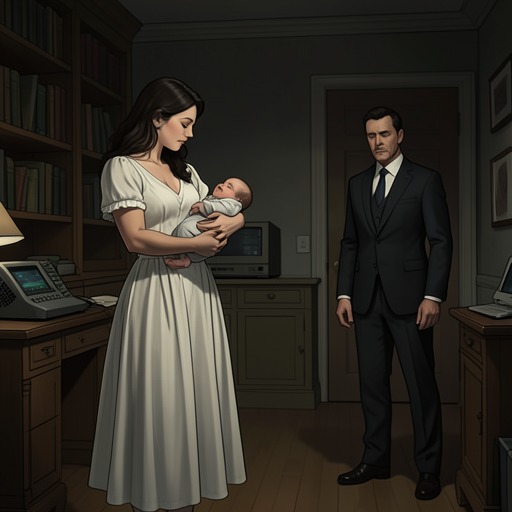
Claire Doyle
The Vampire Prince’s BrideClaire Doyle’s decisive role in the story is to turn a murder investigation into a passage across the boundary between ordinary human law and a concealed werewolf society. Introduced as Detective Doyle, she approaches Roland Davis’s mansion as an investigator of Melissa Clarkson’s death, not as a participant in supernatural romance. Her evidence-driven pursuit of the truth brings her face to face with Roland’s pack, exposes the danger surrounding the Alpha’s succession, and ultimately places her at the center of a family whose future depends on the child she carries. Claire’s arc is therefore not a simple conversion to a hidden world: it is a negotiation between the independent life she planned, the evidence she uncovers, and the attachments she chooses to accept.## Identity and IntroductionClaire enters the narrative with the authority and composure of a professional detective. At the crime scene, she arrives in a fitted business suit and sensible flats, with short, perfectly curled hair and a large black bag over her shoulder. Her self-confidence is described as queenly, but her presentation is practical rather than ornamental. She is recognized by the police as Detective Doyle, and she introduces herself formally to Roland, identifying him as Roland Davis and establishing her role before she asks about Melissa Clarkson’s body. The contrast matters: Roland may be the Alpha of a werewolf pack, but Claire initially meets him through the institutional language of homicide investigation.She works with Catherine Grace, one of the detectives assigned to homicide, and is shown examining crime-scene photographs from the Melissa Clarkson case at her desk. Her concentration is so complete that Grace observes how little Claire notices when focused on a task. The detail defines Claire’s investigative temperament: she is not presented as someone waiting to be swept away by the supernatural, but as someone capable of narrowing her attention until every other concern recedes. Even when the case becomes personally dangerous, she continues to frame events as questions requiring answers. Her professional identity remains active after the revelation of Roland’s secret.## The Investigation into Melissa ClarksonClaire’s first sustained objective is to determine why Melissa Clarkson was found in Roland’s bed and who killed her. She asks Roland and his head of security, Adam Buchan, where they were between 6:00 and 8:00 that morning, treating the time window as a conventional homicide clue. The questioning also reveals the social web around the victim: Roland was Melissa’s employer, while Adam had known her well enough to describe their relationship. Claire’s manner remains businesslike even when Adam’s charm and flirtation attempt to alter the atmosphere. Her response to the case is observation rather than intimidation.Claire later accepts Roland’s invitation to attend a wake for Melissa at his mansion. The proposed gathering is to include the people who attended his previous party, allowing Claire to meet coworkers and acquaintances in a less formal setting. She recognizes the ethical gray area of using a wake as an investigative opportunity, but also sees its practical value: people might reveal interpersonal tensions they had concealed from uniformed officers, particularly if alcohol loosened their tongues. She even concludes that bringing Grace would make the investigation too conspicuous, so she plans to attend alone. This decision shows both her tactical intelligence and her willingness to operate at the edges of procedure when the pursuit of evidence demands it.## Encounter with the Werewolf PackClaire’s investigation becomes an encounter with the supernatural when she returns to Roland’s mansion beneath a bright full moon. She has keys to both the mansion and the crime scene, and she arrives early, intending to inspect the property again while it is officially unoccupied. Before she reaches the front door, a bone-tingling howl breaks the stillness. The carefully manicured grounds, attractive in daylight, become threatening at night, while the cedar trees beyond the lawn transform the familiar estate into a boundary between civilization and wilderness.The danger is immediate. Claire sees werewolves that she recognizes as Roland’s employees, and Adam changes back while looking at her with terror. Her rescuer orders the wolves away, and Claire recognizes the voice. Roland turns toward her with amber eyes, revealing that the leader of the hidden pack is the man she had been investigating. Roland carries her inside and places her on the couch, anxious because she has fallen silent and appears to be in shock. Claire, however, refuses to remain merely a rescued victim. She insists that being shot at regularly has made her difficult to frighten and demands to know whether Melissa discovered the pack’s secret. She directly connects the supernatural revelation to the murder investigation rather than allowing the rescue to close the subject.She also confronts Roland about his relationship with Melissa. When he explains that Melissa was part of the pack, Claire immediately follows with the fact that he had been sleeping with her. The accusation makes the revelation personal and morally complicated. Claire is not given a clean division between innocent human investigator and trustworthy supernatural protector: Roland is both the man who saved her and the Alpha connected to the dead woman, while Melissa is both a murder victim and a member of the concealed community. Claire’s questions preserve the investigative pressure even after the story changes genres around her.## Pregnancy, Autonomy, and DecisionClaire’s discovery that she is pregnant intensifies the conflict between her professional independence and Roland’s expectations of family continuity. Roland believes the child may be important to the pack’s future, but Claire refuses to let his desire determine what happens to her body. When she considers whether she will even carry the pregnancy to term, Roland recognizes that he cannot simply assume she wants the baby as much as he does. He wants to beg her to try, yet understands that he cannot tell her what to do with her own body. Claire’s position is consequently framed through bodily autonomy rather than passive acceptance of a mate’s claim.She continues working and declares that she will find Melissa Clarkson’s killer while deciding what to do about the pregnancy. At the police station, she asks Grace to investigate the past relationships of both Melissa and Roland, looking for anyone who may have been dangerously obsessed with either of them. The request shows that the murder case has not been displaced by the supernatural revelation. Claire’s personal crisis becomes another reason to seek facts, not an excuse to abandon the investigation. At the same time, she admits that her expected timetable for motherhood had been distant: she had imagined children someday, after finding a stable relationship, and believed she had perhaps ten years before the issue became urgent. A werewolf pregnancy destroys that carefully deferred plan.She eventually receives medical confirmation that she is pregnant. The certainty brings relief, not because the situation is easy, but because uncertainty has ended. Claire then makes an explicit decision: although she had not wanted a baby so soon and had wanted stability first, she will carry the child to term despite being frightened. The decision remains conditional in the surrounding danger, since the full moons might threaten the fetus, but it is still hers. Her acceptance is not portrayed as surrender to Roland’s wishes; it is a conscious choice made after she has confronted the risks and the disruption to her planned life.## Relationship with Roland Davis and Family EndingClaire’s relationship with Roland develops through conflict between his certainty and her caution. Roland recognizes her as his mate and treats their bond as something that would eventually have brought them together even without the pregnancy. Claire is more skeptical of that inevitability, especially because their pregnancy began after a single night and because the relationship emerges alongside murder, secrecy, and pack politics. Her resistance gives the romance a counterweight: Roland speaks from supernatural conviction, while Claire tests the claim against her own judgment and experience.The full-moon attack forces the relationship into a more dangerous form. Roland understands that the wolves pursued Claire because he failed to take control of Brian when the pack scented her. The wolves might have recognized the scent of the Alpha’s unborn child and submitted to her as the Alpha’s mate, but instead they attacked while under the moon’s influence. Roland carries Claire away from the danger and tries to care for her, while she demands answers rather than comfort alone. Their bond therefore grows through the collision of protection and accountability.Claire ultimately gives birth to Ada Doyle-Davis, who weighs five pounds and four ounces and is exceptionally thin because she is premature. Claire’s first reaction is fear that the baby, having survived the full moons, may not survive birth. Roland cradles Ada against his chest, and the doctors advise sustained physical contact; Claire and Roland take turns holding their daughter while the pack members prepare food, clean, and remain close to the guest house. The pack’s protectiveness identifies Ada as the child who will become the next Alpha, making Claire’s pregnancy consequential not only to her own future but to the succession of the werewolf community.The birth also confirms Claire’s transformation in relational terms. She and Roland acknowledge that their connection would have endured even without the pregnancy, and Claire admits that she feels as strongly as he does. With Ada present, she tells Roland that she loves him, and he answers with a promise of enduring love. The ending does not erase Claire’s earlier fear or professional identity; it places those qualities within a chosen family. She becomes mother, mate, and future Alpha’s parent without ceasing to be the detective whose first instinct was to ask who killed Melissa Clarkson.## Narrative Function and Thematic SignificanceClaire is a round character because the supernatural revelation does not produce a single, automatic response. She is frightened, suspicious, sexually and emotionally implicated, professionally persistent, and capable of making a deliberate choice under pressure. Her movement is not from ignorance to unquestioning belief. Instead, each new fact produces another demand for verification: the pack must be explained, Melissa’s death must be investigated, the pregnancy must be medically confirmed, and Roland’s claim of an inevitable bond must be tested through lived experience.Claire’s story also places competing ethical frameworks beside one another. Roland’s world emphasizes pack duty, reproductive succession, and the importance of an Alpha’s heir. Claire insists on the principle that her body and future cannot be commandeered by those collective needs. The tension resembles the ethical dispute elsewhere in the novel, where Shay argues that it is sacrilege to experiment on beings who cannot give meaningful consent, even when a population faces infertility and extinction. In Claire’s plot, the same moral pressure appears in intimate form: communal survival and lineage may matter, but consent remains the boundary that cannot be casually crossed.Her investigation further links supernatural secrecy to ordinary institutional power. Claire first encounters Roland through the police process surrounding a murder, and she continues to use homicide methods even after learning that the suspects and witnesses belong to a hidden species. The mansion, the full moon, the transformed employees, the body in Roland’s bed, and the medical confirmation of pregnancy all function as concrete signs that force her to revise the meaning of earlier evidence. By the end, Claire has not merely entered Roland’s private world; she has made that world answerable to her questions and has chosen, on her own terms, to help shape its future through Ada Doyle-Davis.