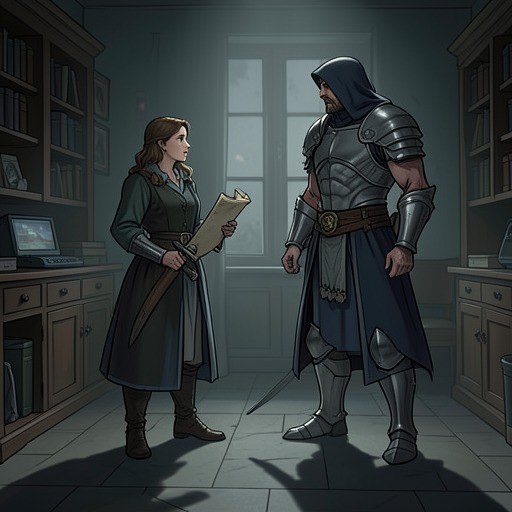
Darilth Rothgar
The Vampire Prince’s BrideDarilth Rothgar is the exiled prince of Iovis whose story turns on the collision between royal duty, forbidden intimacy, and a divided Drakonaar identity. Known as Darilth in humanoid form and as Mekarth when his inner dragon manifests, he is neither two unrelated beings nor a simple disguise: he understands the dragon as another consciousness within the same person. His journey moves from concealment and flight to imprisonment, resistance, restoration, and coronation, ending with Darilth as King of the Rothgar throne and Ella Darilth Rothgar as his Queen.
Identity and the Inner Dragon
Darilth’s most decisive revelation comes when he shifts before Ella. The transformation is so rapid that it escapes the human eye, leaving a graceful white dragon where the prince had stood moments earlier. Mekarth is immense, with leathery wings, rows of horns extending from the brow and forehead along the spine and tail, sapphire eyes with slit pupils, large claws, and pointed teeth. Yet the physical display of danger is balanced by an aura of civilized grace, dignity, and icy strength. The dragon is not presented as a mindless beast but as a formidable, intelligent aspect of Darilth’s being.
Mekarth speaks in a deep, rumbling voice and immediately identifies himself as Darilth’s other side. Darilth explains that the two are “two sides of one being,” describing Mekarth as a manifestation of another consciousness within them. This explanation matters because Ella’s first response is fear: she backs away, trembles, and asks for Darilth to return. Darilth does not dismiss her reaction or force her acceptance. He shifts back, takes her in his arms, and comforts her, telling her that he did not mean to frighten her. His gentleness makes the revelation a test of trust rather than merely a spectacle of supernatural power.
The scene also places Darilth’s identity against the religious guilt Ella has inherited from Sister Margaret’s sermons about winged demons. Ella briefly interprets the dragon through a human framework that equates unfamiliar desire and nonhuman form with sin. Darilth’s honesty and tenderness gradually break that opposition apart. He is a shifter, but he is also her husband; the narrative insists that his dragon nature does not cancel his moral personhood or the legitimacy of their marriage.
Exile, Marriage, and the Flight from Iovis
Darilth’s marriage to Ella is politically dangerous because he remains in exile and is still under royal penalty. When Ella asks what will happen once the King learns of their union, Darilth reveals that they must leave the castle that night. Their public cover will be that Ella is his slave, while their actual destination is R13, the moon closest to Iovis, where he believes they can be safe. The plan shows the practical cost of his royal status: even a private marriage can become a capital offense when it defies the King’s orders.
Darilth also refuses the seemingly simpler solution of openly telling the King. He explains that, while still exiled and under penalty, disobedience is punishable by death. If their marriage becomes known, both he and Ella could be killed. His protection of Ella therefore requires concealment, calculated movement, and the willingness to abandon the castle rather than appeal to authority that may already be hostile. The threat is not abstract. The planned escape turns their relationship into a direct challenge to the political order governing the Rothgar family.
The escape fails before Ella reaches safety. While traveling through space, Darilth repeatedly checks the band kept in a black box: the Draco’s Eye glows when he touches it, and he feels its power surge through his blood after placing it on his wrist. He also wears a ring that functions as a communicator and can project a holographic screen. When no message arrives from the guard assigned to escort Ella to R13, Darilth contacts his housekeeper and learns that Ella never reached home. His anticipated refuge becomes evidence of betrayal, and the distance of the spacecraft intensifies his helplessness.
Betrayal, Loss, and Resistance
The news that reaches Darilth compounds the disappearance. A message from the Council Chief informs him that his father has been assassinated and orders him to abandon his current tasks and return immediately to Rothgar Castle. He is therefore pulled between two emergencies: Ella has vanished, and the royal succession has been destabilized by the death of the King. His personal rescue mission and his dynastic obligation become inseparable.
When Darilth returns, he immediately recognizes that Prince Keralth has changed. Keralth sits haughtily on the throne, his amber eyes carrying a sinister gleam, and Darilth feels a chill as he tries unsuccessfully to read his brother’s mind. Keralth’s welcome is openly hostile, and the blocked mind-reading suggests that the new political environment has been prepared against Darilth. The throne is no longer simply vacant; it has become the center of a betrayal that Darilth must interpret while grieving and searching for Ella.
Darilth is eventually left in restraints, overwhelmed by grief and crying Ella’s name into the darkness while attempting to reach her telepathically. His first reaction is emotional collapse, but Mekarth interrupts that collapse with a demand for control. The inner dragon reminds him that saving Ella and saving the throne require clear thought. Darilth’s response marks a crucial change in his role: he moves from a grieving husband toward an active strategist without abandoning the relationship that gives his struggle meaning.
His solution depends on an overlooked feature of the ring. The captors do not know that it is a secret communicator, and the device is undetectable to demons. Darilth uses it to send a message to Merelith, the witch who may be able to help him. The action is small but decisive. Physical restraint and supernatural surveillance do not entirely control him because his technology, memory, and partnership with Mekarth preserve a hidden channel of resistance.
Confrontation and Restoration
The confrontation with Keralth places Darilth’s private loyalty and public claim to power in the same scene. When Keralth threatens and humiliates Ella, Darilth steps forward with the Lazarus sword and points it at his brother’s throat. He orders Keralth to stop, making the weapon a visible declaration that Ella is not disposable property and that Darilth will oppose the usurping power directly. Merelith’s presence and transformation further expose the instability surrounding the throne, but Darilth’s intervention supplies the immediate boundary Keralth has crossed.
Darilth’s struggle is consequently not only a succession dispute. It is also a defense of a marriage that the royal system treats as punishable and of a self that cannot be reduced to either prince or dragon. His divided nature repeatedly becomes a resource rather than a defect: Mekarth provides counsel when grief threatens to paralyze him, while Darilth’s human tenderness gives political action an ethical purpose. The same duality that frightened Ella becomes part of the strength through which he survives betrayal.
Six months later, the political conflict has been resolved in Darilth’s favor. Prince Darilth Rothgar is crowned King of the Rothgar throne, and Ella is crowned Queen. The ceremony is grand, and the people of Iovis celebrate the new royal pair. His return therefore completes more than a journey home: the exiled prince re-enters the political center not by erasing his marriage or suppressing his dragon nature, but by bringing both into the public order of kingship.
Family, Integration, and Narrative Significance
Darilth teaches Ella to summon her own inner dragon after she becomes Queen. Her transformation initially brings dizziness and headaches, but these eventually disappear. When she first shifts, she experiences the event as the discovery of another side of her inner self; Darilth names her dragon Saphira the Magnificent. This reversal mirrors Darilth’s earlier revelation to Ella. What began with Ella’s fear of Mekarth ends with her own acceptance of a transformed identity, and Darilth becomes not merely the person she must learn to tolerate but the guide who helps her inhabit the same kind of divided embodiment.
Their son develops far faster than a human child, appearing to be two years old when he is only six months old. He has bright blue eyes and dark hair, and Merelith predicts that he will become a strong warrior, stronger than other Drakonaars because he is a half-blood prince. The child joins royal succession, supernatural inheritance, and family continuity in a single figure. Darilth’s political restoration thus produces a future shaped by mixed identity rather than by the exclusion that once made his marriage dangerous.
Darilth’s ending is defined by integration. He remains a prince in memory, a king in public authority, a husband to Ella, and a being shared with Mekarth in his inner life. The story repeatedly tests whether these roles can coexist: Ella’s first terror, the planned flight to R13, the assassination of the King, Keralth’s occupation of the throne, imprisonment, and the threat against the marriage all attempt to force the identities apart. The coronation and the family’s life afterward answer that pressure by joining them. Darilth’s decisive achievement is not simply taking the throne; it is making room within the restored throne for the dragon, the marriage, and the half-blood family that the old order sought to endanger.