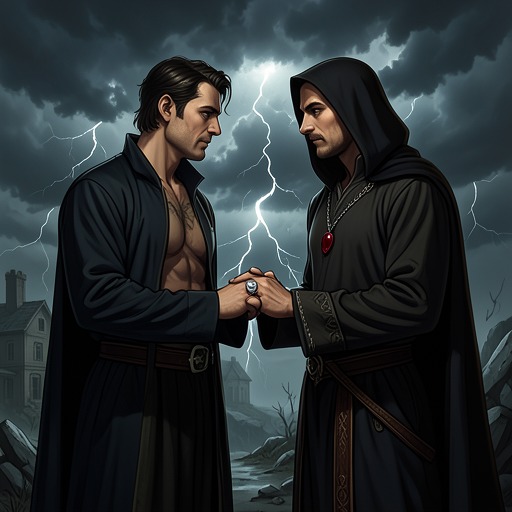
Darilth and Ella's marriage and true-mate bond
The Vampire Prince’s BrideDarilth and Ella's marriage and true-mate bond joins personal recognition to dynastic legitimacy: the Draco’s Eye identifies Ella as Darilth’s destined mate, and its awakening proves that the exiled heir has married the woman meant to stand beside him. Their union begins as a dangerous secret, threatened by royal law and political assassination, but ends with Darilth and Ella crowned together on Iovis and raising a son whose mixed heritage embodies the future of the Rothgar line.
Recognition and Forbidden Marriage
Darilth’s bond with Ella is not presented as an ordinary attraction. When he gives her the silver band bearing the large blue stone, he explains that it is the Draco’s Eye, the hereditary object carried by the heir to the Rothgar throne. When he first saw Ella on Earth, the stone showed him that she was his destined mate. The Eye therefore functions as both a personal sign and a dynastic authority: it recognizes Ella before the court does, and it makes their relationship inseparable from Darilth’s claim to succession.
The marriage is nevertheless politically illegal and personally perilous. Darilth remains in exile and is forbidden to defy the King while under penalty; discovery of the marriage could result in both spouses being killed. He plans to leave the castle with Ella that night, conceal her as a slave, and take her to R13, the moon closest to Iovis, where they may be safe. His secrecy is not a rejection of the relationship but a protective strategy forced upon it by royal power.
Darilth also insists that the marriage possesses undeniable legitimacy. He tells Ella that the Draco’s Eye can awaken only after the Crown Prince has married his true mate. The awakened Eye therefore converts an intimate act into political evidence. Their union is secret in the eyes of the regime, yet authenticated by the very inheritance symbol that defines the throne. Marriage becomes at once their vulnerability, their proof, and the mechanism through which Darilth’s dormant royal destiny is activated.
Separation, Betrayal, and Shared Danger
The couple’s attempt to escape is interrupted before safety can be reached. While traveling aboard a spacecraft, Darilth watches the Draco’s Eye and anxiously waits for word from the guard assigned to take Ella to R13. When his housekeeper reports that Ella never arrived home, his fear confirms that the danger surrounding their marriage has become an active abduction rather than a distant threat.
The crisis deepens when Darilth receives a message from the Council Chief announcing that his father has been assassinated and ordering him to return immediately to Rothgar Castle. Ella soon suspects that the King has learned of their relationship, but Darilth reveals that the King is already dead. He identifies Keralth as the murderer, explaining that Keralth acted to obtain the Draco’s Eye and seize the throne. The couple’s private marriage is thus caught inside a succession struggle: the same object that validates Darilth and Ella’s bond also makes them targets.
When Darilth reaches Ella after her ordeal, she sees bruises on his face and understands that he has entered the conflict rather than abandoning her. She urges him to return and fight for his rightful place. Her response marks the relationship as reciprocal political loyalty, not merely protection offered by a prince to a vulnerable woman. Ella’s survival depends on Darilth’s claim, while Darilth’s claim is strengthened by the mate bond that Ella makes visible.
Marriage as Dynastic Legitimacy
The relationship connects intimate choice to the rules of Drakonaar succession. Darilth is not simply a royal man who marries for affection; he is the heir whose marriage to his true mate awakens the Draco’s Eye and thereby confirms the legitimacy of his position. Ella’s presence changes the meaning of the inheritance object from a private emblem of bloodline into a public sign of chosen partnership.
That connection also places Ella at the center of a conflict over who may define royal legitimacy. The King’s authority treats their marriage as punishable disobedience, while the Draco’s Eye treats it as the condition for rightful succession. The couple therefore occupies a liminal position between outlawed spouses and legitimate monarchs. Their relationship must pass through concealment, flight, violence, and royal reversal before its authority can be recognized openly.
The ending completes that movement from clandestine union to public institution. Six months after the crisis, Darilth is crowned King of the Rothgar throne and Ella Darilth Rothgar is crowned Queen. The people of Iovis celebrate the new rulers together. Their marriage is no longer a secret that endangers the dynasty; it has become the visible basis of the dynasty’s restoration.
Shared Transformation and Family
Ella’s bond with Darilth is also physical and species-crossing. After becoming part of the Rothgar royal future, she must adjust to a new form, experiencing dizziness and headaches before learning to summon her inner dragon under Darilth’s instruction. Her first shift is described as discovering another side of herself, and Darilth names her dragon Saphira the Magnificent. The transformation makes their partnership more than a human–Drakonaar romance: Ella comes to inhabit the identity connected to Darilth’s people and throne.
Their family extends that hybrid significance. Their son grows far faster than a human child, appearing approximately two years old at six months, and is described as unusually intelligent, with bright blue eyes and dark hair. Merelith predicts that he will become a powerful warrior because he is a half-blood prince. The child therefore carries both the emotional consequence of the marriage and its political future, combining human and Drakonaar inheritance within the royal line.
Ella’s final sense of having found home gives the relationship its emotional resolution. She begins as a woman whose connection to Darilth must be hidden and whose safety depends on flight. She ends as his crowned Queen, a transformed Drakonaar, and the mother of a half-blood prince. The marriage has not erased the danger that produced it; instead, it has converted danger into belonging, succession, and a shared household.
Narrative Significance
Darilth and Ella's marriage and true-mate bond is structured around the tension between coercive institutions and relational recognition. Royal commands, exile penalties, assassination, and succession law attempt to regulate whom Darilth may marry and what Ella may become. The Draco’s Eye offers a competing authority grounded in destiny and mutual attachment, while Ella’s insistence that Darilth fight for his rightful place gives that bond an active voice within the political plot.
The relationship also repeatedly crosses boundaries: Earth and Iovis, human and Drakonaar, private marriage and public monarchy, exile and sovereignty, and individual love and dynastic reproduction. Its decisive significance lies in how those boundaries are not treated as final. By the epilogue, the couple’s forbidden union has become the instrument of royal continuity, Ella’s altered body has become part of her self-discovery, and their half-blood child embodies a future broader than the inheritance system that first sought to exclude them.