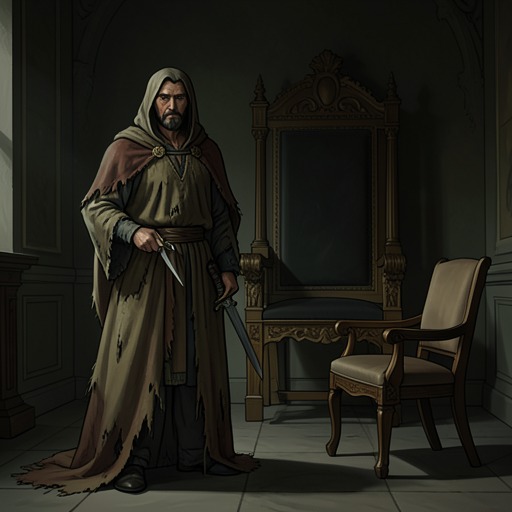
Darilth’s Coronation
The Vampire Prince’s BrideDarilth’s Coronation is the public culmination of Darilth’s struggle to reclaim the Rothgar throne. It follows the collapse of the succession crisis: Keralth has been sentenced to death for murdering his father, the weapon used in the assassination has been recovered, and the surviving conspiracy has been exposed even though one accomplice killed himself before confessing. Six months later, the private victory becomes a public order when Darilth is crowned king and Ella Darilth Rothgar is crowned queen, while the people of Iovis celebrate their new rulers.
Causes and Dynastic Background
The coronation is made possible by the defeat of Keralth, Darilth’s principal rival and a direct source of the violence that destabilized the Rothgar succession. The Council’s sentence confirms that Keralth will be executed for stabbing his father, King Rezelith III. The discovery of the dagger used in the attack, together with the identification of the assassin responsible for killing a guard and a maid, gives the transition a legal and political foundation rather than leaving Darilth’s claim as a simple act of battlefield possession.
Darilth’s relief is therefore inseparable from grief. After the Council meeting, he feels at peace because Keralth’s guilt has been established and punishment is imminent, yet he also wishes that his father were alive to witness the birth of his grandson and recognize that Darilth was worthy of the throne. The coronation answers that absent recognition publicly, but it cannot restore the father whose approval Darilth wanted. The new reign begins in the shadow of a family loss that the ceremony can commemorate only indirectly.
The Coronation and Public Restoration
The ceremony occurs six months after the Council’s judgment and is described as grand. Darilth is crowned King of the Rothgar throne, while Ella Darilth Rothgar receives the crown of queen. Their paired enthronement makes the succession a shared dynastic image: Darilth’s authority is restored through kingship, and Ella is incorporated into the Rothgar royal line through marriage, title, and transformation.
The people of Iovis celebrate the new King and Queen, turning the coronation into a collective act of recognition. The event thus moves Darilth’s restoration through three stages: the old order is separated from the throne by assassination and punishment; the succession passes through a dangerous, uncertain interval; and the monarchy is reconstituted in a public ceremony that gives Darilth and Ella stable social identities. Its significance lies not only in the crown itself but in the transition from contested bloodline to acknowledged rule.
Ella’s Transformation and the New Royal Household
Ella’s queenship is inseparable from her conversion into a Drakonaar. Darilth has made her drink his blood, knowing that she would survive but would awaken changed, stronger, and permanently connected to his people. By the time of the coronation, she has spent months adapting to her new form. The dizziness and headaches eventually disappear, and Darilth teaches her to summon her inner dragon.
Her first transformation is presented as both strange and thrilling, because it reveals a previously inaccessible dimension of her identity. Darilth names her dragon Saphira the Magnificent, giving the newly awakened form a personal and royal designation. The act of naming makes the transformation more than a physical alteration: it turns an unfamiliar power into part of Ella’s recognized self and helps define the queen she will become.
The coronation also confirms a rapidly developing royal family. Darilth and Ella’s son grows much faster than a human child, appearing two years old when he is only six months old. He has bright blue eyes, dark hair, and unusual intelligence. Merelith predicts that he will become a strong warrior, stronger than other Drakonaars because he is a half-blood prince. His existence gives Darilth the descendant he wished his father could have seen and supplies the restored throne with a future beyond the immediate succession crisis.
Consequences and Narrative Significance
The coronation resolves Darilth’s political arc by converting survival and revenge into legitimate sovereignty. Keralth’s death sentence closes the immediate cycle of dynastic violence, while the public celebration on Iovis presents the new monarchy as a communal renewal rather than merely the triumph of one brother over another. Darilth’s rule is therefore founded on both judgment and continuity: the guilty rival is condemned, the murdered king remains mourned, and the next generation is already visible in the royal household.
For Ella, the ceremony completes her movement from outsider and abducted human into queen, Drakonaar, and mother of a half-blood prince. Her adaptation to Saphira and her sense that she is finally home show that the coronation is also an act of belonging. The throne does not simply receive a king; it produces a new household in which human and Drakonaar identities, marriage, parenthood, and royal succession are joined.
As a ritual, the event turns private transformation into public meaning. Darilth’s inner certainty, Ella’s difficult bodily change, the punishment of Keralth, and the child’s accelerated growth are gathered into one dynastic image: a restored Rothgar crown with a queen who has discovered her inner dragon and an heir whose mixed ancestry promises unusual strength. The coronation is consequently both an ending to the succession conflict and the beginning of a new political order.