Darius
The Vampire Prince’s BrideDarius is a vampire military commander whose private ambition and public duty become inseparable during the conflict with the Rebeluna. Raised beneath the image of King Iosif, he grows from an admiring child into the officer entrusted with the kingdom’s most dangerous investigation. His decisive significance lies in the way his desire for the crown is tested by love: he does not reach succession through inheritance alone, but through a choice to risk himself for Cleo and to end a war that has made the borderlands unsafe.
Identity and Ambition
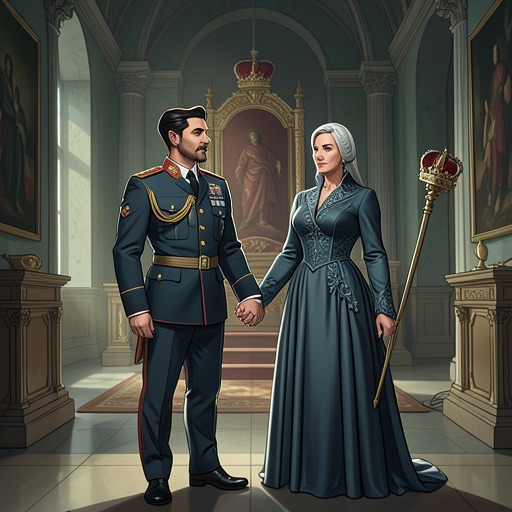
Darius’s earliest image of power is the portrait of Iosif hanging above the mantle in his study. The king has ruled the lands from the Black Sea across the Carpathian Mountain range to the Danube River for almost two thousand years, and Darius has stared at that portrait in wonder since childhood. Stories of Iosif’s victories over shifters—who once attacked vampires and killed recklessly—fill Darius with pride and give his ambition a precise shape: he wants to become as great as the king and eventually wear the crown himself.
That aspiration is not presented as effortless entitlement. As Darius matures, he recognizes that the crown will require hard work, discipline, and sustained service. Determination becomes his defining quality. He is not merely a prince waiting for elevation; he is an officer who accepts difficult assignments and measures himself against the king’s military reputation.
His closest professional ally is Gordon, his best friend and second-in-command. Their working relationship places Darius within a chain of command while also giving him someone with whom he can test his judgments. When reports describe wolves killing three dozen sheep and a shepherdess disappearing near the region, Darius studies the map and distinguishes between disorganized local wolves and the more formidable Rebeluna. His judgment is that the Rebeluna are organized and efficient, whereas the immediate incidents are likely caused by wolves who call themselves rebels without the courage to commit to open rebellion.
The Rebeluna Investigation
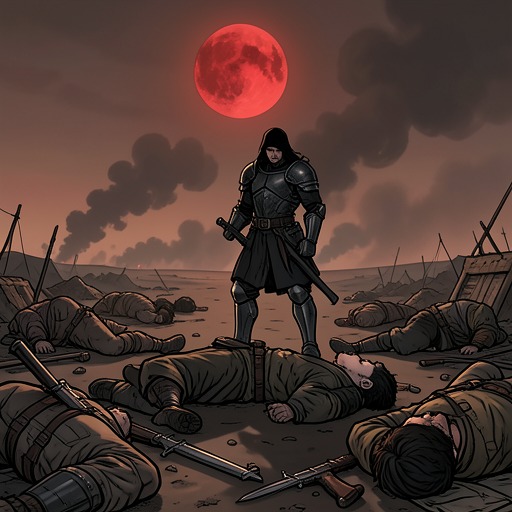
The Rebeluna are a self-proclaimed rebel group resisting King Iosif by every available means. Shifters from different clans have gathered under its cause, and the group is responsible for more vampire deaths than any other organization in the previous decade. After the Rebeluna assassinate the last colonel assigned to find them, Iosif transfers the investigation to Darius, making the mission both a military responsibility and a test of his suitability for greater authority.
Darius’s pursuit quickly carries him away from home for days or even weeks. His troops initially seek vague information about the Rebeluna, but a witness reports overhearing two shifters discussing a forest camp, and drones confirm that the camp exists. Darius understands that the discovery is probably a trap, yet the information is too valuable to ignore. His reluctance to remain away from home is intensified by Cleo’s pregnancy. He wants to know more about it, but he also understands that her silence is deliberate, so he forces the subject from his mind and follows the Rebeluna instead.
The investigation therefore divides Darius between two forms of responsibility. As a commander, he must pursue an armed insurgency whose violence threatens vampire territory. As Cleo’s husband, he is drawn toward the private future represented by her pregnancy. His decision to continue the pursuit establishes the pattern that governs his arc: duty is not abandoned, but it is repeatedly made vulnerable to personal attachment.
Hostage Crisis and Sacrifice
The Rebeluna’s strategy turns Darius’s investigation into a personal crisis when he receives a letter stating that they have Cleo and will kill her unless he surrenders. The discovery is physically destabilizing; after reading the letter more than once, he crumples it and puts it in his pocket. Gordon initially wonders whether Darius has silver poisoning, but Darius explains that the shifters have taken Cleo and that her life depends on his surrender.
The threat is uncertain as well as immediate. Darius knows what surrender will probably mean, but he does not know whether Cleo is truly in Rebeluna hands or whether she may already be dead. His attempt to call her reaches voicemail, leaving him without confirmation and forcing him to act on the hostage demand alone. The scene makes his sacrifice more than a calculated rescue operation: he gives up control precisely when the evidence is incomplete.
Darius’s decision also transforms the meaning of his ambition. The crown had once been the central object of his life, symbolized by the portrait of Iosif and the military feats associated with it. Yet when Cleo becomes the price of his freedom, he chooses exposure and possible death. The future king is defined first by his willingness to endanger the future he has spent his life pursuing.
Duel with The Thunder
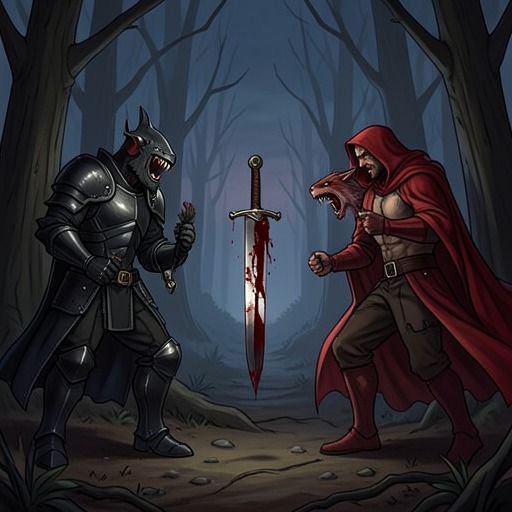
The surrender leads to a confrontation with The Thunder, a massive bear shifter whose own actions are driven by the loss of his mate. During the fight, Darius recognizes that The Thunder is not simply a monster or political enemy. The bear continues to raise his knife despite exhaustion, rage, desperation, and pain. Darius realizes that, if their positions were reversed and Cleo had died, he might have acted in the same way.
That recognition gives the duel an unusual moral symmetry. Both fighters are risking their lives for someone whose absence has made every other option intolerable. The conflict is not reduced to vampire against shifter or king against rebel; it becomes a contest between two men bound to revenge and bereavement. Darius’s sympathy does not make him lower his weapon, but it changes the emotional character of the victory.
When Darius twists the knife from The Thunder’s hand and drives it through his throat, he shows no joy. The Thunder shows no fear. Darius withdraws the knife, apologizes, and catches the fallen bear before lowering him slowly to the ground. The gesture does not erase the killing, but it refuses to treat it as triumphal spectacle. Victory is presented as necessary, costly, and haunted by the knowledge that the defeated opponent was also acting from attachment.
Heirship and Narrative Role
The Rebeluna accept the terms connected to The Thunder’s defeat and retreat from vampire territory, taking the shifters who have been fighting against the vampire armies with them. Once they are gone, shifter incidents virtually stop. Darius’s personal act therefore produces a public consequence: a hostage exchange and duel become the immediate mechanism for ending a wider campaign of violence.
King Iosif publicly praises Darius for staking his life on the chance to drive the shifters out. A three-day celebration follows, and at its conclusion Iosif declares Darius his new heir. The appointment fulfills the childhood hope represented by the portrait in Darius’s study, but it also revises that hope. Darius does not become heir simply because he has admired power or defeated an enemy. He is elevated because he has accepted the risk of losing everything, including his life, for Cleo and because that sacrifice brings a measure of peace to the realm.
Cleo later explains the political result to her sister in simplified terms: Darius has been adopted by the king, is now a prince, and will someday be king. The description compresses complicated politics into a family revelation, but it captures the visible change in Darius’s status. The investigator becomes Prince Darius, and the military officer associated with the Rebeluna campaign becomes the successor to Iosif.
Darius’s arc combines quest, rescue, sacrifice, and ascension. He begins by looking upward toward the king’s image, moves outward into dangerous territory, descends into uncertainty when Cleo is threatened, and returns with both a personal rescue and a political reward. Yet the conclusion does not make power uncomplicated. His rise is founded on a death he regrets, an enemy he understands, and a private bond that has proved more urgent than ambition. Darius therefore embodies a heroic ascent that remains morally burdened: the crown is gained, but its foundation is the recognition that every side in the conflict contains people fighting for someone they cannot bear to lose.