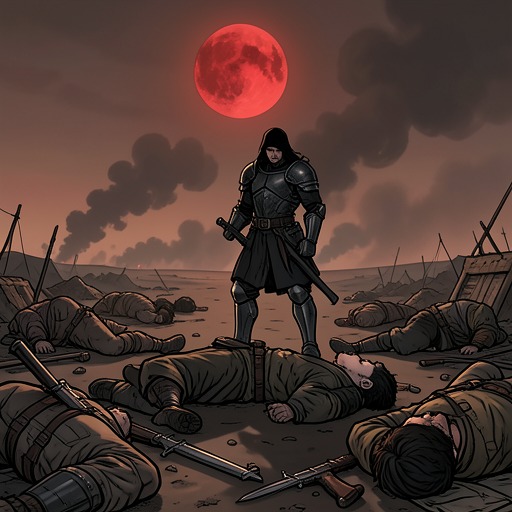
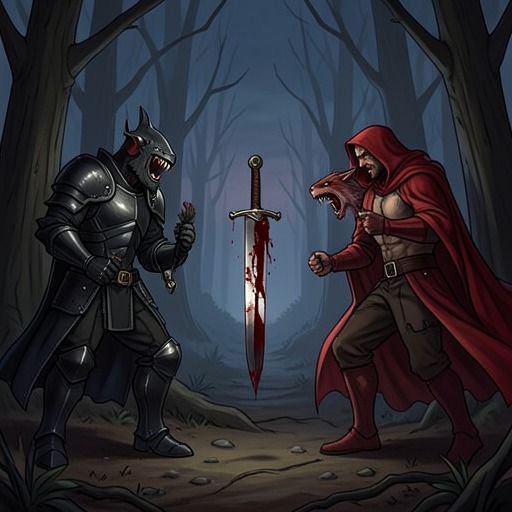
Darius–Thunder challenge
The Vampire Prince’s BrideDarius–Thunder challenge is the confrontation that transforms Cleo’s captivity from a threat of execution into a contest whose result may determine both her fate and the course of the vampire–shifter war. When The Thunder arrives carrying Cleo beneath one arm, Darius sees that she is physically unharmed but visibly frightened and far more heavily pregnant than when he last saw her. Faced with the immediate danger to his wife, the hostility of the shifter camp, and the possibility that an army may stand behind her captor, Darius chooses a duel whose stakes extend beyond personal survival.
Causes and Background
The challenge grows out of The Thunder’s revenge. He tells Darius that the elaborate campaign against him exists because Darius killed his mate. Darius remembers that the shifters he killed had been enemies in battle, but he also recognizes that grief does not become less destructive because the death occurred during war. The Thunder’s grievance therefore joins private bereavement to military ambition: he intends not merely to punish the vampire responsible, but to destroy Darius and break the kingdom defended by Darius’s armies.
The immediate leverage is Cleo herself. The Thunder explains that he knows the vampire custom allowing one man to challenge another for a mate. Under that custom, he claims, the victor may take the defeated husband’s wife. He threatens to make Cleo his new mate, to father children with her, and to reduce the child growing inside her to slavery under those future children. The threat turns pregnancy into a political and bodily vulnerability at once. Cleo is not simply a hostage whose life can be exchanged; The Thunder seeks to seize her marriage, reproductive future, and unborn child as the spoils of victory.
The Challenge and Its Stakes
Darius responds by refusing to let The Thunder claim Cleo without a fight. He declares that The Thunder must kill him in battle before taking her, making his own body the barrier between the captive woman and the enemy’s intended possession. The Thunder accepts the logic of the demand and orders the shifters to untie Darius so that he can tear him apart. Cleo struggles against the shifter holding her and warns that Darius has no chance against The Thunder, emphasizing the physical imbalance between the two opponents and the terror of the proposed contest.
The duel takes place just beyond the tents, inside a large ring burned into the grass and cleared of debris. The setting gives the encounter a formal boundary: the surrounding camp remains the field of war, while the ring concentrates the conflict into a visible test between two leaders. The Thunder waits crouched and ready to pounce, wearing only black shorts, his oiled muscles making it difficult for Darius to obtain a secure grip. The match is therefore presented as a contest of strength and endurance in which even the conditions of combat favor the Alpha.
The Thunder states the rules plainly. The first combatant forced from the ring, rendered unconscious, or killed loses. If The Thunder wins, Darius dies and Cleo becomes The Thunder’s mate; if Darius wins, he keeps her. The terms initially appear to offer Darius only the preservation of what he already has. At that moment, however, Darius realizes that he is already fighting for both his wife and his kingdom and can make the political consequences of the duel explicit.
Darius accepts the personal stakes but expands the bargain. He demands that, if he defeats The Thunder, he and Cleo be allowed to return safely to their home. The Thunder must also abandon assassination attempts against them, even if Darius chooses not to kill him. Most significantly, Darius requires every shifter present to leave vampire territory and surrender in the war. The challenge thus becomes more than a husband’s defense of his mate: it is a wager over territorial occupation, military withdrawal, and the possibility of ending the immediate invasion through a single decisive result.
The Duel as a Reversal
The scene reverses the power arrangement established by the hostage-taking. The Thunder enters with Cleo physically under his control and with the shifter camp surrounding him; Darius begins as the threatened captive whose enemy expects an easy death. Yet the formal challenge gives Darius a narrow form of agency. By invoking the custom of mate challenge and then adding terms for safe passage, non-retaliation, and military surrender, he forces The Thunder to acknowledge a public framework rather than kill him arbitrarily.
The emotional center of the challenge is Darius’s response to Cleo’s face and condition. Seeing her frightened eyes intensifies his desire to kill, but that impulse is redirected into a focused commitment to win. He understands that The Thunder’s revenge is personal even though its consequences are collective, and he answers on both levels. Cleo’s pregnancy makes the stakes immediate, while the threatened collapse of Darius’s armies makes the duel a possible turning point for the entire kingdom.
Cleo also participates in the negotiation despite being held hostage. Her protest that Darius cannot stand against The Thunder expresses fear, but when Darius proposes additional terms, she recognizes what he is attempting and nods for him to continue. Her response does not remove her captivity, yet it establishes her as an attentive partner in the bargain rather than a silent prize. The duel’s terms are therefore shaped by the marriage the enemy is trying to appropriate.
Consequences and Significance
The challenge establishes the conditions under which The Thunder’s defeat can produce more than revenge. Darius’s stated objectives are Cleo’s recovery, their safe return, protection from further assassination attempts, and the withdrawal and surrender of the shifters in vampire territory. The agreement also creates a direct contrast between two uses of violence: The Thunder treats victory as the right to possess a woman and enslave her unborn child, whereas Darius uses the threatened duel to protect a marriage and bind military conduct to an enforceable public promise.
As a plot action, the challenge combines rescue, rivalry, revenge, and sacrifice. Its structure resembles an underdog contest because Darius faces a physically dominant Alpha under hostile conditions, but the scene’s decisive weapon is not strength alone. Darius’s insight lies in recognizing that the enemy’s custom can be turned against the enemy’s larger campaign. He accepts the possibility of death, then makes that risk serve a collective objective: if he survives and wins, the battlefield victory may become a forced end to the shifter incursion.
The burned ring consequently functions as both arena and political threshold. Inside it, Darius’s life, Cleo’s freedom, and The Thunder’s claim are tested through combat. Beyond it stand armies, territory, and the unresolved war. By insisting that all those wider stakes be included in the wager, Darius makes the duel a concentrated judgment on the conflict itself. The challenge is therefore the point at which a threatened husband, a captive queen, and a besieged kingdom become inseparable stakes in one contest.