Darrenkar bone disease
The Vampire Prince’s BrideDarrenkar bone disease is a major biological crisis among the Darrenkar people and the force that transforms Natalie Donovan from a captive bride into the key to a possible cure. The illness is not treated as a remote medical detail: its effects reach into royal succession, scientific ethics, captivity, and the survival of children. When Dr. Barca discovers that Natalie’s blood can cure the disease, the knowledge gives her life extraordinary value while making her more vulnerable to those who wish to control, exploit, or eliminate her.
Disease and Social Stakes
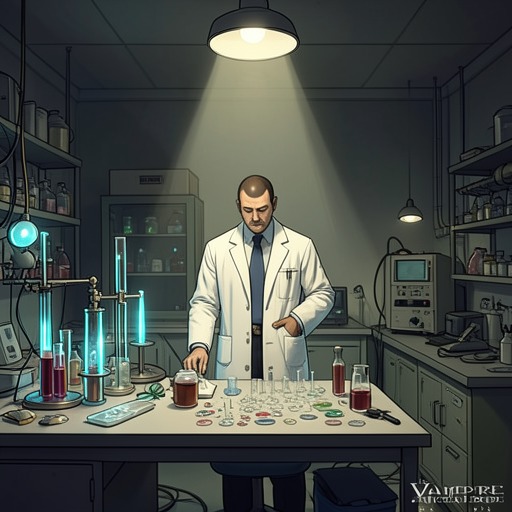
Darrenkar bone disease is presented as a condition severe enough to threaten children across the Darrenkar population. Dr. Barca tells Erdal that he has found a cure and that Natalie’s rare blood could heal his own daughter as well as “all the other children.” The discovery therefore carries both intimate and collective stakes. It is rooted in a father’s concern for a sick child, but it could also alter the fate of an entire people whose medical crisis has resisted an effective solution.
The disease’s importance is heightened by the structure of Darrenkar society. Natalie is being held in a royal environment where human bodies, reproduction, and dynastic claims are subject to political control. The potential cure does not arrive in a neutral hospital system. It appears inside a court ruled by King Zutaar, where medical knowledge can become a weapon and where the value assigned to a person may depend on how useful that person is to royal power.
Natalie’s Diagnosis and the Hybrid Pregnancy
The disease becomes directly connected to Natalie on the day before her wedding. She wakes feverish, aching, vomiting, and barely conscious. Erdal, who ordinarily checks on her each day, finds her still in bed and immediately takes her to the palace infirmary. Dr. Barca examines her, draws blood, and runs tests. The fever proves to be viral and is expected to subside within a day or two, but the examination reveals a far more consequential fact: Natalie is almost six weeks pregnant.
The pregnancy is not an ordinary Darrenkar pregnancy. Dr. Barca identifies the fetus as a human–Darrenkar hybrid, and fetal DNA matches Erdal’s. The discovery changes the meaning of Natalie’s illness and captivity at once. She is not merely a woman being prepared for a royal wedding; she is carrying Erdal’s child, a hybrid whose existence threatens the arrangements imposed by King Zutaar. The pregnancy also makes Natalie’s body medically significant, since the blood that may cure Darrenkar bone disease is the blood of a woman already placed at the center of a contested royal lineage.
Erdal reacts with panic when the diagnosis is disclosed, but the danger is not limited to his fear for the unborn child. Dr. Barca warns that Natalie’s life is in immediate danger because Zutaar would kill her if he learned that a cure had been found. The disease thus produces a cruel reversal: Natalie’s blood gives her unprecedented importance as a medical resource, yet that same importance makes concealment and escape necessary.
The Cure and Its Ethical Conflict
Dr. Barca’s intervention is driven by both scientific urgency and personal responsibility. He has already taken enough samples of Natalie’s blood to last a lifetime, meaning that he does not need to keep her confined in order to continue his work. His decision to help Erdal and Natalie escape therefore rejects the logic that would reduce Natalie to a specimen. The blood is valuable, but the person who provides it remains vulnerable, pregnant, and entitled to protection.
The medical breakthrough is nevertheless entangled with coercion. Natalie is not described as freely volunteering her blood for research; the samples are obtained while she is under royal control and in danger. Dr. Barca must persuade King Zutaar that Natalie is more valuable alive than dead, then secretly remove her before the king discovers the significance of the research. The episode exposes the contradiction between medical progress and bodily autonomy: a cure that could save countless children emerges through a system in which the donor’s safety depends on her usefulness to those in power.
Dr. Barca’s plan is therefore both practical and protective. He frees Erdal, insists that Natalie cannot remain in the palace, and directs them toward a hidden route: the back gate of the fifth garden, opening into the Clapwood forest. He has arranged a car at the rear of the palace and tells Erdal that the pair must leave immediately. The cure becomes the reason for the escape, while Natalie’s pregnancy makes delay potentially fatal.
Political and Narrative Consequences
Darrenkar bone disease converts a scientific discovery into a dynastic crisis. Natalie’s pregnancy proves that Erdal is the father of a hybrid child, while the blood research offers a cure that could undermine King Zutaar’s control over the population. The two revelations reinforce each other. Natalie cannot be treated simply as a bride, and Erdal cannot remain merely a captive or displaced figure; both are now connected to a child, a medical breakthrough, and a possible challenge to Zutaar’s authority.
The disease also creates a conflict between competing definitions of value. King Zutaar’s court treats Natalie as a body whose fate can be decided by rulers. Dr. Barca recognizes her as the source of a cure, but his most important act is to prevent that recognition from becoming a justification for continued captivity. Erdal, meanwhile, is forced to understand that the woman carrying his child is endangered not only by royal violence but also by the political consequences of her biology.
In narrative terms, the disease is a catalyst rather than a self-contained subplot. It explains why Dr. Barca risks his life, why Natalie must be removed from the palace, and why the pregnancy becomes impossible for Zutaar to tolerate. A condition that initially belongs to Darrenkar children expands into a crisis involving human–Darrenkar hybridity, royal succession, scientific secrecy, and the survival of a family formed under coercive circumstances.
Significance
Darrenkar bone disease embodies the book’s recurring tension between bodies as living persons and bodies as resources. Natalie’s blood can save the Darrenkar people, but the story refuses to let that potential cure erase the danger and dignity of the woman who carries it. Her fever leads to a diagnosis; the diagnosis reveals the hybrid pregnancy; the pregnancy intensifies the political threat; and the medical discovery provides the narrow path toward escape.
The disease therefore links collective survival to individual protection. Dr. Barca’s work promises relief for his daughter and other Darrenkar children, yet the cure can only become ethically meaningful if Natalie is not sacrificed to obtain it. By tying the illness to a hidden blood sample, an endangered pregnancy, and a flight through the palace’s back gate toward the Clapwood forest, the narrative makes medical knowledge the instrument of both danger and liberation.