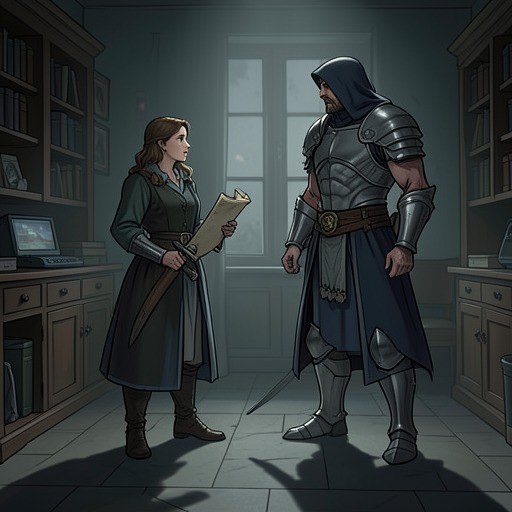
Ella Darilth Rothgar
The Vampire Prince’s BrideElla Darilth Rothgar is the human woman whose secret marriage to Prince Darilth Rothgar places her at the center of the Rothgar succession crisis. Initially terrified by the alien world and by Darilth’s dragon nature, she becomes his true mate, bears a half-human, half-Drakonaar heir, survives imprisonment and a life-threatening childbirth, and is ultimately transformed into a Drakonaar herself. Her coronation beside Darilth gives personal love a public and dynastic consequence: Ella does not merely enter the Rothgar royal family; she becomes part of the people and future she once feared.
Identity and Introduction
Ella enters the story through the shock of radical displacement. Darilth has taken her from Earth, and she has married a man from another universe whose identity is inseparable from a nonhuman inheritance. When Mekarth appears as a graceful white dragon, Ella initially retreats in terror and begs for Darilth to return. The dragon’s sapphire eyes, horns, wings, claws, and overwhelming presence activate the religious language of her human past, including the fear that winged creatures are demons who lure people into sin. Yet the scene does not leave her in that interpretation. Ella forces herself to distinguish fear from moral judgment: Darilth has been honest and gentle, he is her husband, and his nonhuman nature does not make their relationship sinful.
That internal correction is crucial to Ella’s identity. She is not presented as fearless or immediately liberated from the values she inherited on Earth. She trembles, cries, and struggles against guilt, but she also argues with the voice that condemns her desires. Her first major act of self-definition is therefore interpretive: she chooses to understand Darilth as a husband rather than a demon and to recognize her marriage as real even when her old categories cannot contain it.
Marriage, the Draco’s Eye, and the Flight from Power
Ella’s marriage to Darilth is tied to the awakened Draco’s Eye, a silver band with a large blue stone. Darilth places it around her wrist, where it contracts to fit her perfectly, and explains that the Eye identified her as his destined mate when he first saw her on Earth. The object makes their relationship more than a private attraction. It is a dynastic sign, a supernatural confirmation, and a visible link between Ella’s body and the Rothgar throne.
The revelation also makes Ella politically dangerous. Darilth knows that the King will eventually discover the marriage and tells her that they must leave the castle. He plans to present her as a slave while they travel toward R13, the moon closest to Iovis, because the King does not yet know that the Eye has awakened. Ella’s position is consequently double-edged: she is the woman chosen by the succession artifact, but she must be concealed as property in order to survive the royal order that should have protected her.
Her vulnerability intensifies after Darilth leaves for battle. During the night, she is taken from her chambers and placed aboard a small spacecraft. The craft’s guard and maid are killed by a hooded pilot wielding a silver dagger, leaving Ella captive and unable to understand the forces acting around her. The captivity strips away her access to Darilth, time, and reliable information. She is fed twice a day, but no one answers her questions, and the uncertainty becomes as oppressive as the physical cell.
Pregnancy, Captivity, and the Ordeal of Survival
In confinement, Ella’s body becomes the first evidence that her marriage has produced a future beyond the reach of her enemies. Daily nausea, cramps, abdominal swelling, and painful breasts lead her to realize that she may be pregnant. The recognition does not arrive as uncomplicated joy. She is isolated, convinced that punishment is being visited upon her, and afraid that no one will rescue either her or the unborn child. Her despair becomes so severe that she stops eating and eventually collapses unconscious on the cold floor.
Darilth’s rescue reveals the physical cost of her imprisonment. He reaches the underground cell with Dr. Wyern, carrying medication and warm clothing, and finds Ella unconscious, gray-pale, cold, damp, and visibly pregnant. Her breathing is shallow and erratic, and Dr. Wyern says that her body is entering shock. The rescue is therefore not a simple recovery of a hostage. It is a race to preserve a mother and an heir whose lives have been endangered by the political conflict surrounding the throne.
Ella cannot safely receive general anesthesia during the emergency delivery, so Dr. Wyern uses a spinal epidural and operates while she remains conscious. The cries of a baby finally interrupt the tension. Her son is a beautiful boy, visibly half human and half Drakonaar, with subtle scales on his temples and human eyebrows: a true half-blood prince. Ella is able to see her child and feel relief, but she is still slipping away, making the birth both a dynastic victory and a near-death ordeal.
Transformation and Royal Reintegration
Ella survives, but she awakens to find that survival has altered her identity at the most fundamental level. Back in the castle, she feels renewed energy despite dizziness and weakness. Looking into a mirror, she discovers that she is no longer albino and no longer human. Her skin remains pale but has changed in shade; her hair is silver-white, her eyes are deep sapphire blue, and subtle scales and ridges mark her temples and forehead. The reflection is strange to her, yet she also sees the woman as confident and beautiful.
The transformation completes a movement begun when Ella first confronted Mekarth. At first, the dragon form seemed to threaten the human identity she knew. Later, her own body carries the same boundary-crossing nature. Her change is not merely cosmetic or a forced replacement of one self by another. It gives physical form to the relationship that she had already chosen and makes her part of the Drakonaar world in a way that marriage alone could not. Her body becomes a living connection between Earth and Iovis, humanity and Drakonaar inheritance, private intimacy and public succession.
Six months later, Prince Darilth Rothgar is crowned King of the Rothgar throne, and Ella is crowned Queen beside him in a grand ceremony celebrated throughout Iovis. The woman who arrived as a vulnerable human outsider is now publicly incorporated into the kingdom. Her son grows far faster than a human child, appearing two years old at six months, and is expected to become an exceptionally strong warrior because he is a half-blood prince. Ella’s transformation therefore affects not only herself but also the royal future: her child embodies the legitimacy and possibility of a mixed lineage.
Relationships and Narrative Significance
Ella’s defining relationship is with Darilth, whose tenderness gives her a way to survive the strangeness of his world without denying her fear. He recognizes that Mekarth frightens her and shifts back into human form, taking her in his arms while explaining that Mekarth is another side of the same being, a manifestation of another consciousness within them. Later, when Ella worries that the King will discover their marriage, Darilth responds with a concrete plan of escape rather than empty reassurance. Their bond is thus built through disclosure, protection, and the difficult work of making an alien reality emotionally intelligible.
Her connection to Mekarth is more complicated. Mekarth is both a separate presence and part of Darilth, and Ella must learn to hold those two truths together. Her fear is not erased by the narrative; it is acknowledged, expressed, and gradually answered by Darilth’s return and gentleness. In this sense, her marriage is also an initiation into a form of personhood that cannot be divided neatly between human and animal, man and dragon, or body and consciousness.
Ella’s pregnancy and coronation give her arc a political scale. She is targeted because the royal family regards the Draco’s Eye, the throne, and the human woman connected to them as competing sources of power. Her survival defeats the attempt to isolate her from Darilth and erase the unborn heir. Her later status as Queen also reverses the terms of her captivity: the woman once treated as a hidden slave becomes a publicly honored ruler.
Ella’s narrative significance lies in this reversal and in the story’s repeated use of thresholds. She crosses from Earth to Iovis, from secrecy to marriage, from human fear to acceptance of Drakonaar identity, from imprisonment to rescue, from endangered pregnancy to motherhood, and from outsider to Queen. The ceremonial platform that carries Cheryl from temple to palace offers a contrasting model of imposed royal transition, while Ella’s own ascent is marked by danger, bodily change, and a choice to remain with the person whose world first terrified her. Her ending does not return her to an untouched human past. It establishes home as a new, hybrid belonging in which love, lineage, and transformed identity are inseparable.