Ella Stewart
The Vampire Prince’s BrideElla Stewart is an albino human whose stark appearance marks her as an outsider on Earth and within the Convent where she has been raised. Her decisive significance lies in the collision between that imposed identity and the extraordinary status Darilth assigns her: she is the woman who awakens the dormant Draco’s Eye, the heir’s destined mate, and the person whose acceptance may determine the future of the Rothgar throne and the war threatening Iovis.## Identity and Confinement Ella is introduced as a young woman with stark white skin and silver-white hair, a physical condition that makes her seem ghostlike to others and contributes to her exclusion. She has lived at the Convent in a white habit, separated from ordinary family life and treated as though her appearance limits her usefulness. Her aunt Nora sent her there when Ella was nine, arguing that the child’s difficulties with other pupils made the Convent a better place for her. The decision is presented not as Ella’s choice but as an adult judgment that converts difference into incapacity.
The confinement becomes permanent. Ella expected to leave when she came of age, but instead she was forced to take vows at eighteen because her aunt believed her “condition” would prevent her from finding other work. She became a teacher at the Convent’s senior school, yet the institutional role did not give her belonging. Its gray building, empty rooms, and uncaring routines become the visible shape of a future she fears: growing old alone, increasingly bitter, and forgotten by the family that abandoned her. On her twenty-third birthday, her aunt does not call, reinforcing the fact that Ella’s exclusion is both social and emotional rather than merely geographical.
Her birthday night supplies the threshold through which that stagnant life breaks open. After seeing a strange light in the trees, Ella follows Sister Margaret beyond the garden wall and into the thicket. There she finds the older woman lying in blood, then discovers that someone is watching the scene. Two strong hands seize Ella from behind, silence her scream, and pin her against a tree. The captor’s chalk-white face and piercing sapphire eyes make the encounter terrifying, but the scene also begins Ella’s passage from the closed world of the Convent into a hidden, nonhuman order.
Meeting Darilth and Crossing Worlds
The man who captures Ella is Prince Darilth. He has placed a force field around the area, and Sister Margaret was injured after trespassing into it; unable to heal her, Darilth killed her. Ella therefore meets him in the immediate aftermath of violence, not through a safe courtship or a voluntary introduction. Her first knowledge of his world is filtered through blood, confinement, physical superiority, and the discovery that the apparent human stranger belongs to a royal and technologically advanced civilization.
Darilth’s recognition of Ella is nevertheless immediate and transformative. When he asks her name, fear makes her stutter, and she answers, “El-Ella.” He repeats the name as if fixing it in memory. The encounter then shifts from abduction to revelation: Darilth realizes that the Draco’s Eye has responded to her. For centuries, the stone’s magic has remained dormant, and many ancestral mates failed to awaken it. Ella’s response makes her exceptional among the women connected to the Rothgar line.
Ella wakes afterward in an unfamiliar stone chamber, naked beneath the covers, without her glasses but able to see clearly. The room resembles an ancient castle fitted with modern electrical lighting, a concrete sign that her old categories of history and technology no longer apply. She remembers the stranger, Sister Margaret’s body, her healed eyes, and the kiss, while cold, thin air leaves her weak and struggling to breathe. Her restored vision is therefore not a simple medical improvement: it is evidence that her body has already been altered by contact with Darilth’s world and its powers.
Darilth tells Ella that he wants to marry her, but she initially refuses. Her resistance is grounded in both personal uncertainty and institutional obligation. She has taken vows of celibacy, doubts whether Darilth can love her, and fears that the king will prevent the match. She had wanted freedom and adventure, yet her new situation overwhelms her because the apparent escape from the Convent has placed her inside another structure of authority. Her decision is not a carefree surrender. When she finally says yes, she qualifies it: she will accept him if he can love her.
Darilth answers her conditional consent with a passionate kiss and declares that he will make her his queen regardless of what the king thinks. The exchange establishes Ella’s speech as consequential. She does not merely receive a title selected by men; she names the condition under which she can accept it. At the same time, her path remains shaped by Darilth’s power, his royal status, and the supernatural bond he identifies before she fully understands it.
The Draco’s Eye and the Mate Bond
The Draco’s Eye is the central object through which Ella’s identity is reclassified. Darilth removes the silver band bearing its large blue stone and slides it onto her wrist. The band contracts to fit her, and the stone glows bright blue. He explains that, as heir to the Rothgar throne, he is the bearer of the Eye and that its reaction to Ella revealed her as his destined mate when he first saw her on Earth.
The Eye carries political as well as personal power. Once awakened, it grants ultimate healing abilities and makes its bearer the most powerful ruler in the galaxy. Neighboring planets are under attack, and Iovis is threatened, so Darilth understands the awakening as a duty connected to war, succession, and planetary survival. Ella is consequently not only the object of a prince’s desire. Her body and response become the conduit through which dynastic authority and military hope may be restored.
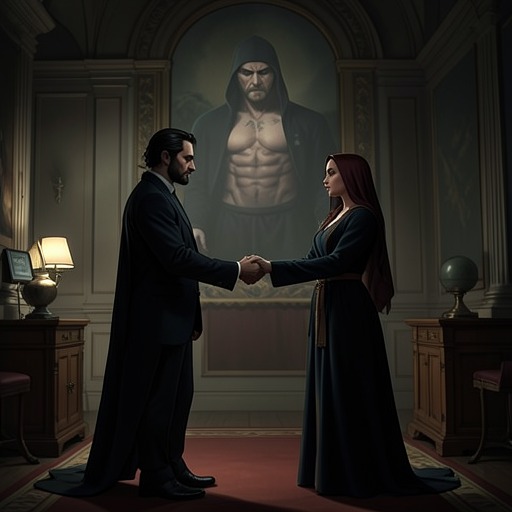
Darilth asks Ella to awaken the Eye. As he recites an incantation while holding her hand, fluorescent vines grow from the stone and entangle their joined hands. The vines are made of light, yet they bind them physically and allow Ella to feel the strength of her bond with him. The episode gives the mate relationship a material form: destiny is not merely spoken as a romantic idea but rendered as illumination, touch, energy, and restraint. Ella’s participation activates a dormant inheritance, but it also places her inside a bond whose political consequences exceed her previous life.
Ella’s transformation thus combines bodily healing, technological estrangement, royal marriage, and cross-world identity. Her clear sight without glasses suggests restored capacity; the Eye’s light identifies her as a mate; and the proposed queenship gives her a public function. These changes do not erase the vulnerability established at the Convent. Instead, the narrative carries her vulnerability into a more dangerous arena, where she must negotiate love, authority, dynastic expectation, and the responsibilities attached to the power she has awakened.
Agency, Relationships, and Contrasts
Ella’s relationship with Darilth is built on an uneven but developing exchange. He first appears as a captor capable of killing an intruder and physically overpowering Ella, while she appears as an isolated human woman who has no knowledge of his species, technology, or political world. Yet Ella is not silent within that imbalance. She gives her name, questions why Darilth chose her, refuses marriage at first, and makes love a condition of consent. Her acceptance is therefore a movement from fear toward chosen attachment rather than an entirely passive transfer from one guardian to another.
Her question about Darilth’s choice exposes the difference between being valued as a person and being selected for a function. Darilth answers by explaining the Draco’s Eye and its recognition of her as his mate. The answer is emotionally compelling, but it also makes Ella’s value inseparable from an inherited object and the future of a throne. The narrative holds those meanings together: Ella is desired by Darilth, yet she is also required by the Eye; she may become queen, yet her qualification begins with a power that others need her to awaken.
Ella’s contrast with other extraordinary women in the wider story is especially revealing. Sara uses bionic eyes as concealed stun grenades, turning an artificial body part into a weapon during an escape. Lisa undergoes medical scanning that projects a three-dimensional image of a cross-species embryo, making pregnancy a visible meeting point between human biology and alien life. Gemma learns that Stlozyn people descend from humans taken from Earth and genetically altered so that certain traits and additional DNA strands permit shape-shifting. Ella’s own body participates in the same broad redefinition of the human: her albinism first makes her socially marginal, then her healed eyes and response to the Draco’s Eye make her central to an interspecies dynastic order.
The comparison also clarifies that Ella’s significance is not limited to romance. Joining, as explained to Teresa, is a periodic Kinai institution in which unmarried men and women between twenty and thirty spend the winter at the Rookery every twenty-five years, when beastlings hatch. Harrod’s full-moon trial likewise places personal identity within a communal ritual witnessed by the entire den and by Siobhan. Ella’s own transition is less publicly regulated at first, but it follows a comparable pattern of separation, ordeal, and possible incorporation. She leaves the Convent’s restricted identity, passes through a violent and supernatural threshold, and is prepared for reintegration as Darilth’s mate and prospective queen.
Change and Narrative Significance
Ella begins as a woman told that her appearance determines her future. The Convent treats her as a problem to be housed, her family withdraws from her, and her work becomes an extension of the institution that confines her. By the time of her birthday, she imagines her life narrowing into permanent loneliness. The strange light in the trees interrupts that imagined future, but the interruption is not gentle: it arrives through a dead nun, a force field, an abduction, and a prince whose world is as dangerous as it is magnificent.
Her change is marked most literally by sight. At the Convent, her glasses and albinism emphasize her difference; after Darilth’s intervention, she can see clearly without the glasses she instinctively searches for. The restored vision makes the new world legible even as it renders the old one unreachable. She sees the castlelike room, the technology embedded in an apparently ancient setting, and the glowing object that identifies her destiny. Vision becomes both gift and burden: Ella can perceive more, but what she perceives demands decisions she was never trained or permitted to make.
The strongest evidence of her emerging agency is her answer to Darilth’s proposal. She does not accept merely because he is a prince or because the Draco’s Eye has selected her. She says yes only if he can love her. That condition places emotional recognition beside political destiny and insists that queenship cannot be separated from personal regard. Darilth’s response confirms that he intends to defy his father, but it also leaves Ella facing the consequences of a choice that may challenge the existing royal order.
Ella’s arc therefore turns on a reversal of the word “different.” At the Convent, difference is used to diminish her and justify confinement. In Darilth’s world, the same woman is different from her own kind in a way that marks her as uniquely powerful and chosen. The narrative does not make the transition uncomplicated: Ella remains exposed to royal authority, alien politics, bodily vulnerability, and the possibility that her worth will be measured through the Eye’s needs. Nevertheless, her movement from unwanted girl and secluded teacher to awakened mate and prospective queen gives her isolation a new, politically consequential meaning. She is no longer merely the person left behind; she becomes the person through whom a dormant power, a threatened dynasty, and a cross-world future may begin again.