Eric McKenna's Pack
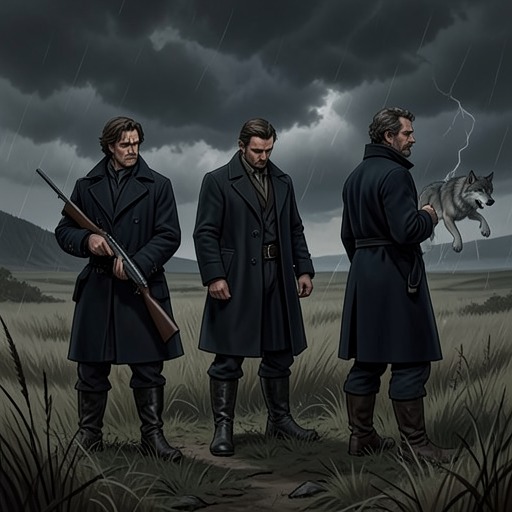
The Vampire Prince’s BrideEric McKenna's Pack is the werewolf community organized around Eric McKenna's leadership, family authority, and collective life in the woods of the reservation. It is more than a group of animals or a backdrop for Eric's transformations: the Pack is the inheritance Jason McKenna covets, the community whose judgment determines legitimate leadership, and the social world Eric repeatedly leaves his human household to rejoin. Its survival and apparent prosperity provide the decisive measure of the story's resolution.
Nature and Social Order
The Pack operates through a hierarchy in which the Alpha's authority depends not only on personal strength but also on recognition by the Pack. Jason's grievance reveals the political structure beneath the family's supernatural identity. He argues that leadership should belong to the brother he considers more intelligent, diplomatic, and strategically ambitious, while the existing order values the physical ability to prevail in combat. His complaint presents the Pack as a community with both inherited authority and collective consent: Jason may claim superior political vision, but Eric answers that the Pack is content with the way it is and would never accept Jason as Alpha.
Jason's proposed future is openly expansionist. He imagines the Pack placing its people throughout the government of the Tristate Area and eventually controlling the territory according to its own interests. His vision would turn the Pack from a family-based community into a political machine, and he treats its land, company shares, and institutional influence as instruments of personal rule. The Pack's existing members, however, are not portrayed as passive property. Their refusal to accept Jason exposes the limit of his ambition: he understands power as something that can be seized and distributed through coercion, while the Pack's legitimacy rests on collective allegiance.
The Coup Against Eric McKenna
Jason's challenge becomes a direct assault on the Pack's continuity. He abducts Bianca and uses her as leverage to force Eric to come to him, then declares that he will eliminate Eric and Hector before removing Bianca as well. Jason believes that, with Eric and the other heirs gone, the law will support his claim to leadership. His plan therefore combines violence, property seizure, succession manipulation, and the exploitation of Bianca as a vulnerable human connection to Eric.
Eric confronts Jason with controlled fury rather than immediate panic, asking what he thinks he is doing and rejecting the logic of the kidnapping. Jason answers that he is taking what he considers rightfully his, revealing that the attempted coup is driven by resentment as much as by political calculation. He wants Eric's land and company shares, but he also wants the authority to cut off the members of the Pack and compel their submission. The Pack's political future is consequently placed at stake alongside Bianca's life and the McKenna family's internal order.
The confrontation turns when a werewolf with a red-brown pelt leaps from the trees behind Jason. The intervention is timed with Eric's warning that Hector and he are not yet dead, and the resulting crunch, thud, and silence imply that Jason's immediate threat is ended. The Pack thus answers the coup through physical solidarity and coordinated defense rather than through Jason's proposed political takeover. Its response protects Eric's succession and prevents Jason from converting family wealth and legal technicalities into control of the community.
Pack Life and Eric's Membership
The Pack is represented as an active nocturnal society whose members call to one another across the woods. On a full-moon night, howls fill the silence, and Eric tells Bianca that his Pack is calling him. He shifts from human form into a massive, shaggy werewolf and leaves through the bedroom window, moving from intimate domestic space into the Pack's communal wilderness. His transformation is not a rejection of Bianca but a return to a second social identity that remains essential to him.
Bianca's response clarifies the Pack's place in the household. At first, the werewolf form appears macabre and fascinating, and she wonders how she could ever have thought of Eric as a monster. She touches his fur, discovering that it is softer than expected, while Eric responds with a light nip before leaping from the window and running into the woods at a speed beyond anything found in ordinary nature. The scene makes the Pack's world physically present without reducing it to horror: its animality becomes an intimate part of Eric's identity and a source of wonder within their relationship.
Eight months later, the same pattern recurs. After spending time with his pregnant wife, Eric opens the bedroom window and morphs so that he can run with the Pack in the reservation. Bianca still says she is unsure whether she will ever become accustomed to seeing him shapeshift, but her pride and wonder have replaced fear. She pets him behind the ears, kisses him between the brows, and wishes him a happy hunt. Eric touches his snout to her nose before leaping into the woods, showing that Pack membership and marital tenderness coexist rather than compete.
Stability, Family, and Resolution
The Pack's recovery is inseparable from Eric's domestic life. After the attempted coup, Eric and Bianca are married, and Bianca is visibly pregnant. Eric's happiness is not presented as conditional on the child's sex or as merely an obligation to continue the family line; he has spent months convincing Bianca that he loves her for herself and not only because she carries his child. His attachment to Bianca gives the Pack's political survival a personal counterpart: the community is secure because the relationship and family Jason tried to destroy have endured.
By the final appearance of the Pack, Eric's mate and child are safe, the Pack is thriving and strong, and Eric experiences these conditions as a single emotional triumph. He runs out to join the others under the full moon and releases a long, victorious howl. The howl serves as both greeting and declaration. It marks Eric's return to the Pack, confirms that the community remains alive after internal betrayal, and carries his private joy into the wider werewolf world.
Narrative Significance
The Pack functions as the story's test of legitimate belonging. Jason's rhetoric treats it as an organization waiting to be modernized and possessed, while Eric's conduct treats it as a living community whose customs, attachments, and acceptance matter. The conflict does not simply ask which brother is stronger; it contrasts coercive ambition with recognized leadership and communal continuity.
Its repeated connection to the full moon and the reservation also gives the Pack a threshold setting between domestic humanity and animal transformation. Eric crosses that threshold through the window, leaving Bianca's room as a human husband and entering the woods as a werewolf among his own kind. Because Bianca comes to witness and accept this crossing, the Pack is not kept outside the family narrative. Instead, it becomes part of the happy ending: Eric can return to his Pack without losing his wife, his child, or the emotional security he has built with them.