Establishment of the Human Sanctuary
The Vampire Prince’s BrideThe Establishment of the Human Sanctuary is the long-term consequence of Tom’s mission to recover humans held in stasis and prevent them from being sold through the interstellar economy. What begins as a covert operation becomes the creation of a protected human community under Zon’s authority, with Sara’s assistance and later diplomatic service. The event matters because it replaces human captivity, commodification, and historical disappearance with collective survival: the rescued people are not merely extracted from danger, but awakened into a place where they can build infrastructure and a future of their own.
Causes and Background
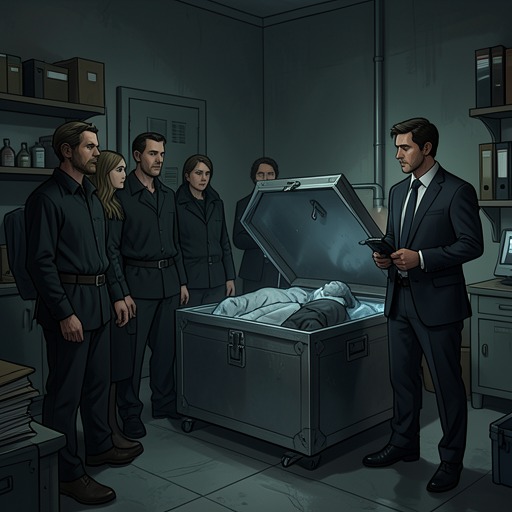
The sanctuary is conceived in response to a cargo ship containing humans in stasis. Tom tells Sara that he has been tasked with retrieving the ship and needs a United Species Corps officer to pass security checkpoints. His stated purpose is not to deliver the humans to the Ruziers Corporation, but to take them to a planet where they can be awakened and establish a human sanctuary. The mission therefore carries two intertwined stakes: the immediate rescue of vulnerable bodies and the preservation of a species whose members have been abducted from Earth across centuries.
Sara understands the danger with particular force because she is herself a human abducted from Earth and revived hundreds of thousands of years later. She has learned that technological advancement has not produced equivalent social progress, and that humans are treated as a rare and expensive commodity. Her blue tattoo and golden bionic eyes disguise her identity from casual inspection, but her DNA could expose her to corporations interested in purchasing human genetic material. The proposed sanctuary answers precisely this condition: it offers humans a collective refuge rather than leaving each survivor to concealment, sale, or exploitation.
The wider political context makes the rescue more difficult. Sara has seen institutions that claim authority over vulnerable beings suspend ordinary dignity in the name of law, security, or custom. The Fifth Cycle Festival, an ancient practice in which men kill one another for possession of a woman cast as a goddess, has been banned by the United Species because the designated goddess was often killed and eaten. That history provides a stark contrast to Tom’s mission. The sanctuary is founded against systems that make bodies available to victors, corporations, or states, even when those systems present violence as tradition or administration.
The Rescue Mission and the Turn in Trust
Tom initially protects his identity by using the name Bond. During an intimate encounter with Sara, he finally tells her that his real name is Tom. The disclosure is more than a personal revelation: it begins to connect Sara’s guarded trust with the larger mission he has been concealing. He later explains that he is the son of Zon, warlord protector of the Rouge Systems, and that his human mother taught him to respect all species rather than only the peoples represented within the United Species.
Tom’s explanation clarifies why he volunteered. He learned that a ship full of humans was going to be sold and chose to intervene, intending to place the survivors under Zon’s protection. His objective is not abstract humanitarianism detached from danger; it requires a Corps officer to open security routes, a ship capable of recovering the cargo, and enough political force to deter retaliation. Sara’s position as a trained officer makes her essential to the operation, while her status as a human gives the mission an emotional and historical urgency that Tom cannot fully possess on his own.
The decisive operational moment comes when Tom secures the cargo ship with anchors and confronts the nearby United Species vessel. He identifies himself openly as Tom, the son of Zon, and warns the soldiers that half of his father’s fleet is approaching. The threat succeeds: the colonel’s ship withdraws rather than risk a confrontation with Zon’s family. Tom activates the anchors, the net holds despite the absence of power interruptions, and the rescued ship begins its journey. The action converts the sanctuary from a proposal into a physically secured possibility.
Sara then recognizes that Tom had truly been trying to help the humans and that his concealed identity was connected to the mission rather than to a plan to betray her. Her trust is not restored by a romantic promise alone; it is altered by visible action. The withdrawal of the hostile ship, the successful capture of the human cargo, and Tom’s public invocation of Zon’s protection give material proof to the claim he had previously been unable to make credible.
Building a Human Future
The sanctuary is defined not simply by safety but by resettlement. Tom’s assignment is to transport the humans to a planet where they can be woken from stasis and colonize it. This makes the event a transition between states of existence: the humans move from unconscious storage and commercial ownership toward bodily awakening, communal organization, and historical agency.
The later account confirms that the project succeeds on a substantial scale. The final batch of humans is awakened, bringing the total to five hundred and seventy-two people. They have already begun assembling infrastructure, which means that the sanctuary has progressed beyond emergency shelter. Its inhabitants are no longer only rescued dependents waiting for protection; they are constructing the practical foundations of a society.
The humans’ origins also reveal the temporal depth of their displacement. Reports indicate that all of them were taken during the period between 2000 and 2100. Sara and Tom’s mother were among the first people abducted from Earth, placing their personal histories at the beginning of a much larger pattern of removal. The sanctuary consequently gathers not one generation or one incident, but a population formed by repeated historical violence and separated from its home world by radically distorted time.
Sara understands that awakening cannot erase what happened. She anticipates that beginning again will be terrifying, while still treating the effort to rebuild as an expression of human spirit. Her response gives the sanctuary its ethical center: recovery is not presented as a return to an untouched past, but as the difficult creation of community after forced displacement. The infrastructure under construction becomes evidence that survival has acquired a collective form.
Sara’s New Role and the Political Aftermath
The rescue also changes Sara’s public identity. Colonel Flanard’s testimony against her is judged highly tainted, so she is not expelled from the United Species Corps. The United Species, eager to demonstrate that humans will be treated with dignity and respect, assigns her as an ambassador between the United Species and Zon’s fleet within a few months of the incident.
This appointment links the sanctuary to formal diplomacy. Sara is no longer only a hidden human trying to survive inside an alien military structure, nor merely an officer assisting Tom through security checkpoints. She becomes an intermediary between the institution that claims responsibility for interspecies governance and the fleet that actually protects the rescued humans. Her personal experience of abduction, concealment, bodily exploitation, and distrust gives the diplomatic role a perspective unavailable to a detached administrator.
The arrangement also exposes the limits of institutional protection. The United Species must actively prove that it will treat humans with dignity because the surrounding political order has repeatedly failed to do so. Zon’s fleet supplies practical power, while Sara’s appointment supplies a channel through which that protection can be negotiated and made publicly legitimate. The sanctuary therefore stands between military deterrence and diplomatic recognition rather than existing as an isolated refuge beyond politics.
Meaning and Ending
By the epilogue, the sanctuary has become part of Sara and Tom’s shared life. They are recognized as T’shav starmates, and Sara is pregnant while continuing to work within the political relationship created by the rescue. Their domestic future and the human settlement develop alongside one another: private partnership does not replace the public mission, but grows within the world that mission helped make possible.
The sanctuary’s most important reversal is the movement from humans as merchandise to humans as a people. Earlier threats involve sale, extraction of DNA, imprisonment, and the use of vulnerable bodies for another group’s purposes. The later count of five hundred and seventy-two awakened humans, their emerging infrastructure, and Sara’s ambassadorial position show a different social logic. Protection is no longer only an individual favor offered by Tom or Zon; it has become the basis for collective reconstruction.
The event also preserves the tension between safety and autonomy. Zon’s authority and fleet make the sanctuary possible, but the humans’ own labor gives it substance. The rescued population must do more than remain under the protection of a powerful alien family: it must establish a functioning home. In that sense, the sanctuary is both a refuge from the galaxy’s violence and a declaration that human survival cannot be reduced to continued dependence upon those who happen to possess the power to defend it.
The Establishment of the Human Sanctuary thus closes the rescue sequence with a durable consequence rather than a single victory scene. Tom’s concealed identity is revealed, Sara’s trust is earned through action, the hostile vessel retreats, hundreds of humans awaken, and a displaced population begins building a society. The sanctuary’s foundation marks the point at which rescue becomes history, governance, and a future shared by humans, Sara, Tom, and the wider political order around Zon’s fleet.