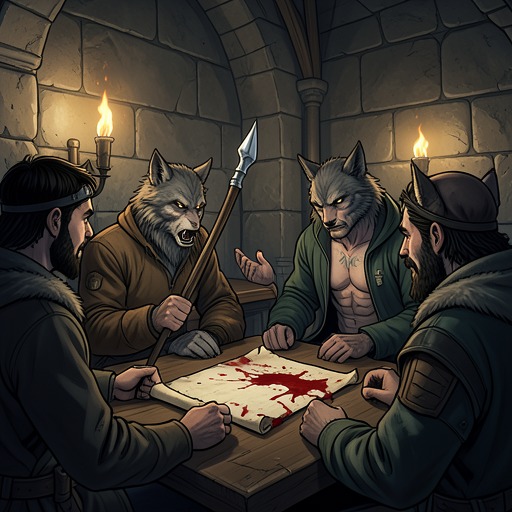
Full-Moon Werewolf Pregnancy Rule
The Vampire Prince’s BrideThe Full-Moon Werewolf Pregnancy Rule defines pregnancy with a werewolf child as a cyclical transformation rather than a purely human biological process. A fetus carrying werewolf inheritance changes during the full moon while still inside the uterus, creating physical danger for the mother and threatening the pregnancy itself. Its most direct consequence is the possibility of miscarriage at every full moon, especially as the child grows and each transformation becomes more difficult.
Definition and Mechanism
The rule is explained when Roland Davis tells Claire Doyle that the baby she is carrying is a werewolf and therefore transforms during the full moon. The transformation begins before birth; the fetus does not wait until infancy or adulthood to express its inherited nature. According to Roland’s explanation, the unborn child changes into a wolf inside the uterus, and that internal change can cause the pregnancy to fail.
The rule also provides a supernatural explanation for the repeated miscarriages suffered by Melissa Clarkson. Roland connects those losses to the full-moon cycle, arguing that Melissa could not carry the werewolf pregnancies to term because the fetuses transformed during the moon’s recurrence. The scarcity of werewolf births is therefore attributed not only to reproduction but to the danger of surviving gestation under this rule.
Risks to the Mother and Child
The full moon functions as a recurring biological crisis. Claire is warned that she may miscarry during the next full moon, and the possibility remains uncertain even before the medical records are fully confirmed. The same evidence allows Grace to consider whether what had previously been called Melissa’s miscarriages might instead have been pregnancies disrupted by fetal transformation.
Claire’s pregnancy demonstrates that the rule is progressive. The full moons become increasingly difficult as the baby grows, suggesting that the fetus’s transformations place escalating strain on the mother’s body. The danger is not confined to one isolated incident: each full moon creates another threshold the pregnancy must survive, and the risk intensifies with fetal development.
Claire’s Pregnancy and Survival
Claire ultimately carries the pregnancy through the full-moon cycles despite the danger. Roland remains beside her during the difficult transformations, and his body itself changes into a humanoid wolf while he supports her. His presence does not remove the rule, but it gives Claire practical and emotional support as the pregnancy passes through each recurring crisis.
The pregnancy ends at thirty-six weeks, before Claire has to endure another full moon while carrying the child. She gives birth to Ada Doyle-Davis, whose small size makes the relatively easy labor understandable in retrospect. Ada’s birth confirms that a pregnancy threatened by the rule can survive, but it does not make the process safe or ordinary.
Related Supernatural Biology
The rule belongs to a wider system in which human pregnancy, inherited animal traits, and supernatural transformation overlap. Shay explains that Stlozyn ancestors were human and that additional DNA permits shape-shifting, while Lisa’s pregnancy is initially mistaken for a parasite before a medical scan identifies an embryo. These contrasting cases distinguish ordinary uncertainty about alien or hybrid reproduction from the specifically cyclical danger of a werewolf fetus.
The rule also emphasizes that supernatural identity is inherited before it is socially recognized. A child may already possess the defining transformation of its species while still hidden inside a human mother. Pregnancy therefore becomes the stage at which the boundary between human and werewolf is first made physically visible, even though the child has not yet been born.
Narrative and Thematic Significance
The Full-Moon Werewolf Pregnancy Rule converts the moon from a background symbol into a biological clock. The recurring full moon measures the pregnancy’s danger, structures Claire’s anxiety, and explains why werewolf reproduction is rare. It also links maternal experience to the werewolf body: Claire must survive transformations she cannot perform herself, while Roland’s own shifting makes the child’s condition tangible within the family.
The rule further exposes the ethical and political pressure placed on supernatural bodies. Medical records, forensic confirmation, and inherited explanations compete to define what has happened to pregnant women and their unborn children. In Claire’s case, the rule is not merely a piece of lore; it determines whether she can safely continue the pregnancy, how visitors must be scheduled around the full moon, and whether Ada will be born at all. Its eventual outcome is survival, but survival achieved through repeated risk rather than through the disappearance of the danger.