Heart line
The Vampire Prince’s BrideHeart line is the name given to a distinctive birthmark associated with a shifter’s destined partnership. It is not merely a decorative mark or an inherited blemish. In the clearest explanation of the expression, every shifter is born with one, and the mark may correspond either to another shifter or to a human whose matching mark exists elsewhere in the world. When the two marks are brought together, the connection becomes physically perceptible: the lines glow, warmth passes through them, and one person can feel the other’s heartbeat in the marked skin. The heart line thus turns an abstract claim about soul mates into an embodied sign that can be seen, touched, and experienced.
Appearance and Recognition
The mark is first presented through Clara Maddison’s body. She has lived with a line that begins near her sternum and extends down her arm to her wrist, slightly darker than her normal skin. She has considered it unremarkable and disliked displaying it, usually keeping it covered. Its apparent ordinariness is important: before the matching mark is revealed, Clara does not treat the line as evidence of anything supernatural or relational.
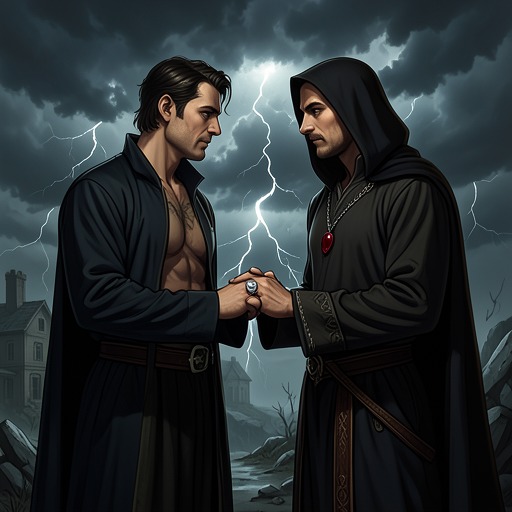
Nathaniel Snyder gives the mark its name and meaning when he tells Clara that they are meant to be mates. Clara initially rejects his claim as madness rather than accepting destiny as an explanation. He rolls back her sleeve, exposes the line on her arm, then reveals that a corresponding mark runs up his own arm. When he presses their arms together and removes his shirt to show that his mark reaches as far as hers, the marks begin to glow with a dull pulse resembling a second heartbeat. The physical response changes the mark from an ordinary feature into a sign of recognition. Clara’s confusion is not resolved by argument; it is confronted by a bodily event that both of them can witness.
Operation Within Shifter Society
The heart line is described as a universal feature of shifters rather than a private anomaly belonging only to Clara and Nathaniel Snyder. Some shifters are destined to be with another shifter, while others have a human counterpart waiting for them. This makes the mark a bridge across species boundaries and gives human–shifter relationships a recognized place within the world’s supernatural order. The matching mark does not require both partners to share the same biology, because the text explicitly allows a human to carry the corresponding sign.
Recognition is interactive rather than purely visual. Nathaniel Snyder explains that the significance lies in the matching mark, but the scene demonstrates that significance through contact: when he takes Clara’s hand, she feels his heartbeat in her own mark. The line therefore operates simultaneously as an identifying symbol and as a channel of affect. Warmth, fluttering, and the pulse of a second heart reach Clara before she can fully organize the experience into belief. The bond is communicated through the skin as much as through speech.
Relationship, Resistance, and Consent
The heart line establishes destiny, but it does not automatically compel immediate emotional surrender. Nathaniel Snyder says that Clara is meant to be his mate, yet Clara calls him crazy and questions the implications of the discovery. She resists the conclusion that a matching mark means she will simply fall into his arms. His reply acknowledges that the mark does not erase her choice: he does not claim that she must instantly accept him, even while expressing his hope that she will.
This distinction gives the expression a double function. It validates a powerful supernatural connection, but the surrounding exchange preserves a difference between recognition and consent. Clara’s acceptance develops through the encounter rather than preceding it. The mark makes soul-mate language easier for her to understand after the extraordinary events of the night, but it does not reduce her to a passive emblem. Her questions, skepticism, and decision to lean toward Nathaniel Snyder remain part of the bond’s formation.
Domestic Continuity and Narrative Meaning
The heart line continues to matter after the initial revelation. In the ending centered on Clara, she lives with her husband and daughter in a household that is unconventional but emotionally secure. While she watches them together, the mark that combines her with her mate warms again. Its recurrence transforms the heart line from a one-time proof of supernatural identity into a continuing sign of domestic attachment.
That final warmth also gives the expression a broader narrative significance. The mark begins as something Clara hides because she sees it as an unwanted or insignificant feature. It becomes the visible point where two bodies recognize one another, then remains present within family life as a quiet confirmation of belonging. The recurring image of warmth and heartbeat makes the heart line a compact symbol of the book’s larger movement from disbelief to relational integration: the supernatural is not left outside ordinary life but becomes part of marriage, parenthood, and the family’s sense of perfection.
Symbolic and Cross-Species Significance
As an image, the heart line fuses anatomy and destiny. Its location on the body makes intimacy literal, while its matching pattern turns personal identity into something relational: the mark cannot disclose its full meaning in isolation. It gains significance through comparison, contact, and the presence of another marked body. In that sense, the expression rejects the idea of a self-contained identity. Clara’s mark is hers, but its deepest meaning emerges only through its correspondence with Nathaniel Snyder’s.
The expression also belongs to a wider pattern in which bodies, technology, species, and reproduction are repeatedly made legible through visible or measurable signs. Elsewhere, bionic eyes can become concealed weapons, medical scans can distinguish a parasite from an embryo, and a glowing device can identify a destined mate. Against those more technological or institutional forms of knowledge, the heart line offers an intimate form of evidence. It is not a laboratory report or an official declaration; it is a mark whose truth is verified by sensation. Its power lies precisely in the way it makes destiny feel like touch, pulse, and shared warmth rather than an abstract rule.