Human Alpha female
The Vampire Prince’s BrideHuman Alpha female status is the political and relational condition of a human woman accepted as the Alpha female of two werewolf packs. In the novel, it is not granted as a decorative title or tolerated as a temporary compromise: Amelia insists that she is the third member who completes the Alpha triad, while the council initially treats her humanity as evidence that she cannot properly occupy the role. Her eventual welcome into the pack marks a structural change in the packs’ understanding of leadership, mating, and belonging.
Definition and Initial Objection
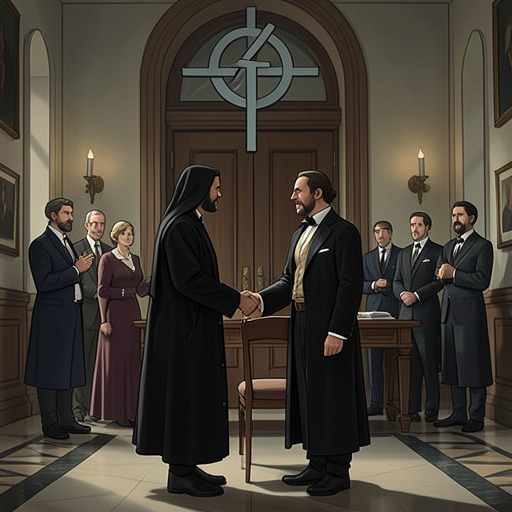
The status emerges when Xavier Knight and Timothy Pond court Amelia and believe that she is their mate. The elderly werewolf council objects on both biological and cultural grounds. Lucinda’s grandfather, once a powerful werewolf and now partly crippled by arthritis, states that the two Alphas are courting a human female. The council’s objection is not merely personal dislike: it rests on the conviction that humans cannot be an Alpha’s mate and that a human woman could never bear strong Alpha children. In that logic, mating with a human is presented as an insult to the pack’s werewolf females and as a threat to the hereditary strength of Alpha leadership.
The council’s position makes the Human Alpha female status a question of collective survival rather than private romance. Timothy and Xavier are still young and have not had enough time to establish the dominance their fathers possessed. A conflict between the Alphas and the council could divide or destroy the packs, while refusing the bond could likewise fracture the alliance between the two leaders. The council’s deliberation therefore places Amelia’s body, species, and reproductive capacity inside a political calculation about pack continuity.
Recognition Through the Mate Bond
Timothy and Xavier answer the council by separating the existence of the bond from the council’s permission to name it. They acknowledge that they have not yet mated Amelia physically, but maintain that they are already mated to her in soul. If the physical union occurs, they declare that the council must respect her as their Alpha female. Xavier’s composure restrains Timothy’s anger, and the two Alphas stand together rather than allowing the council to exploit any division between them. Their united posture makes the status inseparable from the Alpha triad itself: Amelia is not one Alpha’s private exception but the partner jointly chosen by both leaders.
The council initially withdraws without offering a clear decision, leaving Timothy fearful that rejection could force a destructive challenge. When the elders return, they explain that solidarity between the two packs matters more than their personal approval of a human mate. They admit that Lucinda’s efforts to separate the Alphas from Amelia could have had disastrous consequences, and they agree to accept a human female Alpha rather than risk tearing the packs apart. The decision is therefore both conservative and transformative. The council preserves pack unity, but it does so by recognizing a form of leadership its inherited doctrine had declared impossible.
Amelia’s Assertion of Authority
Amelia refuses to accept recognition framed as reluctant tolerance. When the council describes acceptance as preferable to the destruction of the packs, she objects that the arrangement is not good enough. Her intervention changes the scene from a council’s decision about a woman to a woman’s demand to participate in the decision herself. She holds the elders responsible for teaching Lucinda from childhood that she would become the Alpha female, identifies that expectation as part of the conflict, and rejects the implication that she has merely replaced a preferred werewolf candidate.
Amelia defines her own position in explicit political terms. She says that she is not simply a human whom the Alphas will mate instead of another werewolf; she is the completion of their Alpha triad. That distinction protects the status from being reduced to substitution or compromise. She also demands an apology and requires that the elders stop speaking about her as though she were absent. Her authority begins not with biological inheritance or a council appointment, but with her insistence on being addressed as a present subject whose consent and judgment matter.
The council’s surprise reveals how unusual this agency is within the older hierarchy. The elders expect to discuss Amelia, while Amelia speaks back to them. Her humanity, which they had treated as proof of weakness, becomes part of the force of her challenge: she does not imitate the council’s authority or wait for the Alphas to translate her position. She directly contests the language used to contain her. After she identifies herself as human and insists that this does not make her less worthy of mating with the Alphas, Lucinda’s grandfather acknowledges the point and welcomes her to the pack.
Social and Biological Boundaries
The Human Alpha female status unsettles several boundaries at once. It crosses the line between human and werewolf society, challenges the assumption that Alpha reproduction must be exclusively werewolf reproduction, and exposes the difference between a pack’s inherited ideology and the actual bonds formed by its leaders. The council’s argument about strong Alpha children treats reproduction as a measure of political legitimacy. Amelia’s acceptance instead shifts legitimacy toward the mate bond, the Alphas’ shared decision, and the survival of a unified pack structure.
This boundary-crossing belongs to a wider pattern in the novel, where bodies and identities are shown to be mixed rather than securely divided. The Draco’s Eye identifies Ella Stewart as Darilth’s destined mate through a blue stone set in a silver band, while the artifact’s inheritance is tied to the Rothgar throne. Sara uses bionic eyes that can function as concealed stun grenades, turning a bodily prosthesis into a weapon and a means of escape. Lisa’s pregnancy is confirmed by a medical scanner that produces a three-dimensional hologram of an embryo with a strange tadpole-and-dinosaur appearance, yet the scan establishes that it will develop into a baby. These examples do not make Amelia’s status identical to those transformations, but they reinforce the book’s recurring refusal to treat human identity, biological form, technology, and social belonging as fixed categories.
The same principle appears in Shay’s explanation that the Stlozyn ancestors were humans taken from Earth centuries earlier. Their descendants possess emphasized genes and additional DNA that allow shape-shifting, making species difference a matter of altered inheritance rather than an absolute origin. Against that background, the council’s claim that humanity disqualifies Amelia appears less like an eternal biological truth than a social boundary maintained through custom and fear.
Ethical and Narrative Significance
The status also exposes a conflict between authority and ethics. The elders claim to protect pack strength, but their first response is to measure Amelia by usefulness to Alpha reproduction. Amelia’s demand for an apology challenges that instrumental view. Her acceptance is meaningful because it follows a confrontation in which she refuses to be treated as a solution to a male political crisis. The council welcomes her only after she has made clear that inclusion without respect would preserve the hierarchy while merely changing its object.
The novel’s treatment of consent and bodily autonomy elsewhere sharpens this significance. Shay refuses to permit Niqæsh to experiment on Gemma or on Gemma’s unborn child, even though fetal DNA might provide a more potent route to curing infertility. He calls experimentation on those unable to give informed consent sacrilegious against science itself. Amelia’s position similarly insists that a body cannot be converted into a political instrument without acknowledging the person inhabiting it. Her status becomes legitimate not because the council discovers that a human body is secretly acceptable, but because the old criteria are forced to yield to relationship, agency, and collective choice.
By the end of the council confrontation, the Human Alpha female status has moved from accusation to recognition. Amelia is welcomed into the pack, and the remaining task is to introduce her two mates to her brother. The immediate crisis ends without a fight, but the settlement carries lasting implications: the packs remain united, Xavier and Timothy’s shared rule is preserved, Lucinda’s inherited expectation is displaced, and Amelia enters the political order as an acknowledged Alpha female rather than a tolerated outsider. The status therefore functions as both a relationship condition and a reforming principle, showing that pack continuity can depend on accepting a form of kinship its traditions were built to exclude.