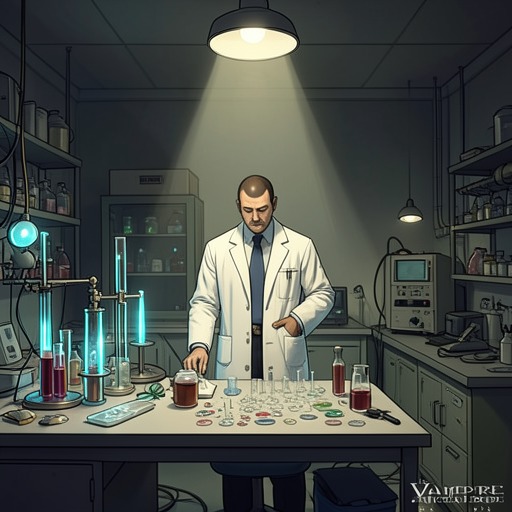
Human DNA infertility cure
The Vampire Prince’s BrideHuman DNA infertility cure is a proposed biological treatment for the infertility disease afflicting the Stlozyn, a dragonlike people whose reproductive crisis has made human DNA a coveted resource. In the novel, the cure is not merely a medical solution: it becomes the justification for abducting human women, the basis of a struggle within Stlozyn government, and a test of whether science serves living persons or reduces them to usable material.
Biological Basis and Intended Function
The cure was discovered after Stlozyn researchers learned that an infusion of human DNA reverses the effects of the infertility plague. Din explains that human women can become pregnant by a dragon even without receiving the treatment, making human biology valuable both as a source of genetic material and as a means of restoring Stlozyn reproduction. The treatment therefore links two distinct processes: the synthesis of a medical cure and the use of human reproductive capacity to bypass the disease before that cure is widely available.
The scarcity of the treatment shapes its distribution. The dragon who developed the cure was promoted to the Science Board, the highest level of Stlozyn government, but synthesis remained slow. The cure was given only to dragonesses because one male dragon could impregnate many dragonesses, and officials judged female recipients more important to the species' reproductive recovery. That decision turns a scientific intervention into a demographic policy: access is determined by reproductive utility rather than by equal medical need, while male Stlozyn who want children remain unable to father them.
Exploitation Behind the Cure
The shortage creates an environment in which human women disappear from Earth. Din treats those abductions as part of a known pattern, revealing that humans have been taken to serve as reproductive or genetic resources. His own plan is especially extreme. He tells Libba that he does not intend to have children with her, but wants a living specimen from which to extract DNA because synthesizing the cure takes too long. His proposed method is to reduce her body to its base components, a description that converts a person into raw biological inventory.
Din also evaluates Libba through the language of yield. He regards her thicker layer of body fat as advantageous because it would provide more genetic material and help sustain her body during the process. The clinical vocabulary does not soften the violence; it exposes how scientific classification can erase agency. Libba has been abducted, imprisoned, and denied any meaningful ability to refuse, while the prospective benefit belongs to the Stlozyn population rather than to her.
The larger system is defended as protective rather than exploitative. Stlozyn authorities decided that abducted human women should be settled among their people instead of returned to Earth, arguing that humans would ridicule anyone who claimed to have traveled to the stars. This rationale combines paternalism with concealment: the authorities present permanent removal as being in the women's interest while also protecting Stlozyn secrecy and preserving access to human biology.
Justice, Science, and Resistance
Brask's rescue mission arises because Din's research has crossed an ethical and legal boundary. Din is already known for unethical experiments on non-sentient beings, but the abduction of a human woman violates newly established laws against taking human females from Earth. His powerful mother, Nylæq, protects him through her influence over the Science Board and other governing bodies, frustrating repeated attempts to imprison him. The cure's importance thus operates inside a corrupt political structure where scientific status and family power obstruct accountability.
After Brask and Biryl recover Libba, they confront a dilemma created by the same laws they are trying to uphold. They have illegally retrieved a woman who was illegally abducted, and returning her to the Science Board might allow Nylæq to reclaim her. Brask nevertheless argues that failing to return her through lawful channels would also be illegal, even as he recognizes that the official system may not protect her. His anger is not presented as a rejection of science; it is a demand that science respect life, consent, and legal responsibility.
The contrast between Din and Brask gives the cure its central ethical tension. Din treats knowledge as a license to dissect, extract, and possess. Brask sees the value of the research but refuses to accept a cure purchased through a captive person's destruction. The novel consequently separates scientific discovery from scientific legitimacy: finding a treatment does not make every method of obtaining it permissible.
Cross-Species Biology and New Possibilities
The cure is part of a wider revelation about Stlozyn origins. Shay explains that Stlozyn ancestors were humans taken from Earth several hundred years earlier. Their distinctive scales and shapeshifting abilities arose through intensified genes and added DNA strands, while their underlying ancestry remained human. This history makes the search for human DNA more complicated than a simple encounter between unrelated species. The Stlozyn are genetically connected to humanity, even though their society treats humans as external specimens and hides them from their homeworld.
That shared ancestry becomes visible through Gemma's pregnancy with Shay's child. Shay concludes that the two peoples are technically the same species, or different subspecies, after observing that the pregnancy is developing normally. The child therefore offers evidence that the boundary separating human and Stlozyn biology is permeable. A mixed pregnancy may provide the scientific key to the infertility crisis, but it also becomes vulnerable to scientific capture: a dragoness tells Gemma that her impossible child is the key to curing the Stlozyn and intends to use her as a research specimen.
The pregnancy makes the cure's stakes personal. Human DNA is no longer an abstract ingredient in a laboratory process; it is embodied in women, embryos, ancestry, and future families. The same biological connection that could enable healing also gives the Science Board a reason to claim authority over a pregnant person's body.
Narrative Significance
Human DNA infertility cure functions as the book's clearest science-fiction novum: an apparently simple biological discovery reorganizes law, reproduction, interspecies relations, and political power. Its consequences extend from the disappearance of human women to the division between Science and Justice, from the privileged treatment of dragonesses to the danger faced by Gemma and Libba. The cure promises to restore a population's future, yet the institutions pursuing it repeatedly treat individual futures as expendable.
The concept also unsettles the boundary between natural and artificial life. Stlozyn biology already combines human ancestry, engineered genetic difference, shapeshifting, and dragon physiology. Human DNA infertility cure continues that pattern by making reproduction a technological and political process rather than a private natural event. The cure's significance lies not only in whether it works, but in who controls it, whose body supplies it, and whether the restored fertility of one species can be achieved without reproducing the violence that caused the crisis to become visible.