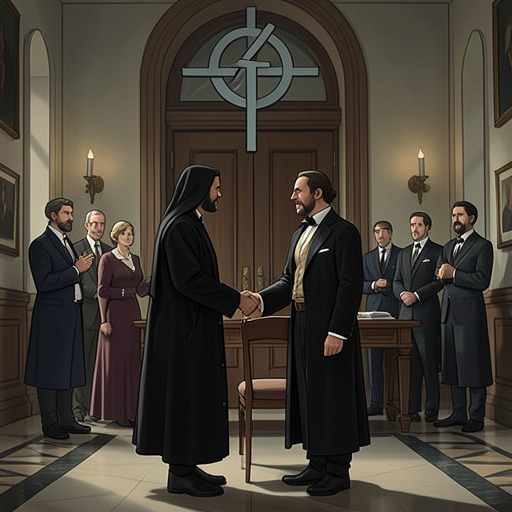
Human-Wife Requirement
The Vampire Prince’s BrideHuman-Wife Requirement is the central reproductive and political rule governing vampire continuity and advancement. It makes marriage to a human woman more than a private alliance: the wife becomes evidence of a vampire’s capacity to coexist with humanity, control his predatory nature, and produce the next generation. Through Darius and Cleo, the rule is shown as both a demographic necessity and a system that turns marriage, pregnancy, and public reputation into measures of political worth.
Definition and Social Function
The rule emerges from the succession crisis facing vampires. Iosif and his human mate had no children of their own, and they required the vampire chosen to replace Iosif to demonstrate good relations with humans. Marriage to a human woman was presented as the clearest proof of that qualification, making a human wife an institutional requirement for a prospective ruler rather than merely a companion chosen for affection. Darius therefore married Cleo as part of the process by which he could become a credible successor.
The arrangement also rests on a biological distinction that the vampire society misunderstands or conceals from outsiders. Humans who live among vampires and are regularly fed from may acquire vampiric traits: their aging slows dramatically, they become stronger and faster, and they develop a taste for blood. They do not, however, become vampires. Vampires are born vampires, usually male, and human wives are necessary for reproduction. Without women such as Cleo, the vampire population would become extinct within three generations. The rule consequently converts human marriage into a species-survival institution.
Marriage as Political Qualification
Darius’s marriage to Cleo is explicitly strategic. Cleo is his twenty-year-old human wife, and at the time of their meeting they have been married for four months. Darius chose her partly because of her beauty, including her bronzed skin, long curly hair, black eyes, and rounded, robust figure. Gordon questioned whether Darius truly wanted a woman so physically substantial, but the choice nonetheless established Cleo as the human partner through whom Darius would satisfy the expectations surrounding his position.
The marriage is not reduced entirely to political calculation. Darius remembers meeting Cleo and tells her that he knew immediately she was the woman who would become his bride. Their relationship therefore contains an emotional and erotic dimension alongside its institutional purpose. Yet the system never allows private feeling to stand apart from public utility. Cleo’s presence demonstrates Darius’s relations with humans, while her pregnancy becomes evidence that he can control himself sufficiently to impregnate a human woman without killing her.
That standard is made explicit when Darius reacts to the discovery of Cleo’s pregnancy. He explains that a healthy child would increase his position because it would prove his self-control and his ability to complete the reproductive role expected of him. Pregnancy is thus both intimate fact and political credential. Cleo had withheld the information because she did not want Darius distracted from the danger of shifter attacks, but Darius regards the pregnancy as a matter that directly affects his standing.
Promotion, Pregnancy, and Public Recognition
The rule produces a visible hierarchy of rewards. When Iosif meets Cleo, he recognizes her pregnancy and praises Darius for having captured a Rebeluna prisoner whose information helped prevent further attacks. Iosif tells Darius to care for her and links her presence to future promotions. The king’s approval makes clear that military achievement alone is insufficient: Darius’s service is strengthened by his successful human marriage and impending child.
Darius then reveals that he is being promoted to general, although the announcement will not become public for several months. Cleo celebrates not only because Darius has advanced, but because the promotion will make her a general’s wife and increase her influence. She already knows many generals’ wives and expects to gain access to their social network. Her ambition extends beyond the immediate promotion toward becoming a prince’s wife and possibly a princess, though that path would depend on circumstances involving Camlo, the current heir.
This exchange shows how Human-Wife Requirement distributes power through women as well as men. Darius’s military advancement elevates Cleo’s social rank, while Cleo’s marriage and pregnancy help validate Darius’s advancement. The rule therefore operates as a reciprocal-looking exchange: the vampire gains legitimacy and reproductive proof, while the human wife gains status, influence, and access to the ruling hierarchy. The reciprocity is real but unequal, because the institution measures Cleo primarily through her value to vampire survival and succession.
Limits, Consent, and Institutional Pressure
The rule is connected to a broader pattern in which bodies, reproduction, and intimacy are treated as political resources. Cleo is expected to bear a child who will confirm Darius’s fitness, just as other societies in the book organize marriage, mating, fertility trials, and human partnerships around succession. The difference is that the vampire system is driven by demographic dependence: human women are indispensable because vampires cannot sustain their population through vampire reproduction alone.
The surrounding narrative also contrasts this system with more coercive reproductive arrangements. Cheryl is publicly transferred from the temple toward royal marriage and is told that her future consists of luxury and producing children for her king. Maribel is selected by Sheridan specifically to bear him a child. These parallels show how Human-Wife Requirement belongs to a larger political logic in which women’s reproductive capacity is tied to rank and collective survival. Cleo, however, is given a more active social position: she proposes aid for flooded human communities, discusses an outreach program for vampire relations with outliers, and sees kindness as a way to change the direction of war.
Cleo’s conduct complicates the rule’s instrumental basis. Darius thinks in terms of battles, conquest, control, and military proof, whereas Cleo thinks in terms of aid and human outreach. He recognizes her as a valuable ally because humans are essential to vampire survival not only as blood sources but as the population through which vampires can continue. Her political intelligence therefore expands the meaning of a human wife beyond reproduction. Cleo becomes a mediator between species and a participant in the policy consequences of the rule.
Narrative Significance
Human-Wife Requirement turns marriage into a test of species survival, personal restraint, and political legitimacy at once. Darius’s union with Cleo demonstrates how an apparently private choice is embedded in royal succession: Iosif’s approval, Darius’s promotion to general, Cleo’s pregnancy, and her rising influence all follow from the same institutional expectation. The rule also explains why human–vampire relations remain central to the war with shifters. Humans are not peripheral civilians; they are the demographic and political hinge on which vampire continuity depends.
Its deepest tension lies in the contrast between necessity and agency. The vampire kingdom needs human women, but that need does not automatically make the women equal participants. Cleo gains power by fulfilling the role, yet she also reshapes it through diplomacy, social ambition, and direct influence over Darius. Her marriage reveals the rule’s contradiction: the system treats the human wife as a biological requirement, while the story shows that survival depends equally on her judgment, political labor, and ability to imagine relations between species in terms other than conquest.