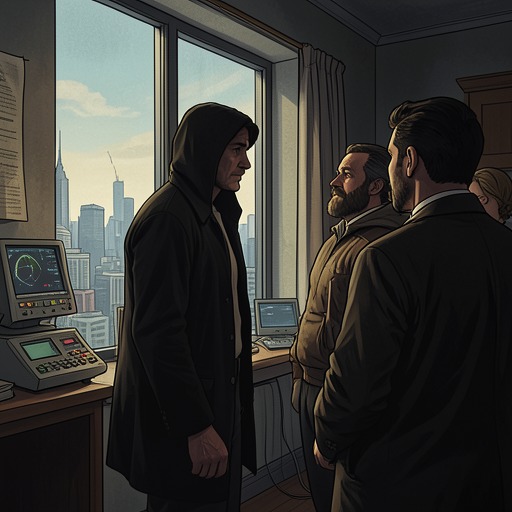
Joseph Baker's Cave
The Vampire Prince’s BrideJoseph Baker's Cave is a secluded refuge associated with Joseph Baker’s need to withdraw from the pressures of city life and reconnect with his Bear. In the aftermath of violence, it becomes a place of emergency care for Ana Medina, whose injury and determination pull the shelter into the wider struggle surrounding Senator Seth Fischer and anti-shifter groups. The cave’s importance lies in this contrast: it offers physical protection, yet it cannot keep its occupants outside the political conspiracy and personal grief that brought them there.
Refuge and Setting
Joseph Baker’s Cave is one of Joseph’s favorite haunts, a place he uses when urban life becomes too constricting and he needs to be with his Bear. The description establishes the cave as more than an anonymous hiding place. It is a familiar private environment connected to Joseph’s divided identity and to the instinctive presence of his Bear, giving the location the character of a retreat where human judgment and shifter nature can coexist.
Ana initially has little sense of the setting. When she looks around and takes in her surroundings for the first time, her eyes widen at the sight of the cave. That reaction marks her transition from the immediate confusion of injury and danger into an awareness of the unfamiliar shelter around her. For Joseph, the cave is known territory; for Ana, it is a sudden refuge whose safety depends on his knowledge and vigilance.
Shelter After Violence
Joseph has prepared a nest of blankets on the cave floor for Ana. The detail makes the cave a makeshift care site rather than merely a tactical hiding place. Ana has nearly died for the second time in two days, and Joseph has been tending to her while remaining alert to threats outside. When he leaves briefly to check the perimeter, the cave continues to hold the practical boundary between her vulnerability and the dangers of the forest.
The shelter also exposes the limits of protection. Ana refuses to remain behind while Joseph investigates the surroundings. Despite her injured leg, she staggers out of the cave and leans against its wall, insisting that they return to the city to find Seth Fischer. Her movement from the blankets to the cave entrance transforms the location from a sanctuary into a point of conflict: Joseph understands rest as necessary protection, while Ana understands continued movement as the only responsible response to the conspiracy.
Joseph and Ana at the Cave
Joseph tries to maintain professional distance inside the cave. After carrying Ana back when she attempts to hobble into the forest, he settles her again on the blanket nest. His hand begins to smooth her honey-dyed hair away from her face, but he stops himself and clenches his hand at his side. The cave therefore becomes a confined space in which physical caretaking and emotional restraint are placed almost directly against each other.
Joseph’s Bear urges him to protect Ana and to accept the bond it senses between them. Joseph resists that impulse, partly because Ana is a non-shifter who needs time to decide whom she wants to spend her life with, and partly because Buck Harmon has just died. In Joseph’s reasoning, becoming intimate with Ana only hours after Buck’s death would dishonor the friendship Buck gave him unconditionally. The cave holds this unresolved tension between instinctive attachment, grief, and the need to make deliberate choices.
Ana’s behavior makes the shelter a site of reciprocal rather than passive dependence. Joseph recognizes her as brave, strong-willed, and unwilling to surrender what she wants easily. She will not simply accept confinement, even when her injured leg makes each step painful. Her insistence that they reach the city and recover the anti-shifter documents she collected gives the cave a political dimension: the documents may help expose the groups threatening them, while the cave can only delay the danger.
Narrative Function and Consequences
The cave serves as a temporary pause in a sequence of pursuit, assassination, and loss. Joseph scans the trees for danger, while Ana’s return to the outside forces him to acknowledge that hiding cannot resolve the larger crisis. His warning that Seth may already be dead intensifies the shelter’s emotional pressure, and Ana responds with grief rather than surrender. The cave protects her body, but it cannot protect either character from knowledge of the killings around them.
Its domestic imagery is deliberately fragile. The blankets, Joseph’s attempted gesture toward Ana’s hair, and his effort to keep her calm create the outline of a household or nest, yet that intimacy remains provisional. The setting is still a cave, a place Joseph enters when the city becomes unbearable and a place that can be abandoned at any moment. Its refuge is therefore defined by impermanence: it permits recovery, vigilance, and a brief confrontation with feeling, but it does not end the need to return to the city or confront the anti-shifter threat.
Significance
Joseph Baker’s Cave concentrates the story’s competing values of safety, freedom, grief, and attachment. Joseph wants to keep Ana alive by holding her inside; Ana wants to preserve Seth and the threatened documents by leaving. Their disagreement turns the cave into a spatial expression of the broader conflict between retreat and action. At the same time, Joseph’s Bear treats the shelter as a place where Ana should be claimed and protected, while Joseph’s human judgment insists on restraint.
The location’s decisive significance is thus relational as much as geographical. It reveals Joseph’s established connection to his Bear, gives Ana a protected but temporary place after repeated violence, and brings their emerging bond into contact with Buck’s death and the threat of organized anti-shifter violence. The cave is safe enough for Joseph to care for Ana, but not safe enough to become an ending; it is the enclosed interval from which both characters must eventually re-enter a dangerous public world.