Justice Keepers
The Vampire Prince’s BrideJustice Keepers are Bronæl’s armed guardians of law, but the narrative presents them as more than a military police force. They belong to a society governed by specialized boards, and their authority is repeatedly tested when institutional procedure collides with the protection of vulnerable people. Their most important representative, Brask, understands the order as both a rank and a moral vocation: a Justice Keeper must restrain violence, uphold the law, and decide whether justice lies in following official wording or defending the human purpose behind it.
Institutional Structure and Status
Justice Keepers operate within Bronæl’s board-based government. The Science Board stands at the top of the system, while the Justice Board, Agricultural Board, and other boards oversee distinct areas of public life. Because science is treated as the foundation of every other field, scientific citizens possess the highest social status, whereas Justice Keepers occupy a lower position in the hierarchy despite carrying the practical burden of enforcement. Brask explains that he is not a scientist but a Justice Warrior, a rank comparable to a colonel in an Earth military. The distinction makes the organization both powerful and politically constrained: its members can enforce decisions, but they remain answerable to the boards that define legality.
The hierarchy also produces a cultural dispute about what kinds of work deserve respect. Brask objects to a society that places research above feeding its people and asks whether scientists are the only citizens considered worthy. His criticism gives the Justice Keepers a broader social function. They are not merely executors of scientific policy; they represent neglected obligations to survival, order, and ordinary citizens. Yet the same hierarchy makes them vulnerable to interference from influential scientists and boards, especially when a legal case involves a human, a rare biological resource, or a politically protected family.
Law, Violence, and the Human Question
The Justice Keepers’ central dilemma emerges after Brask and Biryl recover Libba from Din. Libba has been illegally abducted from Earth, but her rescue has also violated Bronæl’s procedures. Returning her to the Science Board could place her back within Din’s reach, particularly because Din’s mother, Nylæq, has influence. Biryl argues that the Justice Keepers have a duty to uphold the law even if the law requires them to surrender the human. Brask replies by separating the word of Justice from its spirit: formal compliance may itself become an injustice when it returns a threatened person to her captor.
The case also exposes the organization’s uneasy relationship with human life. Libba is not treated simply as an ordinary citizen whose freedom is self-evident. She is a human abducted from Earth, and the governing system treats that status as a legal problem requiring board supervision. Brask recognizes that the only lawful way to keep her with them might depend on an agreement she would make only because she feared for her life. That possibility troubles him because consent extracted under coercion would satisfy procedure while violating the ethical substance that procedure is supposed to protect.
The organization’s restraint is explicit. Brask reminds himself that the first rule of a Justice Keeper is to avoid violence, especially because he hopes to establish a colony where religion and science can coexist peacefully and cannot afford to create enemies among the boards. This principle does not make the Keepers passive. It makes violence a grave institutional failure rather than a routine instrument. Their legitimacy depends on showing that force was necessary, proportionate, and directed toward protection rather than dominance.
The Confrontation with Din
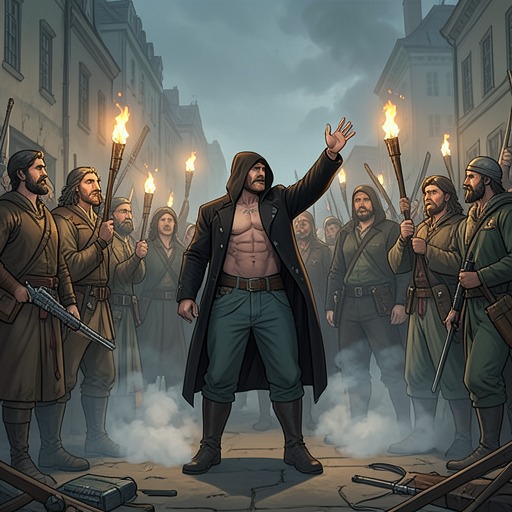
That restraint is tested when Science Alpha Din arrives with six dragons to reclaim Libba. Din presents custody as legality and threatens that something might happen to Libba during the journey if Brask refuses to surrender her. Brask initially addresses him formally and attempts to reason with him, but Din’s position reveals the danger of a system in which legal authority can be used to conceal coercion. Din claims that returning Libba is required by the boards, while Brask understands that the proposed transfer could expose her and her unborn child to further harm.
Brask therefore announces that he will defend his human mate and their unborn child. He tells the assembled Justice Keepers that Din’s claims have not been confirmed directly by the Science Board and that their intervention can be justified as a defense against an unlawful attack. The declaration transforms a procedural dispute into an armed confrontation. Some Justice Keepers withdraw, unwilling to participate, while others advance and take their beast forms. The organization is thus shown as internally divided but not morally empty: its members must choose whether obedience means standing aside or acting against an immediate threat.
The battle is brutal and decisive. Din’s guards are intimidating but lack the combat training of the Justice Keepers. Brask fights in beast form, while the other Keepers engage the dragons; the guards are killed, and several Justice Keepers are wounded without suffering serious injuries. The outcome proves the practical superiority of trained enforcement over hired intimidation, but it also leaves the organization exposed to political retaliation. Brask knows that Nylæq may retaliate over her son’s death and that the boards may interpret the battle as insubordination or murder rather than lawful defense.
Accountability and the Cost of Protection
After Din’s death, Brask orders everyone involved in the attack to prepare the ships and travel to Bronæl. He intends to call for a public trial, both to justify the Justice Keepers’ actions and to prevent Libba’s pregnancy from being terminated. The public trial is significant because Brask does not treat victory in combat as proof of righteousness. The organization must still submit its conduct to a visible legal process, and Libba’s safety depends on whether that process can withstand political influence.
Brask expects personal punishment even if the public accepts his actions as justified. He has led Justice Keepers to kill, something considered inexcusable for a Justice Warrior, and he anticipates losing his rank. His dream of founding a colony where religion and science might live together in peace is shattered by the necessity of violence. Nevertheless, he regards Libba’s survival as worth the cost. The Justice Keepers therefore embody an ethic of accountable intervention: force may be necessary, but those who use it must accept scrutiny, demotion, and institutional consequence.
The episode also shows the organization using collective presence as a legal defense. Brask does not conceal the battle or flee alone. He gathers the participants, plans to bring the case before the public, and seeks a ruling that will protect both Libba and her unborn child. In this sense, the Justice Keepers stand between two failures: blind obedience that would return Libba to danger, and private vigilantism that would place their violence beyond review. Their ideal is a difficult middle ground in which intervention remains answerable to law.
Broader Role in the World
Justice Keepers belong to a wider political order that repeatedly turns vulnerable bodies into matters of official jurisdiction. The fertility regime surrounding Cheryl sends a queen and two Kings Presumptive to the Shrine of Nethja until the alignment of the four moons, making pregnancy the basis for deciding succession and threatening death when the prescribed result is not achieved. The Fifth Cycle Festival offers an even harsher example of institutionalized violence: a woman is selected as a Goddess while men compete to kill one another, and the victor receives control over her; the United Species bans the tradition because the Goddess is often killed and eaten. These practices clarify the scale of the Justice Keepers’ problem. Law in this universe can protect life, but it can also formalize possession, reproductive coercion, and ritual violence.
The organization’s relevance extends beyond Bronæl’s immediate conflicts. During the dispute involving Sheridan and Maribel, an investigating authority states that humans under supervision are not prisoners, yet removing them from custody before the investigation ends would be treated as a hostile act requiring military involvement. That contradiction echoes the Justice Keepers’ dilemma: a person may be described as protected while remaining subject to restrictions that resemble captivity. The narrative repeatedly asks whether institutional custody is genuinely protective or merely a more polished form of control.
Justice Keepers are therefore defined by a contradiction at the heart of the book’s political imagination. They are agents of a legal order that ranks science above other forms of knowledge, regulates human bodies, and can be manipulated by powerful families. At the same time, their code gives individuals such as Brask a language for resisting the system’s most dangerous commands. Their significance lies not in perfect justice but in the struggle to preserve a distinction between law as authority and justice as protection, even when defending that distinction requires the very violence their order was created to restrain.