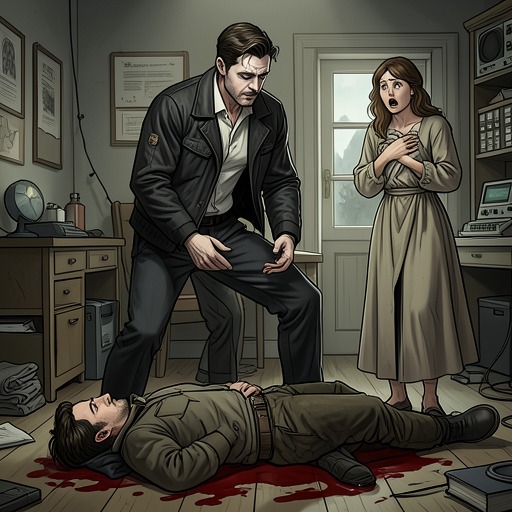
Kill or be killed
The Vampire Prince’s Bride“Kill or be killed” is an expression of forced survival rather than free choice. Its clearest formulation belongs to Erdal, who explains that after being found in a crashed aircraft on the outskirts of a city, he was taken as a slave, trained in sword fighting, and made a gladiator. In that arena, he says, the governing rule was simple: one either killed or was killed. The phrase therefore names both a literal condition of combat and the disappearance of every humane alternative beneath slavery.
Erdal and the Gladiatorial Maxim
Erdal’s use of the expression comes within an account of radical dispossession. He does not remember how he reached the crashed aircraft, and he initially cannot even remember his own name. His master’s discovery of a recording in the wreckage supplies the name by which he is known, but not a family, history, or freedom. The arena then converts that absence of identity into a social function: he serves his master by fighting, learns swordsmanship, and survives only by killing another combatant before the other combatant kills him.
The sentence is significant because Erdal presents violence as an imposed structure, not as a personal creed. His description does not celebrate gladiatorial skill or frame killing as honorable achievement. It reduces the arena to a binary in which the slave’s agency has been narrowed to choosing the timing and direction of violence. The phrase consequently exposes the moral fraud of a system that calls survival a choice after removing every peaceful choice in advance.
Ritual Violence Beyond the Arena
The same survival logic governs the Fifth Cycle Festival, an ancient tradition in which a woman is bound into the fleshy form of a Goddess while men compete until only one remains. The final victor becomes the God and gains power over the Goddess; the tradition is so violent that the Goddess is commonly killed and eaten by the victor. Although the United Species has banned the festival, its persistence demonstrates how institutionalized violence can survive by being presented as religion, custom, or spectacle rather than slavery.
The festival broadens the expression from an individual’s testimony to a cultural system. Erdal is forced to kill because he is an enslaved gladiator; the festival’s combatants kill because their society has constructed victory as proof of divine or masculine legitimacy. In both cases, death is made into a qualification for status. The contrast is that the arena’s coercion is personal and economic, while the festival’s coercion is ceremonial and collective. Both nevertheless turn lethal violence into the mechanism by which an order reproduces itself.
Royal Succession and the Language of Necessity
A related form of coercion appears when Priest Quincy announces the fertility trial involving Cheryl and the two Kings Presumptive. Cheryl insists that the Gods must decide who becomes king and identifies herself as only the queen. Quincy converts that declaration into a binding political sentence: Cheryl and both rival kings are sent to the Shrine of Nethja until the alignment of the four moons. If Cheryl becomes pregnant, the father will be king; if she does not, both men will be executed and a new king will be chosen.
This decree does not use the expression literally, but it constructs the same closed field of alternatives. Cheryl is denied an ordinary wedding night and confined with two rivals who are expected to impregnate her. The kings, meanwhile, face either reproductive victory or death. Religious authority disguises a political contest as divine procedure, while the threat of execution ensures that the participants cannot simply refuse the terms. The phrase’s underlying logic is therefore embedded in the trial’s structure: comply with the violent system or be destroyed by it.
Meaning and Narrative Function
Across these contexts, “Kill or be killed” functions as a compressed statement of life under domination. It links Erdal’s past as a slave to broader institutions that make bodies serve power: the gladiatorial arena turns a captive into entertainment, the Fifth Cycle Festival turns death into sacred tradition, and the Nethja trial turns sexuality and pregnancy into instruments of succession. The recurrence creates a contrast between the language of necessity and the actual choices made by authorities. What is described as inevitable is repeatedly produced by masters, priests, customs, and political rules.
The expression also gains force through its relation to concealed identity and personal naming. Erdal’s name comes from a recording found in wreckage, while Sara later encounters a man known as Bond who quietly reveals, “My name is Tom.” That disclosure occurs during their first sexual encounter and interrupts the imposed identity attached to him. It does not erase the violence of the world around them, but it marks a moment in which a person speaks a self-chosen or recovered name rather than accepting only the role assigned by an institution. Against the arena’s binary, naming preserves the possibility that survival can lead back toward personhood.
The phrase’s final resonance is political as well as existential. The United Species bans the Fifth Cycle Festival, yet other forms of captivity and coercion remain active: human beings are treated as rare commodities, and the vampire authorities insist that humans under their custody are not prisoners while threatening military action if they are removed. Such scenes expose the instability of official language. “Kill or be killed” is memorable because it states the truth more plainly than systems of power do: when protection, religion, law, or tradition suspends ordinary freedom, survival becomes an argument used to justify violence, and the supposed necessity of that violence must itself be questioned.