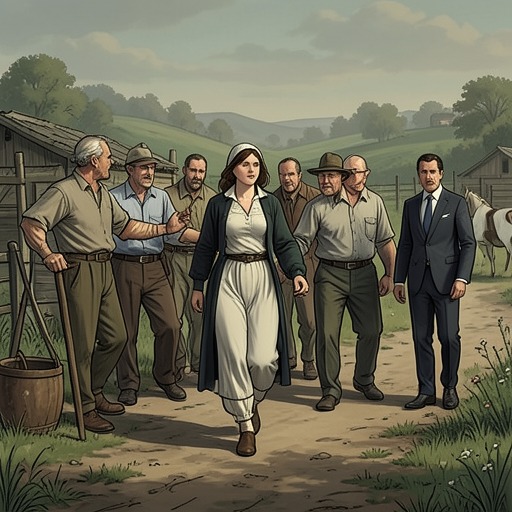
Killian Flanagan
The Vampire Prince’s BrideKillian Flanagan occupies the morally unstable space between organized crime and reluctant protection. Known as “Kelly” to Ryan Higgins, he is introduced as Ryan’s partner, stationed with him near Danita Valdez’s isolated farm to watch for signs that she might flee. His importance lies in the contradiction at the center of that assignment: he belongs to the criminal structure threatening Danita, yet he recognizes that the punishment imposed on her is unjust and ultimately risks himself to prevent it.
Identity and Background
Killian is associated with the Four Clovers, a local crime syndicate whose members, including Killian, Ryan Higgins, and Dean McGrath, are mostly of Irish descent. He works alongside Ryan under McGrath’s orders, making him part of the machinery used to enforce Danita’s inherited debt. The group’s financial pressure comes from McGrath’s own failure: after losing three drug-manufacturing operations in the countryside, he passes the resulting obligation onto people to whom he had lent money. Danita becomes caught in that web accidentally, despite having no responsibility for the criminal operations themselves.
Killian’s first appearance places him in a rough, exposed environment beside Ryan, with brush surrounding them and abandoned-looking buildings across a flat field. Their assignment is surveillance rather than open violence, but the threat is unmistakable. They are expected to report to McGrath if Danita appears likely to run, and Killian understands that her flight would bring danger down on her. His position therefore combines criminal obedience with an emerging refusal to treat Danita as merely property or collateral.
Moral Conflict and Protection
Killian does not dismiss Danita’s fear. When Ryan says that he dislikes intimidating women and considers it unfair that Danita should inherit her uncle’s debt, Killian agrees. The agreement matters because it reveals that his conscience is active before he openly rebels against McGrath’s arrangement. He understands both the brutality of the system and the personal danger created by McGrath’s failure, but neither understanding initially gives him a lawful or simple way out.
His protective impulse becomes decisive when the possibility of killing McGrath arises. Killian rejects the suggestion immediately, explaining that McGrath’s death would force him and Ryan to pay double Danita’s ransom to the Four Clovers’ leader. Instead, he says that he has made an agreement to buy Danita from McGrath. The proposed arrangement gives him one month to pay Danita’s debt plus an additional two hundred and fifty thousand dollars; if he can raise the total, McGrath will leave her alone permanently. Killian’s language still reflects the dehumanizing economics of the criminal world, but his action redirects that economy toward Danita’s survival.
The decision is not presented as a clean escape from crime. Killian remains trapped inside the syndicate’s rules, negotiating with the people who threaten Danita rather than dismantling the system. Yet refusing murder while assuming the financial burden himself marks a significant ethical boundary. He chooses an arrangement that might preserve both Danita’s life and his own, even though the price is immense and the deadline is fixed.
Mate Bond and Partnership
Killian’s agreement becomes more than a business calculation when he tells Ryan that Danita is their mate. The revelation gives the rescue plan a personal and supernatural dimension: Danita is not simply a debtor under surveillance but the woman bound to both men. Ryan’s response changes from anger at Killian’s apparent recklessness to guarded hope, because the mate bond makes their willingness to risk the required three-quarter-million-dollar sum emotionally intelligible as well as strategically necessary.
His partnership with Ryan is consequently defined by disagreement followed by solidarity. Ryan challenges Killian’s methods and reacts with disbelief when he hears that Danita is to be “bought,” but he also understands the urgency of protecting her. Killian, for his part, restrains Ryan from an impulsive killing that would worsen their situation. Their exchange shows two men trying to act ethically within a criminal environment, with Killian serving as the more cautious and calculating of the pair.
Change and Narrative Role
Killian’s arc is grounded in a shift from watcher to protector. At first, he is positioned outside Danita’s home, observing whether she will escape and reporting within McGrath’s chain of command. Once he acts on his concern, he becomes the person attempting to create an exit for her. The transformation is not a rejection of his entire past; the proposed ransom still uses the syndicate’s vocabulary of ownership, debt, and payment. Its significance instead lies in how he bends those terms against the immediate violence they were designed to authorize.
The wider evidence places Killian within a story pattern in which intimacy exposes the moral failures of coercive institutions. The debt system converts vulnerability into a commodity, while the mate bond insists that Danita possesses an identity and value that cannot be reduced to the amount owed. Killian stands at that collision point. He is both implicated in the threat and committed to interrupting it, making his protection of Danita an act of personal loyalty, practical strategy, and resistance to the criminal order he serves.
His established endpoint in this portion of the narrative is therefore conditional rather than triumphant. He has secured a month and a possible bargain, not freedom. The ransom remains enormous, McGrath remains dangerous, and the Four Clovers still possess the power to punish failure. Killian’s importance comes from choosing to carry that danger instead of leaving Danita to carry it alone.