King Zutaar
The Vampire Prince’s BrideKing Zutaar is the brutal Darrenkar ruler who turns royal authority into a marketplace of bodies, obedience, and fear. His defining significance lies in the way he reduces both subjects and political rivals to things that can be purchased, tested, used, or discarded. Through his treatment of Erdal and Natalie, the narrative presents Zutaar as the immediate embodiment of a corrupted monarchy: a king whose power depends less on legitimacy than on intimidation, arbitrary punishment, and the threat of execution.
Identity and Rule
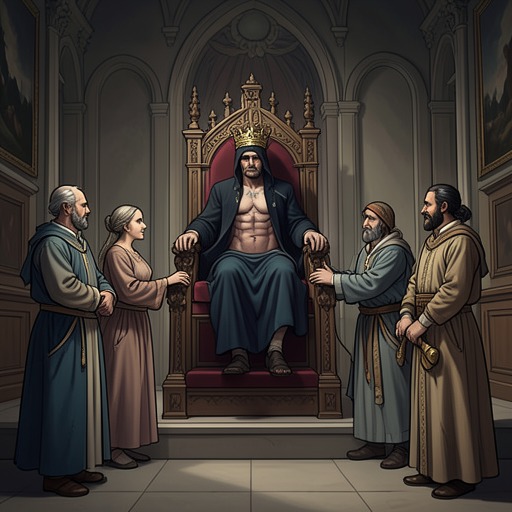
King Zutaar appears as a physically imposing Darrenkar monarch, a hulking man more than seven feet tall with pale-gray skin, silver-white hair, and sharp silver-gray eyes. Seated on a grand marble-and-gold throne, he assesses Erdal as though the prisoner were an animal being bought at a bazaar. His posture and expression communicate haughtiness, while his eyes carry a disturbing gleam of madness. The description makes his body part of his authority: size, armor, throne, and stare combine into a spectacle designed to overwhelm anyone brought before him.
His rule is openly conditional and lethal. When Gezek explains that Erdal is the most experienced gladiator in the arena, known there as DeathRaze, Zutaar does not respond with recognition of Erdal’s personhood or history. Instead, he orders that Erdal be tested on the training ground and kept only if he can please the king; otherwise, the guards are to kill him. The command exposes the logic of Zutaar’s court. Survival is not a right, and service is not a relationship of mutual obligation. A captive’s continued existence depends on whether his abilities satisfy the ruler’s immediate appetite.
Erdal survives the initial judgment because Zutaar values his fighting skills, but survival brings no dignity or real security. Erdal is placed at the lowest rank of the King’s Royal guard. Even this apparent reprieve is another form of ownership: Zutaar converts a defeated gladiator into a weapon of the throne, granting him life only within a hierarchy controlled by the king.
Treatment of Natalie
Zutaar’s predatory authority becomes most explicit when Erdal brings Natalie before him. Erdal orders her to kneel, and she is forced to remain below the few steps leading to the throne while Zutaar examines her. His unfamiliar appearance already frightens her, but the king’s gaze is more disturbing than his physical form. He looks over her with cold, lewd interest, making her feel exposed and objectified while she struggles not to look up at him.
Zutaar praises Erdal for bringing Natalie and calls her a fine piece of work. The language of approval treats her as an acquisition rather than a human being, while his satisfaction confirms that Erdal’s value in the royal guard includes delivering people to the king’s attention. Natalie’s trembling, tears, and intensified heartbeat show the personal cost of this system from below the throne: Zutaar’s court is not merely authoritarian in principle; it produces immediate bodily terror in those subjected to it.
The king’s interest in Natalie also creates the contradiction that destroys his control over Erdal. Erdal is expected to act as Zutaar’s instrument, yet Natalie’s vulnerability awakens his protectiveness. His emotional response becomes visible in physical signs—clenched jaw, fists, and constricted chest—even before he fully understands why he cares about her. Zutaar’s attempt to possess Natalie therefore generates the loyalty that will eventually turn against him.
Punishment and the Order to Kill
Zutaar discovers that Erdal has not remained emotionally detached from Natalie. The discovery provokes fury rather than reflection. He demotes Erdal by almost three levels and orders him to kill her. The punishment is deliberately disproportionate, demonstrating that the king treats personal attachment as disobedience and compassion as a threat to royal discipline.
The order also reveals Zutaar’s method of maintaining power. He does not need to kill Natalie himself to assert ownership over her fate. By commanding Erdal to become her executioner, he attempts to force the guard to prove that royal authority is stronger than love, conscience, or personal loyalty. The command is therefore both a death sentence and a loyalty test. It demands that Erdal erase the very person whose suffering has exposed the moral emptiness of Zutaar’s regime.
Zutaar’s authority depends on the expectation that orders will be obeyed before they are judged. His court offers no meaningful appeal, and the threat behind every command is implicit in the earlier instruction to kill Erdal if he fails to satisfy the king. Yet the order against Natalie produces the opposite result: instead of securing Erdal’s obedience, it clarifies the stakes and turns the king from a distant oppressor into the direct enemy of Erdal’s chosen responsibility.
Exposure and Throne-Room Defeat
The final confrontation begins when Erdal returns with Ornek Zorlu and removes his hood before Zutaar. He demands to know where Natalie is, naming the king directly rather than addressing him through a title. Zutaar responds with mockery, likening Erdal to a rat that has left its hole. His sneer shows that he still interprets resistance through the language of vermin and domination; even at the moment of danger, he assumes that ridicule and command will preserve the hierarchy.
Ornek then identifies himself as the Royal Guard of King Bu’Rak Rezan Urquiorra and declares that Erdal is the rightful heir. This revelation changes the confrontation from a guard’s rebellion into a challenge to Zutaar’s political legitimacy. Zutaar’s expression shifts, but he answers the revelation with another command to violence: he orders the guards to take Erdal and Ornek to the yard and behead them.
The order fails immediately. Ornek unsheathes his katana and kills the guards who approach him, then defeats Gezek by parrying his attack and cutting his throat. Erdal advances toward the throne over the bodies, with rage surging through him. Zutaar’s guards, rather than protecting the king, become the first visible casualties of the collapse of his authority.
Zutaar attempts to fight, but Erdal overwhelms him. Erdal cuts off one of the king’s arms while declaring that the wound is for hurting Natalie. As Zutaar retreats and screams, he falls backward on the steps of the throne. Erdal then raises the Light-Shard and states that the final act is for his father and mother before plunging the blade into Zutaar’s chest. The weapon severs Zutaar’s dark heart, and the king convulses before dying as light leaves his cold gray eyes.
Legacy and Narrative Function
Zutaar’s death is both personal revenge and political reversal. Erdal kills him for Natalie’s suffering, but also for the destruction of Erdal’s parents and the usurpation of the royal line. The reasons are deliberately layered: the king is punished as an abuser, a murderer, and a false ruler. The throne room, once the place where Zutaar reduced others to kneeling objects, becomes the site where his own body is forced backward onto the steps and his power is physically cut apart.
The aftermath emphasizes the contrast between Zutaar’s treatment of Natalie and Erdal’s response to her condition. Erdal finds Natalie unconscious on the dark floor, pale and barely alive, then carries her to the sickbay with tears rolling down his cheeks. Where Zutaar looked at her as property, Erdal treats her as someone whose life must be preserved. This contrast supplies the clearest moral measure of the king’s character and makes Zutaar’s defeat more than a change of ruler: it is the rejection of his system of possession.
Zutaar functions as a threshold guardian in the story’s succession and rescue structure, but in inverted form. He guards a stolen throne, controls access to Natalie, and tries to force Erdal into obedience; yet each act of control exposes the weakness of a regime founded on fear. His commands create the rebellion that defeats him, and his insistence on treating people as objects leaves him unable to understand the loyalty, grief, and rightful inheritance that finally converge against him.