Libba Ross
The Vampire Prince’s BrideLibba Ross is a twenty-seven-year-old human whose defining trait is persistence under pressure. Abducted by the alien Din for use in scientific experiments, she begins as a captive stripped of control over her body and circumstances, yet repeatedly converts fear into action. Her arc moves from imprisonment and frustrated uncertainty about her future toward escape, pregnancy, and a deliberate commitment to Brask and their child. Libba’s significance lies in the contrast between the systems that treat her as genetic material and the choices through which she insists on remaining a person, a partner, and an agent in her own life.
Identity and Background
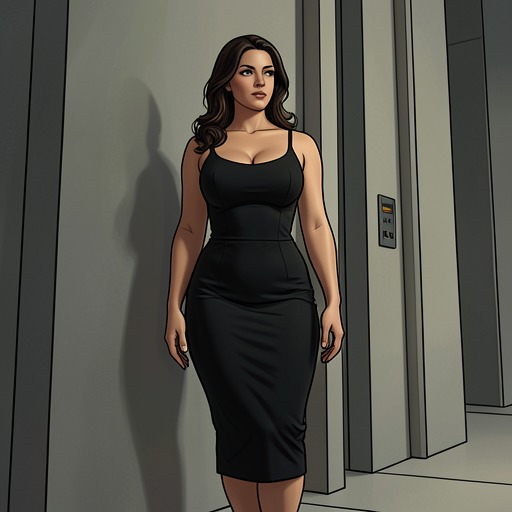
Libba is introduced as a woman who has not found a stable professional or domestic direction. At twenty-seven, she believes she should already be progressing in a chosen career, perhaps with a husband and child, but she does not know which field can hold her interest. She has earned three Bachelor’s degrees without discovering a vocation she wants to pursue permanently. On the day of her abduction, she receives acceptance letters to three Master’s programs—two in the United States and one in London—yet the options deepen rather than resolve her uncertainty. She recognizes that remaining a career student while drowning in debt is no longer sustainable.
Her uncertainty does not mean passivity. Libba drives into the countryside and hikes up a mountain alone, despite other people’s assumptions that her size makes her inactive. She enjoys strenuous physical activity, and the expedition becomes the setting for her abduction when she hears giant wings and sees a dragon diving toward her. The circumstances establish a sharp irony: a woman worried that she has failed to move forward is suddenly removed from Earth and forced into the most consequential transformation of her life.
Captivity and Resistance
Din abducts Libba as part of a wider pattern of women disappearing from Earth. The missing women initially include homeless women and prostitutes, but the disappearances expand to college students and women working ordinary service jobs. Din openly reduces Libba to her body, claiming that her extra layer of fat will provide more genetic material for his experiments and even imagining a daughter named in honor of her sacrifice. The language exposes the scientific project as bodily exploitation rather than neutral research.
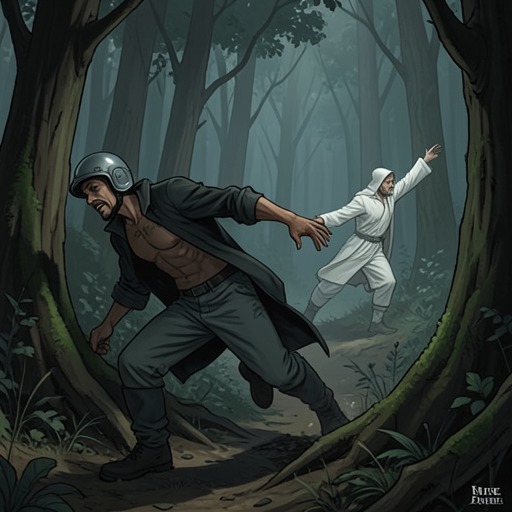
Libba answers that reduction with direct physical resistance. After Din’s provocation, she strikes his nose, knees him between the legs, pulls his head down by the ears, drives her knee into his face, and finishes with an elbow to the back of his neck before running from the room. She has taken up kickboxing to tone her body, but the skill suddenly becomes an escape tool during an alien abduction. Although two armed guards block her path and make the confrontation unequal, the attempt confirms that her refusal to surrender is practical as well as emotional.
Her resistance is also represented as a repeated identity. The narration explicitly defines her as “no quitter,” and that description becomes a principle she later applies to Brask’s danger rather than only to her own captivity. The story therefore makes persistence more than a personality label: it is the mechanism by which Libba refuses the roles imposed on her as experimental subject, runaway captive, or disposable human woman.
Brask, Pregnancy, and Choice
Brask is an alien dragon and a Justice Warrior whose work includes rescuing humans from horrific scientific experiments. His mission brings him into Libba’s story as the counterforce to Din’s exploitation, but their relationship develops beyond a simple rescue plot. Brask’s arrival interrupts the logic that has treated Libba as material for someone else’s project and opens the possibility that her reproductive future might be negotiated rather than seized.
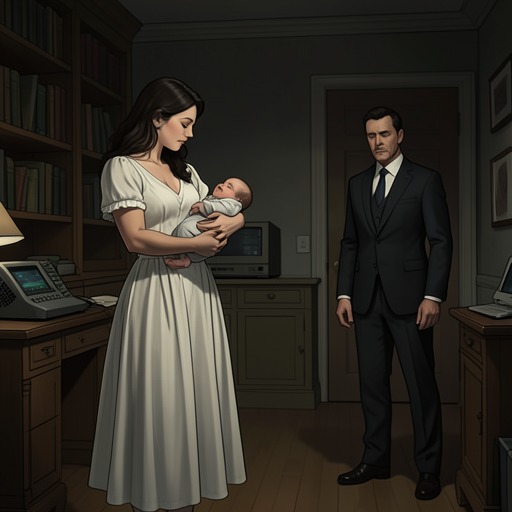
Libba’s decision to become pregnant is presented as complicated, sudden, and nevertheless conscious within the evidence available. After the abduction, she considers that becoming a mother might give direction to a life in which she has struggled to choose a path. She tells Brask, “Okay. Okay, this is really weird and bizarre, but what the hell. I've been wanting to figure out what to do with my life. I might as well be a mom. So let's make babies.” The choice does not erase the coercive environment around her; instead, it creates a tension between reproductive freedom and the circumstances that have made pregnancy possible. Libba is not merely returned to an ordinary human future. She chooses motherhood inside an alien political and biological world, after her body has already been targeted by scientific power.
Her commitment becomes clearer when Brask fears that returning to his homeworld could place both him and the pregnancy in danger. He warns that the pregnancy may be terminated and offers Libba the possibility of leaving him to avoid the crosshairs. Libba rejects that separation with the same language that defined her escape: “Like hell I'm leaving you,” she says, insisting that Libba Ross does not quit and that she will not allow harm to come to Brask or their baby. Her decision makes loyalty an active form of resistance. She does not simply accept protection; she chooses shared risk.
Cross-Species Body and Technology
Libba’s pregnancy is examined through technology that makes the boundary between human, alien, and engineered life visible. In Zon's medical bay, advanced scanners press nodules against her abdomen and construct a three-dimensional holographic image of her uterus. The embryo appears neither recognizably human nor conventionally baby-like, but as a disturbing mixture of tadpole and dinosaur. Libba nevertheless understands that the unfamiliar form will develop into a child. The scene turns scientific visualization into a confrontation with otherness: the image is strange, yet her response is protective and interpretive rather than rejecting.
The wider account of Stlozyn biology gives this pregnancy a larger context. Shay explains that Stlozyn ancestors were humans taken from Earth centuries earlier, with certain genes made more pronounced and additional DNA strands added to their genetic code. That altered inheritance permits shape-shifting, compared in the explanation to a mimic octopus changing its coloration. Libba’s story thus participates in a world where species boundaries are historical, technological, and relational rather than fixed. Her pregnancy is not only a private development; it belongs to a narrative preoccupied with hybrid bodies, modified ancestry, artificial scientific intervention, and the possibility that human identity survives transformation without remaining biologically pure.
Relationships and Narrative Significance
Libba’s relationship with Brask is defined by reciprocal protection. Brask begins as the Justice Warrior rescuing a vulnerable human from Din, but Libba refuses to remain only the rescued party. When Brask is threatened, she claims responsibility for him and for their child, turning the rescue relationship into a partnership. The pregnancy intensifies that bond while also exposing its risks: their connection may place them in political danger, and returning to Brask’s world could threaten the child’s survival.
Her story also resonates with other figures whose bodies or identities cross imposed boundaries. Ella receives the Draco’s Eye when Darilth explains that the blue stone recognized her as his destined mate; Sara uses removable bionic eyes as concealed stun grenades; Cheryl rejects the expectation that she must belong separately to one king and instead requires Bjorn and Maskin to remain together with her; Teresa learns that Kinai Joining is a guarded cycle involving adults and the hatching of beastlings. These parallel episodes place Libba within a larger narrative pattern in which bodies, reproduction, technology, ritual, and partnership determine social belonging. Unlike systems that assign a woman a role from above, Libba’s defining gesture is to speak and act as though participation must include her consent.
Libba’s trajectory combines the plots of escape, rescue, discovery, transformation, and love. She begins behind shining walls, bruised fists, and despair, but the story refuses to let captivity become her final definition. She fights Din, accepts an unexpected future, stands by Brask when separation would be safer, and carries a child whose visible form challenges human assumptions. Her identity remains grounded in human experience while becoming inseparable from alien justice, cross-species reproduction, and technologically mediated embodiment. Libba Ross is therefore not important because captivity makes her exceptional; she is important because, in every system attempting to decide what her body is for, she continues to decide what she will do next.