Lisa
The Vampire Prince’s BrideLisa is a human scientist from Earth whose abduction turns a life devoted to research into an encounter with the far future. Taken from 2016 while investigating how geo-nuclear radiation might alter human DNA, she is sold as an unknown species because her body carries what later societies call universal DNA. Her story links scientific curiosity, bodily violation, interspecies kinship, technological transformation, and the recovery of a lost human history.
Identity and Abduction
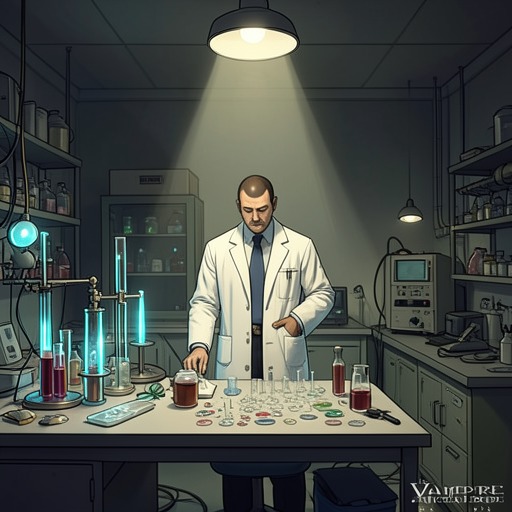
Lisa is introduced at the alien auction as a captive rather than a person. She remembers working late in her laboratory because the survival of her research grants depended on results concerning geo-nuclear radiation from deep inside Earth’s core. A rumble interrupts that work; afterward, she awakens in an alien facility, naked and freezing, where green, winged captors examine her, inject her, and confine her with cuffs and a collar. The auctioneer presents her as a specimen from an undiscovered species found aboard a primitive vessel traveling at light speed, emphasizing her intelligence and possible compatibility with most species while treating her equally as potential companionship or food.
The auction makes the violence of her displacement explicit. Lisa understands that she is being sold like an animal, and the possibility of becoming either a sex slave or something to be consumed reduces the futuristic marketplace to a system organized around the ownership of bodies. Her rescue is itself morally complicated. When she kicks an alien guard in the face, a red-skinned warrior kills the creature with a sword, cuts through the energy cage, severs Lisa’s chain, and throws her over his shoulder. He then offers six hundred to the auctioneer, formally purchasing the woman he has just freed from immediate danger. The scene therefore does not erase the logic of commodification; it carries Lisa from one form of captivity into a relationship whose meaning must later be renegotiated.
Human Origins and Far-Future Identity
Lisa’s discovery that she is human changes the scale of the story. She eventually tells Zon that she is from Earth, explaining that she was born in 1987 and taken in 2016, when humanity had only recently reached the Moon in 1969. The realization that Earth and its people have become ancient history leaves her confronting the loss of home, civilization, and temporal belonging. Her universal DNA is not an accidental scientific curiosity: it is evidence of the deep ancestry shared by the many species that developed after humans were scattered from Earth.
The book reinforces this revelation through Tom, Lisa’s son. Tom explains that his mother is human and that she was among the first humans discovered. He describes human DNA as a common genetic foundation beneath the additional genetic material of other species, making human women capable of carrying children from multiple species. Lisa’s body thus becomes both personal evidence and historical archive. What the future treats as a mythical or extinct people survives through her, through Tom, and through the biological compatibility that links apparently separate species.
Lisa’s encounter with advanced technology also reverses the direction of scientific authority. She is fascinated by holographic tablets, scanning goggles, and molecule breakdown stations that deconstruct waste into atoms and reform those atoms into needed materials. In the medical bay, she struggles to remain still while a scanner presses nodules against her abdomen and constructs a three-dimensional hologram of her uterus and embryo. The image is alien in appearance, resembling a mixture of a tadpole and a dinosaur, yet Lisa recognizes the developmental process. Her scientific training allows her to interpret the unfamiliar rather than merely fear it, preserving her agency inside a civilization that initially treats her as an object.
Pregnancy, Love, and Family
Lisa’s pregnancy with Zon’s child gives her human identity an immediate future. Genetic scans confirm that the embryo carries T’shav DNA, relieving Lisa even as Zon worries about whether the pregnancy will reach term. The pregnancy is not presented as a simple biological miracle. It follows her earlier classification as a universally compatible specimen and places her body at the intersection of reproduction, species continuity, and political ideas about human usefulness. Yet Lisa’s response remains personal: she holds Zon’s hand, studies the developing child, and embraces the pregnancy as the beginning of a shared life rather than as evidence for an abstract theory.
Her relationship with Zon moves from coercive circumstances toward chosen attachment. The auction begins with him acting through a purchase and a violent rescue, but Lisa later tells him that she loves him and wants to remain with him for the rest of her life, regardless of whether their connection can be explained by the Starmate bond. Her declaration gives her a voice that the auction denied her. She is no longer merely a body categorized by buyers, doctors, or genetic systems; she becomes the person who names the relationship and chooses its continuation.
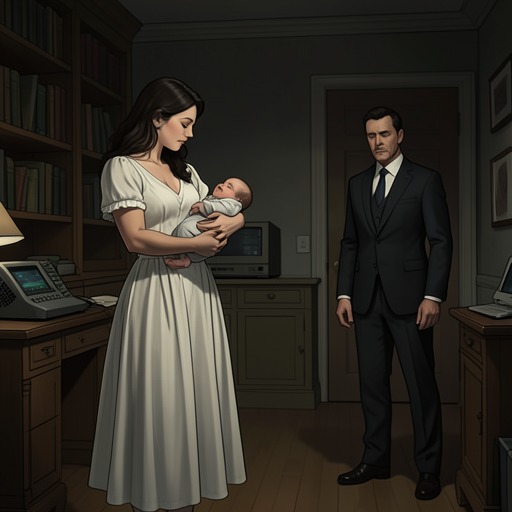
Lisa also enters the family formed by Zon and Tom. Tom describes his parents as intensely and visibly in love, and Lisa later witnesses that affection directly when Zon and Lisa visit her room. Zon carries their grandson, while Lisa and Zon put their arms around each other with an ease that still resembles the beginning of courtship. Lisa’s presence within this family is therefore not only reproductive. She becomes part of a domestic structure that connects human history, T’shav inheritance, and an intergenerational future.
The child, Alex Tang, embodies that crossing. Born healthy and robust less than a standard month before the later sanctuary scene, Alex resembles Tom except for his blue eyes, the color Lisa’s eyes had before her accident. The detail makes inheritance visible as both continuity and difference: the child bears the appearance of his father’s species while retaining a conspicuously human maternal trace. Lisa’s motherhood is consequently a living counterargument to the idea that humanity disappeared without remainder.
Resistance and the Human Sanctuary
Lisa’s vulnerability never exhausts her capacity for action. During a confrontation, she removes one of her bionic eyes and drops it into the corridor as a grenade. Tom sees the device detonate in a flash and high-pitched sound, stunning the attackers. Lisa explains that bionic eyes are useful for smuggling explosives, though these are only stun grenades. The incident transforms a body modification that might otherwise be read only as damage or medical replacement into a tactical resource under her control.
Her resistance is connected to rescue rather than isolated survival. Tom reports that the last group of humans has been awakened and that the total population now numbers 572. They were abducted between 2000 and 2100, making Lisa and Lisa’s son among the earliest humans taken from Earth. The survivors have begun constructing infrastructure, and Lisa recognizes the terror of beginning again while insisting on the persistence of human spirit. Her concern is not limited to whether the rescued people remember their abductions; she understands that rebuilding a community is itself an act of historical recovery.
When Zon and Lisa prepare to go down to the sanctuary, Zon asks whether she has messages for the humans she helped save. Lisa has no message at that moment, but the question establishes her as one of the people responsible for their rescue and future. Her contribution is practical, bodily, and political: she survives the auction, helps secure human lives, and becomes part of the family overseeing a refuge for a species believed to be extinct.
Narrative Significance
Lisa’s arc repeatedly unsettles fixed boundaries: human and alien, natural and technological, captive and partner, scientific subject and scientific observer, mother and historical survivor. Her bionic eyes are weapons; her universal DNA is a biological bridge; her pregnancy with a T’shav child turns supposed incompatibility into kinship; and her passage through the auction exposes how easily advanced technology can coexist with primitive ownership. The novel’s futuristic estrangement therefore does not make Lisa less human. It makes the category of humanity relational, embodied, and open to transformation.
Her significance also lies in the contrast between how institutions see her and how relationships come to see her. The auctioneer identifies a specimen, the captors handle a research body, and the genetic system values compatibility. By contrast, Zon recognizes a mate, Tom recognizes a mother, and the sanctuary recognizes a member of a returning people. Lisa’s story does not deny the danger of these biological and emotional bonds, but it gives her increasing authority within them. She ends not as an artifact recovered from a vanished Earth, but as a scientist, partner, mother, and participant in the rebuilding of humanity.