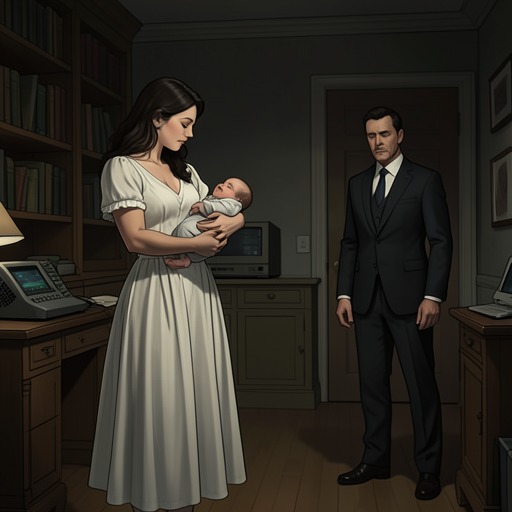
Lisa's Pregnancy Discovery
The Vampire Prince’s BrideLisa's Pregnancy Discovery is the turning point at which recurring sickness becomes a fact with biological, emotional, and strategic consequences. After Zon rescued Lisa from the traders, she began vomiting repeatedly, and the episodes continued even after the immediate stress of captivity and escape should have eased. The discovery confirms that her body is not merely recovering from abduction or teleportation: it is sustaining a pregnancy whose existence challenges the assumptions surrounding human rarity, alien biology, and the risks of their hidden refuge.
Causes and Immediate Context
The discovery begins with Lisa's repeated morning sickness. The next morning—or what she believed was morning in the disorienting conditions of concealment—she threw up into the nearest container until she was weak and shaking. Zon held her hair back and rubbed her back, a routine that had developed since he rescued her. His concern sharpened because the nausea did not fit his initial explanation. He had believed that stress might account for the first episodes, but the persistence of the illness suggested that something more serious had happened.
Lisa herself tried to supply ordinary explanations, wondering whether the food was responsible or whether her system simply could not tolerate it. Zon rejected the reassurance that she had been fine before. He carried her back to bed, cleaned up the vomit, and proposed an immediate medical scan. The decision carried a danger of its own: the obsolete equipment in the hideout emitted radiation that could be detected from space, potentially revealing their location to the traders or other pursuers. Medical care therefore became part of the concealment problem. The pregnancy was discovered within an environment where even diagnosis could expose the patient and her rescuer.
The Scan and Recognition
Zon used a wand-like medical scanner connected wirelessly to a small tablet. The device beeped as he passed it over Lisa, and his frown deepened while he studied the results. At first, the scan appeared to identify a parasite. The equipment registered a lifeform attached to Lisa's uterine wall, feeding from her and altering her hormone production. That reading made the condition sound like an infection or an invasive organism rather than a child, and it explains why Zon initially feared that the traders—or the teleportation process—might have done something to her.
The wording about the uterine wall changed Lisa's understanding immediately. She realized that she had stopped thinking about her menstrual cycle since waking in the alien future and asked how long they had been in hiding. Zon answered that ten standard weeks had passed. Lisa then tested the larger biological question: whether all species shared DNA, whether interbreeding was possible, and whether their gestation periods were comparable. Zon did not answer at once. His wide-eyed silence, followed by his visibly paling as he entered further commands into the tablet, became part of the revelation before he stated it directly.
The result was precise. The average pregnancy among the known species lasted seventy-two standard weeks, while Lisa was already eight standard weeks pregnant. The diagnosis reframed the parasite reading: the lifeform was an embryo attached to her uterine wall, not an organism exploiting her body without reproductive meaning. Lisa's immediate response was the fear that she might vomit again, linking the shock of recognition to the physical symptom that had first concealed the pregnancy.
Confirmation and Cross-Species Biology
Zon still needed to establish that Lisa was pregnant rather than carrying a parasite. A more advanced examination was conducted aboard his ship, where the medical technology could scan her midsection in greater depth. Small nodules placed against her exposed belly constructed a three-dimensional holographic image of her uterus. Lisa was fascinated by the surrounding technology—holographic tablets, wall-scanning goggles, and molecule breakdown stations—but her curiosity had to yield to the examination while she lay still for the doctor.
The hologram made the pregnancy materially visible. The embryo did not resemble a human baby; at that stage it looked to Lisa like a disturbing mixture of a tadpole and a dinosaur. Yet the doctor’s imaging established that it was developing inside her uterus, and Lisa recognized that an embryo at this stage would eventually become a child. The scan thus moved the discovery beyond verbal inference. Her altered body became an observable site where human expectations and alien medical knowledge met.
The broader biological explanation appears elsewhere through Shay's account of the Stlozyn. Shay explains that Stlozyn ancestors were humans taken from Earth centuries earlier. Their descendants were genetically altered not by wholesale redesign but by making certain genes more pronounced and adding DNA strands that enabled shape-shifting. This account provides a framework for Lisa's pregnancy: the apparent boundaries between human and alien subspecies are historically constructed and genetically porous rather than absolute. The pregnancy is therefore not only a private surprise but evidence that the species of the galaxy remain connected to humanity in ways that official categories obscure.
Consequences for Lisa and Zon
The discovery changes the practical relationship between Lisa and Zon. Before the scan, sex had functioned as one of the few forces capable of distracting Lisa from the wreckage of her life. After the diagnosis, intimacy is inseparable from its consequence: she is carrying Zon's child while both remain vulnerable to capture. Zon becomes not only her rescuer and companion but also the person responsible for interpreting the medical danger, arranging further examination, and confronting the possibility that the pregnancy may have been affected by teleportation, radiation, or the traders' actions.
The timing intensifies the danger. Lisa has been hidden for ten standard weeks, and the pregnancy is already eight standard weeks along. Zon fears that a scan may alert their enemies, yet he also believes that failing to investigate could leave a serious condition untreated. His care is therefore divided between protection and surveillance: he holds her hair, rubs her back, cleans the container, carries her to bed, and then risks detection to obtain medical certainty. The pregnancy turns bodily vulnerability into a shared crisis that neither can safely ignore.
The revelation also places Lisa's human identity in a larger system of exploitation. She knows that humans are rare and expensive commodities, and she has already learned that technological advancement does not guarantee social progress. The pregnancy gives those facts a new edge. If her captors discover that she is not merely human but pregnant, her body could become even more valuable to systems that treat reproduction as property. The discovery consequently raises the stakes of concealment without requiring any new external attack: Lisa's body itself now contains information that hostile institutions would have reason to seize.
Narrative Significance
As an action, Lisa's Pregnancy Discovery is structured around delayed recognition. Nausea is first treated as a residue of trauma, then as a dietary problem, then as a possible reaction to teleportation or tachyon saturation, and finally as the bodily sign of pregnancy. Each explanation is plausible within Lisa's extraordinary circumstances, so the recognition arrives through accumulation rather than a single obvious sign. The medical scanner, initially a tool of uncertainty, becomes the instrument that converts an apparently parasitic lifeform into an embryo and a future child.
The event also joins several of the book's recurring boundaries: human and alien, natural and technological, rescue and captivity, intimacy and danger. Lisa's bionic eyes can be weaponized as stun grenades, while the scanner can both save her and expose her location; elsewhere, the Draco's Eye identifies a destined mate and the Fifth Cycle Festival reduces a woman to a ritual prize. Against these contrasting uses of bodies and objects, Lisa's pregnancy is both a biological event and a contested claim to personhood. It gives her a future that hostile traders might commodify, while making the hidden life she is building with Zon impossible to regard as temporary or consequence-free.