Lola
The Vampire Prince’s BrideLola’s decisive significance lies in the way her story turns inherited exclusion into self-authored belonging. Born into a wealthy witch family but denied affection by her parents, she begins as a young woman convinced that she is peripheral to every life that matters. Her passage through the vampire Fort, her pregnancy, and her eventual transformation do not erase that history; they become the circumstances through which she claims a family and future on terms different from those imposed by her mother.
Identity and Background
Lola is a young witch from a long line of witches, raised amid wealth, celebrity, and emotional neglect. Her parents are described as filthy rich, stuck-up, and self-centered, while Lola grows up deprived of affection and accustomed to seeking love by pandering to her mother. The family’s power is hereditary but unevenly distributed: the witch gene skips a generation, so Lola inherits the capacity for magic while her mother does not. The non-witchy generation instead receives the ability to predict the future, a gift that helped her mother become successful, although she refuses to acknowledge that supernatural source publicly.
Her mother’s public identity intensifies Lola’s private exclusion. The older woman is an actor, former top model, philanthropist, member of New York’s elite, and trophy wife to the business tycoon Richard Windsor. She claims to protect her personal life and keep her only child out of the spotlight, but Lola understands that the real purpose is to prevent attention from settling on her. Lola and her mother resemble sisters more than mother and daughter, yet the mother is treated as the beautiful one, and Lola is made to feel physically and socially inferior. Designer dresses and shoes are offered only as reminders that Lola should lose weight before wearing them.
The family home therefore functions less as a refuge than as a theater of exclusion. During parties, Lola is kept in her room while singers, actors, and other celebrities occupy the rooms across the hall. At the opening of her story, after her father’s death, even grief is absorbed into her mother’s performance. A copy of People magazine presents the funeral through photographs of her mother’s custom Giovanni mourning dress, barely acknowledging Richard Windsor himself. Lola recognizes that the spectacle belongs to her mother, not to the dead man or the daughter left behind.
Entry into the Vampire World
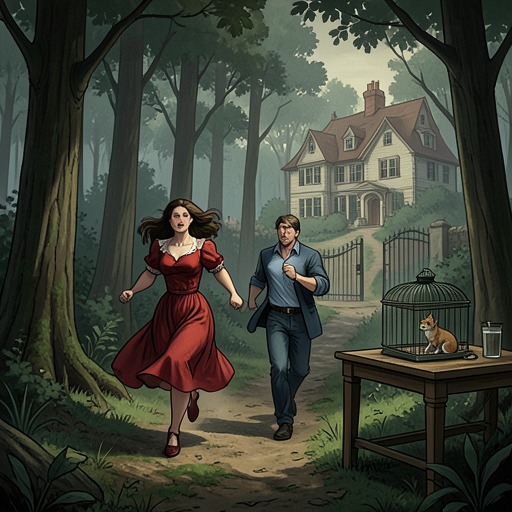
Lola’s encounter with Valnoir begins as an apparently ordinary meeting with a stranger. He introduces himself by name, calling their meeting a pleasure and describing himself as English despite the French-sounding name. The encounter becomes the threshold into a hidden society when Valnoir takes her to the vampire Fort and informs her that the relevant destination is the Harem. What seemed like a brief attraction becomes captivity, danger, and a confrontation with a world whose rules Lola does not understand.
Her first response is resistance rather than passive acceptance. Once dressed, she struggles as Valnoir grabs her arm and attempts to take her downstairs. She tries to remember whether her grandmother taught her a spell for dealing with vampires, recognizing that her mother’s discouragement of witchcraft has left her unprepared. This moment links Lola’s emotional deprivation to a practical loss of agency: the knowledge that might have protected her was withheld or neglected, and she enters the Fort without the tools that her ancestry could have provided.
The Fort also gives Lola a new, unsettling context for her body and her future. She is drawn into the question of an “improbable pregnancy,” and Lady Mary leads her through the lavish corridors to a room where another woman awaits. The pregnancy is not merely a private medical fact; within the Fort’s harem system, it is bound to lineage, reproduction, and the political economy of vampires. Lola’s movement through its corridors is consequently both literal and social: she is being moved from the world of her mother’s polished rejection into a structure that seeks to define her through her reproductive potential.
Pregnancy and Self-Determination
The pregnancy revelation becomes the clearest turning point in Lola’s relation to her mother. After speaking with her grandmother, Lola reaches a simple but powerful conclusion: she is not her mother and will not become her. The statement rejects the family pattern in which a woman’s worth is measured through appearance, status, spectacle, or the approval of a powerful partner. It also marks Lola’s first sustained act of self-definition, because she chooses to treat the pregnancy as the beginning of a new chapter rather than as another instrument controlled by the family around her.
She leaves the Fort for the first time in weeks and takes practical control of what happens next. She goes to a pharmacy for a pregnancy test, returns to her apartment, and waits for the result while hoping intensely that it will be positive. When the test confirms the pregnancy, she resigns from her hospital job and arranges an ultrasound. The scan makes the future concrete: the doctor spreads gel across her stomach, moves the scanner over her body, and points out the baby on the screen.
Lola then tells Valnoir directly that she is pregnant, adding that the women around him had been right. His shock shows that the disclosure changes the terms of their relationship, but Lola does not retreat from the fact. She states that the pregnancy is early while insisting that it is definite. Her body, previously judged by her mother and treated as part of a family image, becomes the source of a decision that Lola announces in her own words.
Transformation and Relationship with Valnoir
Valnoir is a three-hundred-year-old vampire prince whose initial motivation is connected to concern over the Fort’s blood supply, yet his relationship with Lola develops beyond that institutional setting. Lola’s account presents him as a man who has lost his zest for life, while she begins as someone who has never believed she could be truly special to another person. Their connection therefore joins two forms of emotional absence: his exhaustion with an ancient existence and her deprivation of ordinary familial love.
Their relationship also crosses the boundary between human and supernatural existence. By the end of Lola’s arc, she is described as Valnoir’s newly turned vampire companion as well as the mother of his child. The transformation makes her body a site of literal hybridity: she remains the Lola formed by witch inheritance and family injury while becoming part of the vampire world that once held her captive. The change is not presented as a return to her mother’s world of artificial status. Instead, it accompanies Lola’s movement toward a chosen bond and a new social identity.
Valnoir’s proposal makes that chosen future explicit. He addresses Lola as the love of his life, the mother of his child, and his newly turned vampire companion, then asks her to marry him and be his wife for an eternity. Lola answers first with mock irritation, telling him to ask properly, and then accepts enthusiastically, saying that she has waited a long time for him to ask. The exchange turns the relationship from an arrangement shaped by captivity and pregnancy into an openly affirmed marriage proposal. Her final response is not submission to a role assigned by the Fort; it is an impatient, delighted acceptance of a future she has helped make meaningful.
Narrative Role and Thematic Significance
Lola’s plot combines the patterns of transformation, discovery, and love, but it reverses the emotional direction usually associated with a wealthy supernatural heroine. She does not begin with power secured by money, beauty, or lineage. Her inheritance isolates her from her mother, her wealth does not protect her from loneliness, and her proximity to celebrity only makes her exclusion more visible. The supernatural world initially appears to offer another system in which her body can be claimed, yet the story gradually gives her opportunities to leave, choose, disclose, and redefine herself.
Her story also participates in the book’s recurring crossing of human, magical, technological, and nonhuman identities. The surrounding narrative treats bodies as changeable and relational: Darilth identifies Ella through the Draco’s Eye as his destined mate; Sara uses a bionic eye as a concealed stun grenade; Lisa’s pregnancy is examined through a three-dimensional medical hologram; and Shay explains that Stlozyn ancestors were humans whose genes and added DNA enabled shape-shifting. Lola’s own arc belongs to this larger pattern of unstable boundaries. Witch inheritance, pregnancy, vampiric transformation, and partnership with a vampire make identity something lived through the body and through relationships rather than something fixed by family reputation.
Most importantly, Lola’s ending answers the wound established at the beginning. The daughter who believed she had never been special to anyone rejects her mother’s model of emotional cruelty, leaves the Fort to make decisions for herself, accepts the reality of her pregnancy, and receives a proposal that names her as beloved, mother, companion, and future wife. Her significance is therefore not simply that she becomes a witch, a pregnant woman, or a vampire. She becomes the author of a new lineage, one built through acknowledged attachment rather than inherited status and through chosen love rather than the conditional approval that governed her childhood.