Lord Rezelith
The Vampire Prince’s BrideLord Rezelith is the King of Rothgar and the Elder of the Drakonaar, a ruler whose judgment turns a royal presentation into a scene of humiliation and coercion. His refusal to recognize Ella as Prince Darilth’s true mate does more than obstruct a marriage: it reveals the values governing his court. In his eyes, a prospective bride is chiefly a vessel for an heir, and a human woman with a visible genetic condition can be reduced to a slave when she fails that standard.
Identity and Courtly Position
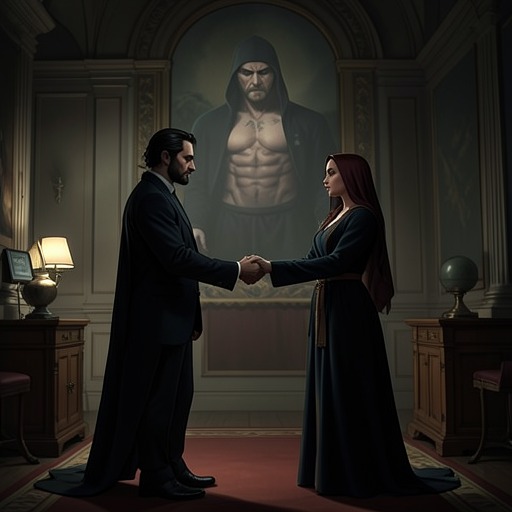
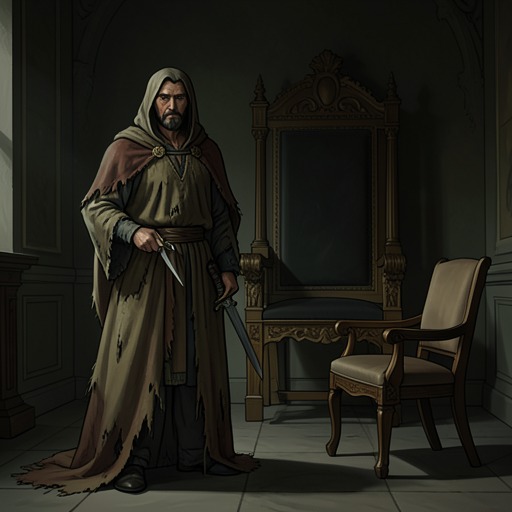
Lord Rezelith appears in the throne room as the sovereign father of Darilth and the central authority of Rothgar. He sits on a dark-stone throne in a hall framed by massive columns, armed guards, and windows looking onto a planet largely covered in ice. The setting reinforces his public image: the royal chamber is imposing and severe, while his demeanor is described as harsh and cold, matching the stone walls around him. A young man identified as Keralth stands beside him with a beautiful but drained-looking woman, creating a visual comparison that Rezelith later uses against Darilth.
His authority is both political and familial. Darilth bows before him and addresses him as Father, but Rezelith’s treatment of his son shows that blood relationship does not soften his rule. He speaks from the throne, interrupts Darilth, makes the final decision about Ella’s status, and dismisses his son with a wave of his hand. Even when Darilth pleads for reconsideration, Rezelith does not enter a genuine discussion; his power is expressed through unilateral judgment.
Rejection of Ella and the Draco’s Eye
Darilth introduces Ella as the woman destined to be his bride and explicitly identifies her as his true mate. Rezelith responds first by objecting to her humanity and then by focusing on her appearance. He says that Darilth has brought a human to the castle and declares that Ella is unlike the other humans he has seen. When Darilth explains that Ella has a genetic condition that makes her look different from her own kind, Rezelith treats that difference as evidence of inferiority rather than as a neutral fact.
The decisive standard Rezelith applies is reproductive usefulness. He tells Darilth that he needs a woman who can give him an heir and judges Ella as too weak to serve that purpose. His comparison with Keralth’s mate is deliberately political as well as personal: Keralth’s partner is praised as a strong, trained warrior, even though she could not awaken the stone. Rezelith therefore privileges physical strength and conventional suitability over the extraordinary sign that Ella has awakened the Draco’s Eye, an ancient power associated with the Drakonaar’s long-awaited true-mate tradition.
Darilth insists that the Draco’s Eye responded to Ella and argues that this confirms their bond. Rezelith silences him before he can complete the defense. The interruption is important because it shows that the king is not merely unconvinced by the evidence; he refuses to let the evidence alter the hierarchy of values by which he rules. The supernatural recognition of the true mate is placed below the king’s judgment of bodily strength, social usefulness, and dynastic reproduction.
The Slave-or-Death Decree
Rezelith’s rejection becomes an explicit threat when he orders Darilth to keep Ella as a slave or kill her, whichever pleases him. He refuses to permit the marriage and reminds Darilth that the prince remains in exile, allowing him to return only after finding a suitable woman. The decree joins personal cruelty to institutional power: Ella’s vulnerability is not merely the result of an insult but of a royal system capable of converting an unwanted bride into property.
The order also intensifies Darilth’s conflict with his father. Darilth had brought Ella to the castle despite expecting resistance because he believed that Rezelith would accept her after seeing that she had awakened the Draco’s Eye. Instead, the king’s response turns the homecoming into a betrayal. Darilth sees no kindness in his father, not even toward his own son, and associates the change in Rezelith’s character with the death of the king’s wife. Rezelith’s emotional hardness thus functions as both a personal wound within the family and a governing principle imposed on the kingdom.
Ella’s response clarifies the immediate consequence of Rezelith’s decision. Trembling and crying, she understands that the royal household may treat her as a slave. Later, she tells Darilth that he should marry a warrior princess rather than a weak human and asks him not to leave her in bondage. Her request to travel with him and work as a free woman is formed directly by Rezelith’s decree. The king’s attempt to define her as property produces the practical alternative she offers: freedom through continued association with Darilth rather than submission to the castle.
Family Conflict and Political Contrast
Rezelith’s relationship with Darilth is defined by obedience demanded from one side and moral resistance from the other. Darilth remains formally respectful, bows before the king, calls him Father, and asks him to reconsider. Yet his clenched jaw, whitening knuckles, and anger at the king’s humiliation of Ella show that filial deference has reached its limit. He recognizes that Rezelith is being unreasonable and that the decision violates the significance of a true mate who has awakened the ancient stone magic.
Keralth serves as an immediate contrast and a source of hostility within the throne room. Rezelith praises Keralth as intelligent and fortunate to have found a strong mate, then tells Darilth that he could learn from him. Keralth responds with a smug smile while looking at Ella, and Darilth wants to strike him. The exchange makes Rezelith’s comparison a form of political pressure: the king uses one son’s apparent conformity to shame the other for following a bond that the royal ideology cannot accommodate.
Rezelith’s authority is therefore sustained through comparison, exclusion, and conditional acceptance. Darilth may return from exile only with a suitable woman; Ella may remain only as a slave or be killed; Keralth is elevated because his relationship appears closer to the king’s model of strength and dynastic value. The family structure mirrors the wider social order, in which royal approval determines whether a person is recognized as a partner, a failure, or property.
Change, Limitations, and Narrative Role
The available scene does not show Rezelith changing his mind. His final statement is that he has made his decision, and the narrative presents that decision as settled rather than open to persuasion. His refusal makes him an institutional obstacle and a threshold guardian in Darilth and Ella’s story: he stands at the entrance to the royal world and denies them legitimacy when they seek recognition there.
At the same time, Rezelith is not portrayed as a supernatural force beyond human understanding. His cruelty is concrete and legible. He fears an unsuitable heir, values warrior strength, distrusts Ella’s weakness, and uses exile and slavery as instruments of control. The scene’s cold architecture and his repeated emphasis on suitability turn him into the human face of a rigid dynastic order. His significance lies less in physical action than in the consequences of his judgment: he transforms a sacred recognition by the Draco’s Eye into a political crisis, exposes the violence hidden inside royal marriage expectations, and forces Darilth to choose between paternal authority and responsibility toward Ella.