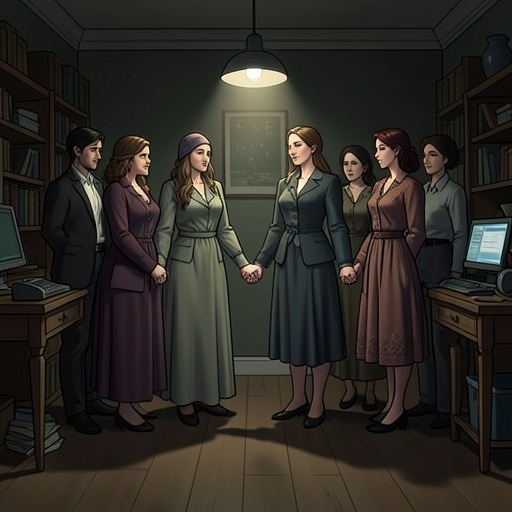
Mara
The Vampire Prince’s BrideMara is the Second Lieutenant of the Darkwing Squadron and the principal internal antagonist in Teresa’s transition from enslaved outsider to accepted member of Kinai society. Initially positioned within Kenner’s military unit, she becomes the most persistent voice insisting that Teresa is a danger to the community. Her opposition is not merely personal dislike: it evolves into an organized attack on Teresa’s legitimacy, Kenner’s judgment, and the cohesion of the Squadron itself.
Identity and Position
Mara appears at the departure from Wallaria as one of the people attached to the Darkwing Squadron, alongside twelve men and women built and dressed much like Kenner. Her presence is immediately uncomfortable for Teresa, who recognizes the hostility in the daggers Mara directs at her. Mara is not presented as a distant civilian critic; she belongs to Kenner’s command structure and therefore possesses enough standing to make her suspicions politically dangerous. Her military position gives her accusations an institutional force that ordinary prejudice would not have carried.
Her antagonism also places her in contrast with Teresa’s emerging freedom. Teresa, once treated as property, is trying to stand openly among the Kinai rather than hide from former masters or hostile witnesses. Mara represents the opposite impulse: she attempts to preserve Teresa’s outsider status by making suspicion permanent. The conflict therefore joins a personal rivalry to a larger struggle over whether Teresa can become a participant in Kinai life rather than remain defined by her former enslavement.
Escalation of Hostility
Mara’s campaign begins with snide comments after Kenner purchases Teresa, an act that costs him nearly half of all his assets. Because the entire Squadron is already teasing Kenner about the purchase, he initially dismisses Mara’s remarks as part of the general joking. That misreading allows the hostility to develop without immediate consequences. Once the Squadron reaches Kinai, however, Mara speaks with such fervent animosity that she openly accuses Teresa of being a spy.
Kenner shuts down the accusation harshly. He regards it as ridiculous and untrue, but also as a direct challenge to his authority as Squadron Commander. Mara’s conduct is thus dangerous on two levels: it threatens Teresa and tests the chain of command. Although Mara becomes more careful about displaying her animosity, she does not abandon it. Instead, she gathers like-minded people around her, and their words and actions become a continuing source of grief for Teresa, including more than one instance of minor damage or injury.
The campaign eventually spreads beyond Teresa herself. Mara agitates within the Squadron and begins to threaten the unit’s cohesion. Arul warns Kenner that she must be relocated, arguing that her jealous fits could bring about the group’s ruin. His explanation clarifies the emotional structure of Mara’s persecution: she has decided that Kenner belongs to her, regardless of reality, and treats Teresa’s relationship with him as an intolerable theft. Arul further states that Kenner and Teresa are effectively a married couple even though they have not yet formally married, while Mara refuses to accept the bond that has formed between them.
The Rookery Accusation
The crisis breaks open after Kenner and Teresa have enjoyed only three days of happiness as lovers. Mara returns early from a reconnaissance flight with Arul and immediately declares that Teresa told the Skatians about the Rookery. Her accusation is public, loud, and designed to turn communal anxiety into a mob judgment. Arul supplies apparently corroborating evidence: he and Mara saw kayaks attempting to reach the Rookery from the Ridgeside, and he then observed a Skatian ship whose main sail carried the symbols of Lady Esplyn’s House.
Kenner believes Teresa is innocent, but he cannot prove it. The accusation gains force because Teresa is a foreigner and because Kenner himself had taken her to the Isle of Ponds and told her about the Rookery. Mara reveals that fact to the assembled crowd, while the youngest Squadron member confirms that he and Mara had overheard Kenner explaining the route to Teresa. The information is therefore arranged to make Teresa appear to be the only possible informant, even though the narrative has not established that she knew enough to betray the Rookery.
Mara’s charge transforms suspicion into collective violence. She rallies supporters who seek to find Teresa and burn her as a witch, while Elder Fanag tries and fails to calm the crowd. Kenner is caught between his certainty that Teresa is not a traitor and his inability to protect her through proof. Mara’s success at this stage comes from converting incomplete evidence into moral certainty: Teresa’s foreignness, Kenner’s disclosure, and the Skatian ship are made to function as a single accusation.
Exposure and Downfall
Mara’s scheme collapses when Lady Esplyn’s testimony contradicts the story she has helped construct. After Mara calls the testimony lies and claims that Kenner must have paid Esplyn to perjure herself, Esplyn points out that Kenner could not afford such a payment and directs attention to her ship, which remains in the Kinai waters after Kenner dragged it onto the Obsidian Ridge. She insists that the crew can be questioned. This detail gives the accusation a verifiable external source and breaks the closed circle of Mara’s allegations.
Realizing that the plan has failed, Mara attempts to flee. The Blackwings stop her, and Kenner finally runs to Teresa’s side. The crowd now alternates between congratulating Kenner and Teresa and jeering at Mara as she is taken to the cages to await trial. The reversal is complete: the woman who tried to make Teresa a prisoner of public suspicion becomes the one physically confined by the community.
Lady Esplyn is questioned further and found to have been only Mara’s dupe, knowing nothing consequential about Kinai. Arul escorts her back to Wallaria, while also carrying gifts from Kinai craftsmen to the Emperor of Skatia as a diplomatic precaution. The aftermath distinguishes Mara’s manipulation from the actual political threat. Esplyn has been used, the Skatian connection is contained, and Mara is left responsible for the internal disorder she created.
Sentence, Death, and Narrative Significance
The Council concludes that Mara’s increasingly prominent instability resulted from a Joining that had not gone exactly right, although it had gone well enough for its cracks to remain hidden until this point. She is sentenced to death, but before the execution can take place, she hangs herself in her own home, refusing to bow to anyone until the end. Her death is therefore both a legal consequence and the final expression of the defiance that shaped her conduct. She does not reconcile with Teresa, submit to Kenner’s authority, or accept the community’s judgment.
Mara’s downfall clears the way for Teresa’s social and domestic future. After the immediate crisis, Kenner and Teresa reunite, later marry, and have twin children, a boy and a girl. The Elders respond by permanently lifting the restrictions that had governed Teresa’s life in Kinai and granting her permission to attempt a Joining in the following winter. Mara’s persecution thus becomes part of the chain of events through which Teresa’s freedom is formally recognized.
Mara functions as a distorted shadow of the belonging she claims to defend. She is a member of the Squadron who treats loyalty as possession, authority as personal entitlement, and uncertainty as evidence against a vulnerable outsider. Her accusations seem strongest when the community is frightened, but they fail once testimony and material evidence are examined. The character arc is consequently not one of repentance or transformation. It is a descent from guarded hostility into factional sabotage, public incitement, attempted flight, and death, while Teresa moves in the opposite direction—from exposed outsider to protected partner, accepted resident, wife, and mother.