Matheus Lindgern
The Vampire Prince’s BrideMatheus Lindgern is the current leader of the Lindgern vampire clan and the king of a civilization damaged by generations of war. He first appears as the son of Lady Jennifer Lindgern and the late Lord Alexander Lindgern, but his significance lies in the distance he tries to establish between his own reign and his father’s. Through Alice, he becomes the figure who attempts to convert inherited power into a more humane political order, even as his family, court, and enemies continue to measure him against the old empire.
Identity and Inheritance
Matheus is introduced through the courtly world of the Lindgern coven, where his mother presents Alice to him as the witch she has brought back for her son. His physical presence combines aristocratic beauty with martial authority: short golden hair frames an alabaster face, ivy-colored eyes stand out against his pale features, and a warrior’s build is carried with the composure of a lord. The description makes him seem almost sculptural, but his charm is active rather than merely ornamental. He approaches Alice with a warm smile and a deep, welcoming voice, creating an immediate contrast between his handsome public persona and the danger represented by his crimson-eyed kind.
His first exchange with Alice establishes both his confidence and his willingness to meet resistance with amusement. When she objects to the way he looks at her and tells him to look at her eyes rather than her body, he does not punish her insolence. Instead, he laughs at her spirit, calls attention to her “spunk,” and dismisses his mother so that he can deal with Alice himself. His proposal that she might become his bride is presented almost casually, but it reveals that he is already considering her not as a servant or captive accessory but as a possible partner in the royal household.
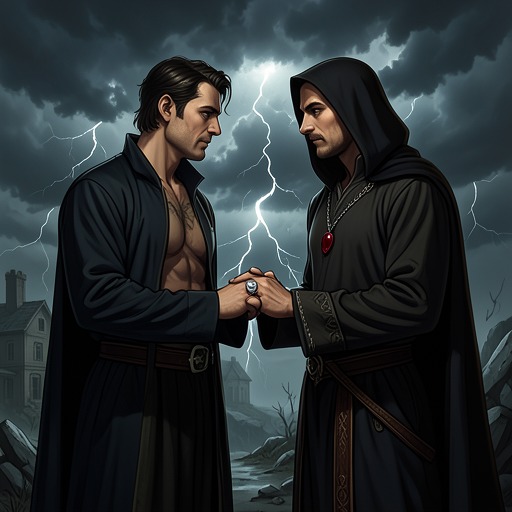
Matheus’s most important act of self-definition is his rejection of Alexander Lindgern’s legacy. He tells Alice that he is not his father and describes Alexander not as a legitimate king but as a warlord whose ambition was to conquer and destroy. Alexander’s campaigns ruined vampire civilization, intensified the distrust directed toward vampires, and left the species regarded as monstrous. The elder Lindgern’s assassination helped bring the wider war to an end, but the victory of the opposing kingdoms did not restore what the vampire empire had lost. Matheus therefore inherits both a throne and a historical indictment: his authority is inseparable from a past he did not create but must answer for.
Courtship and Lifemate Bond
Matheus’s relationship with Alice begins under conditions of distrust. She knows that his mother removed her from her home, understands the political appetite for vampire power, and suspects that Matheus’s gracious manner may conceal the same desire for status that defined earlier rulers. His flirtatiousness and intelligence make him more difficult to reject, not less dangerous, because he can appear kind while remaining a king with the ability to absorb her into his household.
He tries to answer that suspicion through disclosure rather than force. Matheus explains that vampires possess an innate ability to recognize potential mates and assess whether someone is suitable as a lifemate. Alice, as a non-vampire, does not experience the bond in the same automatic way, yet she admits that she feels something unusual between them. For Matheus, this admission confirms that the connection is not solely a royal calculation. His attraction to Alice is political—he values her intelligence, strength, and power—but it is also grounded in the vampire conception of a life mate.
His argument for Alice is notably different from a conventional preference for a decorative queen. He contrasts her with Veronica, whom he imagines as someone who could sit attractively on a throne without doing much to improve the country. Alice, by contrast, is someone he would willingly rule beside because he believes she would care for the kingdom effectively. The statement makes his romantic desire inseparable from his political judgment: he wants a queen capable of governing, not simply a woman who can display royal status.
The relationship crosses into physical intimacy only after Matheus asks for permission. Even with the power imbalance between a vampire king and a witch brought to his court, he asks Alice whether he may make love to her and looks to her for consent. The moment is complicated by the collar around her neck, which suppresses her abilities and remains a visible reminder that their intimacy develops within captivity and unequal power. When Matheus releases its mechanism, the gesture can be read as a movement toward trust, but it does not erase the coercive circumstances in which Alice arrived. His romance therefore contains both genuine tenderness and the unresolved political fact that Alice’s freedom has not been entirely separate from his household.
King, Reformer, and Partner
After Alice accepts Matheus, their private relationship becomes a public institution. He takes her as his mate, and she becomes the standing queen even though she is not a vampire. This makes her the first human vampire queen and turns their partnership into a constitutional and cultural exception. Matheus does not merely desire Alice in private; he gives her a position from which she must participate in the daily politics of the coven, receive visiting lords, and embody the possibility of a new relationship between vampire authority and human identity.
His reformist program appears in practical decisions as well as declarations. He refuses to treat Alice’s attendants as disposable remnants of an earlier household, telling her that they will transfer from his service to hers as previous kings did for a suitable mate. Alice imagines transforming that inherited staff into something more purposeful, perhaps even establishing a school where the women could learn witchcraft. The exchange shows Matheus making room for Alice’s authority while Alice begins to imagine how that authority might produce institutions rather than merely decorate a throne.
He also works beyond the immediate household. Before leaving Alice, Matheus says that he is meeting an ambassador from the Fae in the hope of strengthening friendship and reopening trade routes. Diplomacy and commerce become part of his alternative to conquest. Where Alexander’s model expanded through domination, Matheus seeks stability through alliances and exchange, suggesting that the kingdom’s survival depends on rebuilding trust both inside and beyond vampire society.
His manner reinforces this political contrast. Matheus can appear playful, eager, and almost puppy-like to Alice, particularly when he seeks her company for dinner after a week of speaking with her only in passing. Yet the same man is expected to manage ambassadors, lords, and a restless coven. His charm is not a retreat from kingship; it is the interpersonal form through which he tries to make kingship less threatening. The narrative repeatedly places warmth beside inherited danger, asking whether personal decency can redirect institutions built by violence.
Crisis and Conflict
Matheus’s reforms provoke opposition from within the coven. Lady Jennifer warns Alice that the coven is restless because of the changes he has implemented. Prosperity has not quieted those who want to restore the old ways, and the opposition is becoming bold enough to threaten the king directly. Jennifer identifies Eric Gualtiero, a high-standing lord who believes he can remake the damaged kingdom into the empire Alexander destroyed, as the figure stirring rebellion.
The conflict reveals that Matheus’s chief enemy is not simply poverty or external hostility but the political memory of conquest. Eric’s program treats Alexander’s empire as a model to recover, while Matheus’s reign depends on rejecting that model. The son’s reform is therefore also a struggle over what vampire history means: whether the kingdom’s humiliation after the war should lead to renewed domination or to a different form of legitimacy.
That danger reaches Matheus’s private chamber. An intruder enters while he and Alice are together carrying a silver blade. Alice illuminates the room with magic and uses a surge of water to pin the attacker against the wall. Matheus rises immediately, places himself in front of Alice, and recognizes the would-be assassin as Veronica. His response is not passive protection from a distance; he physically positions himself between Alice and the threat, then confronts the attacker with murderous anger. The scene joins his roles as lover, king, and endangered reformer: the attack is aimed at the couple, but it also demonstrates how vulnerable his new order is to violence from the old court.
Change and Narrative Significance
Matheus changes from a feared royal stranger into a partner whose legitimacy is tested through what he chooses not to repeat. At first Alice sees only the danger of a vampire king whose mother has taken her from home. His beauty, humor, and direct pursuit gradually complicate that judgment, but the decisive change comes through his account of Alexander and his attempts to govern differently. He is not innocent of the power he inherits; rather, he is a ruler trying to use that power against its inherited purpose.
His union with Alice makes that attempt visible. A human witch becomes queen, not because Matheus needs a decorative human presence, but because he recognizes her as intelligent, strong, and capable of ruling beside him. Her presence challenges the boundary between vampire sovereignty and human exclusion, while her pregnancy further embodies the political and biological consequences of their bond. After two months together, Alice realizes that she is pregnant, making their relationship a source of succession as well as reform.
The threat surrounding Matheus prevents the romance from becoming a simple private escape. His affection for Alice, his diplomatic outreach to the Fae, his rejection of Alexander’s imperial legacy, and the rebellion led by Eric Gualtiero all belong to the same transformation. Matheus’s defining question is whether a king born from a violent dynasty can establish authority through partnership, consent, prosperity, and coexistence. The evidence leaves that project under threat rather than fully completed, but it makes Matheus the narrative hinge between the vampire empire that produced him and the more inclusive kingdom he is attempting to build.