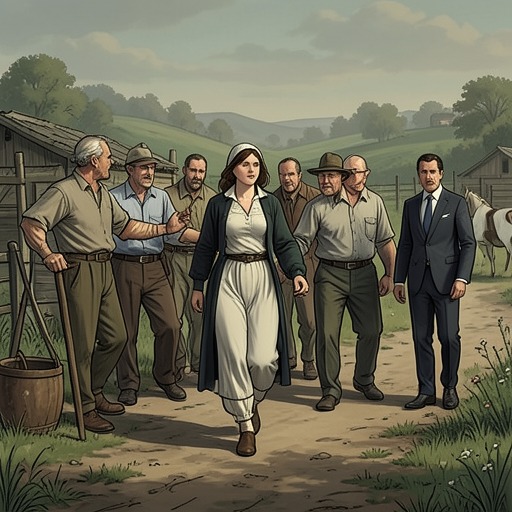
McGrath's Debt Threat Against Danita
The Vampire Prince’s BrideMcGrath's Debt Threat Against Danita is the confrontation in which Dean McGrath turns a financial claim against Danita Valdez's late uncle into a threat to auction Danita's virginity. The encounter begins as an apparent debt dispute over her newly inherited farm and ends with Danita refusing to surrender her body, creating the central coercive premise for the ransom arrangement that follows.
The Debt Claim and the Farm
Dean McGrath arrives at Danita's farm presenting himself as the person entitled to collect the dead man's obligations. He identifies himself directly and offers condolences for her uncle's death, but the sympathy is immediately revealed as an opening move in a financial assault. Danita explains that the inheritance gave her what she had always wanted: land on which to establish herself as a farmer. McGrath then claims that her uncle owed him approximately five hundred thousand dollars and argues that, because of that debt, the farm technically belongs to him.
Danita has already reviewed her uncle's finances with a lawyer and rejects the legitimacy of McGrath's claim. His response is not a legal argument. He warns her against involving lawyers and exposes distinctive fangs when he smiles, making the encounter unmistakably supernatural as well as criminal. The farm therefore becomes more than inherited property: it is the material foundation of Danita's independence, and McGrath uses the alleged debt to threaten both her livelihood and her security.
The Threat of Sexual Sale
When Danita insists that she has no money and points to the farm's poor condition and need for investment, McGrath offers a deadline rather than a solution. He demands a fifty-thousand-dollar payment within three months as a show of good faith, promising to discuss monthly payments later. His language frames extortion as a repayment schedule, while his scrutiny of Danita's body reveals the alternative he is already considering.
McGrath invokes her uncle's suicide as a warning, repeating the implication that Danita could suffer the same fate if she resists. He then describes her physical features, singles out her ethnicity, and asks whether she is a virgin. His statement that Hispanic virgins fetch a high price at auction makes the intended violence explicit: he is not merely threatening foreclosure, but the commercial sale of Danita's sexual status and body. The card he places in her hand, bearing his name and business number, functions as both contact information and a tangible token of control.
The scene's value shift is severe. Danita enters it as a grieving heir imagining a future on her own land; she leaves it facing the possible loss of the farm, coercive debt, sexual commodification, and physical danger. McGrath's power depends on presenting these outcomes as alternatives within a transaction, but the scene exposes the transaction as forced rather than reciprocal.
Danita's Resistance and the Ransom Arrangement
Danita is frightened, and her body registers the threat through shivering, trembling, and the urge to retreat into the house. Nevertheless, she refuses the solution McGrath offers. After he leaves, she recognizes the encounter as a nightmare-like assault but rejects the idea that he will take her dreams from her. Her stated determination is specific: she will find a way out, and that way will not involve selling her body.
The threat produces an urgent practical problem for Killian Flanagan and Ryan Higgins. Killian refuses Ryan's suggestion that they kill McGrath, explaining that killing him would require them to pay double Danita's ransom to the Lion to keep their own heads. Instead, Killian has made an agreement to buy Danita from McGrath. The arrangement requires paying Danita's debt plus an additional two hundred and fifty thousand dollars within a month, after which McGrath will leave her alone permanently. The proposed rescue therefore mirrors the coercive economy that created the danger: Danita's safety is negotiated through money, even though Killian's purpose is to end McGrath's claim rather than profit from her.
Wider Patterns of Exchange and Control
The event belongs to a larger pattern in which bodies, relationships, fertility, and freedom are treated as negotiable assets. McGrath converts inherited debt into a claim over Danita's virginity; Killian counters with a ransom agreement intended to remove that claim. Elsewhere, the narrative presents sharply different forms of exchange: Maskin gives Cheryl a grass necklace as a personal gesture, while Cheryl establishes the condition that any intimacy with one man must include the other and threatens to reject both if they fight. Sheridan tells Maribel that he sought her to bear him a child, making reproductive expectation the basis of a royal relationship. These contrasts distinguish gifts and chosen bonds from transactions enforced through fear.
The same tension appears in other social and ritual settings. At the palace, Cheryl is carried from the temple on a hovering stone platform while crowds chant her name, yet her anticipated role is still defined by producing royal children. In Kinai society, Kenner explains that every twenty-five years, unjoined men and women between twenty and thirty spend the winter at the Rookery when the beastlings hatch; secrecy and communal ritual govern reproduction there rather than a lender's private threat. McGrath's scheme is consequently not presented as an ordinary debt collection. It is the most predatory version of a recurring narrative concern: who has the authority to decide what a body, a future, or a child may be exchanged for.
Consequences and Narrative Significance
McGrath's visit establishes the immediate antagonist and the financial stakes that propel Danita's plot forward. His five-hundred-thousand-dollar claim, three-month deadline, fifty-thousand-dollar initial demand, and later ransom agreement give the conflict measurable terms, while the additional two hundred and fifty thousand dollars makes clear how difficult it will be to secure Danita's freedom. The threat also explains why Killian and Ryan become involved without reducing Danita to a passive prize: her own refusal is the moral center of the event, and the rescue effort answers a danger she has already identified and rejected.
The encounter's lasting significance lies in the collision between economic language and bodily autonomy. McGrath speaks of ownership, payment, good faith, and auction value, attempting to make coercion sound contractual. Danita's final resolve breaks that logic. She does not accept the premise that poverty, inheritance, or debt can make her body available for sale, and the subsequent ransom plan becomes an attempt to dismantle McGrath's power over her rather than an endorsement of his terms. In that sense, the event is both a threat and a declaration: McGrath defines the system through which Danita is endangered, while Danita's refusal defines the freedom the rest of the storyline must fight to preserve.