Oskar Freyson
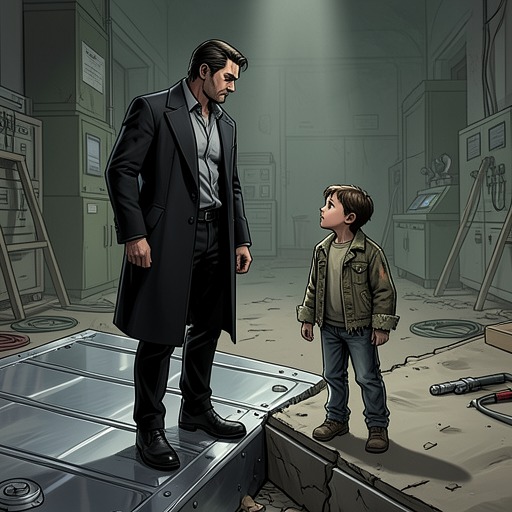
The Vampire Prince’s BrideOskar Freyson is the Alpha of the wealthiest Shifter community in the country, a billionaire businessman, and an unusually placed FBI agent whose public privilege conceals a private campaign for justice. He comes to Blackcliff ostensibly amid plans for investment and development, but his real purpose is revenge for Cindy’s death. The murder investigation makes him a suspect, while Melody Zabat’s ability to see ghosts gives him the first credible confirmation that he did not kill David Fezioni. His decisive turn comes when he learns that he has a son living in Blackcliff, a revelation that redirects his obsession with the past toward responsibility in the present.
Identity and Background
Oskar’s authority rests on several overlapping identities. He leads a wealthy Shifter community, controls substantial personal wealth, and belongs to a family whose electronics company provided him with more money than he could spend. He has never needed employment for survival, yet he is not portrayed as idle. His companies, investments, leadership responsibilities, and government work fill his time, even as the combined demands begin to exhaust him.
His position as an Alpha makes ordinary bureaucratic subordination especially difficult. In his community he is the leader; in his businesses he is the senior authority; within the FBI he must answer to superiors who, in his view, do not understand either his abilities or his reasons for acting. That contrast explains why the agency’s rules irritate him so intensely. The problem is not simply arrogance or wealth. Oskar is accustomed to taking responsibility and making decisions, and the chain of command repeatedly turns that sense of responsibility into insubordination.
Oskar is also a bald-eagle Shifter. In Blackcliff, the physical pressure of that identity becomes a recurring counterpoint to his controlled public persona. He feels his wings beneath his skin and longs to shed his clothes and fly over the valley, but the danger of being mistaken for an ordinary eagle and shot by a hunter keeps him grounded. He has shifted only twice since arriving, leaving his animal side anxious and confined. The restriction mirrors his broader situation: a powerful figure forced to operate within structures that deny him the freedom he considers necessary.
Blackcliff and the Investigation
Oskar has been in Blackcliff for three weeks when he reviews properties and considers developing a ski hill. The project begins as a cover, but the town’s potential gradually becomes genuine in his eyes. He sees mountain trails suited to summer tourism, a nearby lake with exceptional fishing, slopes ideal for winter recreation, and enough snow to support a year-round retreat. In his assessment, modest repairs, fresh paint, and better use of the surrounding landscape could make Blackcliff prosperous.
The investment also places him in tension with the town. Locals resist progress, and Oskar suspects that some of their hostility is directed at him as a Shifter. His response is practical rather than conciliatory: he intends to use his public-relations team to win them over once his more urgent business is complete. Melody Zabat, a local realtor, notices both his financial influence and the pressure his arrival creates. She believes wealthy Shifters could help revive a town whose failing economy might otherwise turn it into a ghost town within a few decades.
The urgent business is David Fezioni. Todd Barton, the leader of Oskar’s FBI team, tells him that Fezioni has been found dead just outside town. Oskar reacts with anger rather than relief. Fezioni was the reason he came to Blackcliff, because Oskar believed the man had information about Cindy’s death. Fezioni’s death threatens to destroy the only path Oskar had toward the truth.
Oskar explains that Fezioni kidnapped and killed his cousin’s fiancé, a member of the Shifters for whom Oskar is responsible. He is furious that agency superiors effectively closed the case and ordered him not to pursue Fezioni. The conflict has already strained his relationship with the deputy director, who regards Oskar as an entitled rich boy and restricts his investigation. Oskar’s insistence that Cindy’s killer must be brought to justice is therefore both personal and communal: Cindy was not merely a private loss but one of the Shifters under his protection.
After Fezioni’s death, Oskar is interrogated by friends and coworkers and becomes the prime suspect. He wants to throw himself into the investigation, partly to help solve the murder and partly to prove that he was not involved, but he recognizes that direct intervention could make his position worse. When he sees Melody leaving the police station, he begins examining her more closely. She found Fezioni’s body, and his investigation into her background becomes more thorough because her role places her near the crime and near the information he needs.
Cindy, Melody, and the Hidden Son
Melody changes Oskar’s understanding of the case by telling him that she can see ghosts. She explains that Cindy has been sitting beside him, that Cindy led her to Fezioni’s body, and that Cindy was present when the murder occurred. Most importantly, Cindy knows Oskar did not kill Fezioni. Melody’s disclosure validates the behavior Oskar had previously observed when Melody appeared to be speaking to herself, and it turns the investigation away from the assumption that Oskar’s presence and motive are sufficient evidence of guilt.
The revelation also gives Cindy a continuing role in Oskar’s life. Her death has left him locked onto a single unanswered question, but her ghost cannot simply provide the whole solution. Instead, Cindy communicates through Melody, and Melody must interpret what she sees and learns. Oskar is therefore forced to accept knowledge from a source he cannot control: not from the FBI, not from his lawyers, and not from his own investigative authority, but from a medium whose testimony depends on a supernatural bond he had not recognized.
Melody then delivers a second revelation that is even more disruptive. Cindy wants Oskar to know that his son is in Blackcliff. The boy’s adoptive parents died in a car crash the previous year, and he is now living in a local foster home. Oskar initially struggles to understand the news, asking whether “here” means the town itself. Melody has seen the child and suspects that Fezioni may have come to Blackcliff in an attempt to extract more money from Oskar.
This discovery expands the meaning of Fezioni’s connection to Oskar. The murder is no longer only a revenge case involving Cindy and a closed investigation; it may also involve concealed parenthood, financial exploitation, and a child who has been separated from his biological father. Melody cannot determine exactly what Cindy wants Oskar to do, but she establishes that the son’s existence is part of Cindy’s unfinished message. The revelation gives Oskar a new obligation that cannot be discharged through arrest, revenge, or professional vindication.
Departure from the FBI
Oskar ultimately quits the FBI. He says that the agency’s orders, restrictive rules, and rigid chain of command have become intolerable. Although he could theoretically work his way upward, he sees no reason to begin at the bottom of an institution when he is already at the top of his other enterprises. He decides instead to focus on his responsibilities as an Alpha and businessman, believing that he can do more good through those positions.
His resignation is a reversal of the role he originally adopted. The FBI gave him an official structure through which to pursue justice, but it also limited his investigation into Fezioni and repeatedly treated his independence as a liability. Leaving the agency does not mean that Cindy’s death matters less. On the contrary, Oskar insists that he never needed the agency to act on behalf of the Shifters who depend on him. His authority becomes less institutional and more personal: he will rely on his leadership, resources, and chosen allies rather than on a badge and a chain of command.
The decision also marks a movement away from defensive self-justification. While he is under suspicion, Oskar is tempted to solve Fezioni’s murder simply to prove that he is not part of it. By quitting, he removes himself from the bureaucratic position that has made the conflict worse and reclaims control over the terms of his work. His identity as a billionaire Alpha is no longer merely a source of privilege or irritation; it becomes the foundation from which he intends to protect his community and respond to the truth about his family.
Relationships and Narrative Role
Oskar’s relationship with Cindy is defined by grief, loyalty, and incomplete knowledge. He has spent two years carrying her death, while the agency’s refusal to give him room to prove Fezioni’s responsibility has converted mourning into pursuit. Cindy’s ghost does not erase that grief, but it gives it direction. Through Melody, she confirms Oskar’s innocence and reveals the existence of his son, making her posthumous presence both a witness to the murder and a guide toward a neglected family connection.
Melody is Oskar’s investigative counterpart and emotional counterweight. She is a local realtor who recognizes the economic possibilities of Oskar’s plans, yet she is also the person who can access information unavailable to him. Their connection develops through danger and disclosure: she has found the body, knows the ghost attached to the case, and eventually tells Oskar that his son is nearby. The mystery therefore joins their personal relationship to the central investigation. Oskar’s wealth and authority cannot produce the truth without Melody’s supernatural sight, while Melody’s knowledge becomes meaningful only when Oskar is willing to hear it.
Todd Barton represents a more workable form of institutional authority than the deputy director. Barton challenges Oskar and warns him to abandon the Fezioni investigation, but he also knows Oskar well enough to recognize that the agent needs something to ground him. Oskar’s resentment is not directed equally at every superior; it is strongest toward the system that denies him discretion. Barton’s presence reveals the conflict between Oskar’s need for independence and the agency’s demand for obedience without reducing that conflict to a simple personal feud.
As a narrative figure, Oskar combines the revenge seeker, the powerful outsider, and the reluctant family man. He arrives with money, influence, and a concealed agenda, then becomes vulnerable when his motive makes him look like the murderer. Melody’s testimony reverses that appearance, while the discovery of his son complicates the older revenge plot with an obligation to care for someone who has already lost his adoptive parents. Oskar’s arc is therefore not a simple rise from suspect to vindicated investigator. It is a shift from pursuing a dead man’s secrets toward accepting the living consequences of secrets kept from him.