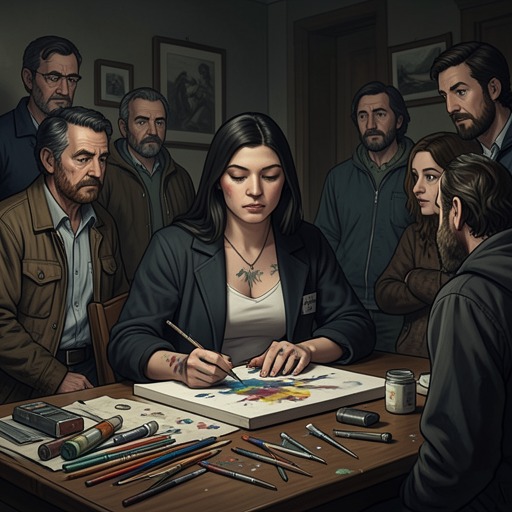
Piper Diamond–Thor Wragge
The Vampire Prince’s BridePiper Diamond–Thor Wragge is a long-running commercial and personal antagonism organized around a sharp dispute over what art is worth. Piper operates a small gallery built on painstaking, handmade work, while Thor Wragge runs a souvenir shop across the street that uses magic to reproduce familiar images cheaply and repeatedly. Their conflict is therefore more than a quarrel between difficult neighbors: it pits cultural and personal authorship against profitable imitation, and turns Piper’s defense of her mother’s painting and her own magic into a direct challenge to Wragge’s business model.
Opposing Businesses and Values
Piper’s gallery is financially precarious even though she manages to break even each month. Her father gave her a house to help her and Baxter get established, but she quickly spent her savings opening the gallery, leaving the business dependent on constant effort. She believes that customers should value the lovingly painted strokes of a real brush, yet sees them choosing the cheap knockoffs sold by Wragge instead. Her artistic commitment is inseparable from economic anxiety: every sale supports a form of labor she considers genuine, while every lost customer strengthens the commercial system she despises. Wragge’s establishment presents itself as a gallery despite functioning as a shop for replicas. It offers copies of famous works, including The Mona Lisa, and magical kits capable of painting an entire room in the style of the Sistine Chapel. His basement operation continually produces these reproductions through magic. The practice is technically legal because he does not claim that the copies are originals, but Piper regards the legality as beside the point. In her view, Wragge’s work embodies bad taste, lack of originality, and the public’s willingness to exchange artistic labor for convenience.
Repeated Harassment and the Buyout Pressure
Wragge repeatedly visits Piper’s gallery under the pretense of browsing or seeking a quiet place to think. Piper refuses to call him by his first name, partly because she rejects the grandiosity of “Thor”: although he is a powerful warlock and has sandy-brown hair and brown eyes, she considers the name an arrogant claim to an identity he has not earned. His attractiveness does not soften her judgment, especially because he routinely ogles her body. The visits carry a commercial threat. Piper has already rejected Wragge’s attempts to buy her out, and she recognizes that his praise of the shop is not innocent appreciation. He tells her that he could do wonders with the gallery and with her, framing both the premises and Piper herself as wasted potential. His language reduces her independent enterprise to an asset awaiting a more capable owner, while its personal undertone makes the business dispute humiliating as well as material. Piper responds by ordering him out rather than allowing his charm or money to redefine the terms of the encounter. Baxter’s presence would make these confrontations more dangerous. The last time he faced Wragge, he nearly attacked him, and Piper knows that Baxter already struggles to find work because he is a Werewolf. Jail would worsen the discrimination and economic vulnerability he experiences. Her decision to handle Wragge herself thus protects Baxter as much as it protects the gallery, even though Wragge’s provocations continue to test that restraint.
The Gallery Damage and the Purpura Informos Hex
After the gallery is damaged, Wragge arrives from his convertible Corvette and studies the destruction with an expression Piper finds suspiciously innocent. He deliberately walks through the debris she has swept into a pile and greets her as though the broken glass were merely an unfortunate neighborhood problem. Piper wonders whether he caused the damage, recognizing that he is a bad neighbor without yet possessing proof that he would go so far. The confrontation becomes personal when Wragge insults Piper’s mother’s painting. The work depicts an apple tree as seen from a window; Piper’s mother painted it from the view she had every day from her hospital bed while cancer slowly drained her life. Wragge calls the painting worthless and amateurish, attacking not only its technique but the memory and suffering embedded in it. Piper answers with a spell of her own design, “Purpura informos,” which covers Wragge’s skin in large purple pustules. She laughs while he yelps, waves his hands, and attempts various anti-hex wards. Piper offers to remove the hex only if Wragge tells her what happened to the painting. His subsequent apology does not repair the relationship. Wragge claims that he had nothing to do with the theft and says that he forgives her for her “little hex,” a phrase that offends Piper almost as much as the attack on the painting. She graduated from magic school with top marks and received a scholarship to the college in Calgary; to her, minimizing the spell is another attempt to diminish her expertise and authority. The exchange reveals that their rivalry is fought through competing claims to value: Wragge dismisses her magic as small, while Piper insists that its precision and force cannot be judged by his condescending standards.
Public Conflict and Escalation
Wragge’s presence remains unwelcome even in spaces where Piper is trying to promote her work. At a gallery event, she spots him across the room and immediately grips her champagne glass, narrows her eyes, and curls her lip. He is visibly uncomfortable in the fashionable crowd, suggesting that the social world of original art does not naturally confirm the commercial confidence he displays in his own shop. The tension erupts when Patrick punches Wragge in the stomach and Baxter pulls Patrick back. Wragge responds by calling Piper a “gold-digging whore,” turning the commercial disagreement into sexualized public abuse. Baxter and Patrick both lunge at him before being restrained. Piper is initially shocked by the violence, but the insult clarifies the hostility that has been accumulating beneath Wragge’s offers, smirks, and insinuations. His accusation also reverses the actual economic dynamic: Piper has refused his money, while Wragge is the person trying to acquire her gallery and convert her art into a reproducible commodity. Piper later explains that Wragge produces copies of the same artwork magically, citing the recurring image of children playing hockey on a pond as an example. He has sold the same picture for years, reproducing it again and again, and wanted to apply the same process to Piper’s art. Her outrage rests on the fear that handmade work would lose its identity once absorbed into his system. Wragge does not merely compete with her; he seeks to make her originality function like another template in his basement.
Meaning of the Rivalry
The Piper–Wragge conflict contrasts two kinds of power. Wragge possesses money, a successful stream of customers, a prominent shop, and magical production methods that let him scale his output. Piper possesses technical magical training, artistic conviction, and an attachment to singular objects whose value cannot be separated from their history. The mother’s apple-tree painting is the clearest emblem of that difference: to Wragge it is an amateur landscape, but to Piper it preserves the final view of a dying woman and therefore carries a meaning no replica could manufacture. Their rivalry also exposes how economic pressure can make cultural principles vulnerable. Piper’s gallery survives only by breaking even, and the constant struggle to remain open leaves her exposed to a neighbor who can promise efficiency, wider appeal, and financial relief. Yet accepting Wragge’s buyout would mean surrendering the very distinction on which her identity as an artist depends. The conflict consequently binds livelihood to memory, magic to authorship, and personal dignity to the refusal to let a richer rival decide what counts as valuable. The antagonism is not resolved by Wragge’s claim that his reproductions are legal, nor by his attempts to sound generous after the painting’s theft. Each encounter repeats the same structure: Wragge approaches as a buyer or patron, Piper recognizes an effort to appropriate her space and work, and an apparently commercial conversation becomes an assault on her judgment, body, family memory, or magical competence. The relationship’s lasting significance lies in that repetition. Wragge represents the pressure to make art interchangeable; Piper’s resistance insists that originality is also a form of self-possession.