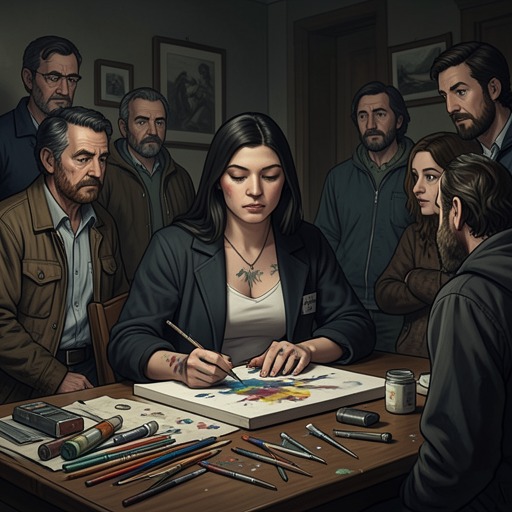
Piper's Mother's Apple-Tree Painting
The Vampire Prince’s BridePiper's Mother's Apple-Tree Painting is a deeply personal family heirloom whose value cannot be measured by the market. It depicts the view from a window down toward an apple tree, the scene Piper's mother saw every day from her hospital bed while cancer slowly drained her life. When the painting disappears during the attack on Piper's gallery, its absence exposes the difference between an artwork's apparent worth and the history, grief, and love invested in it. Its eventual recovery gives Piper back not merely a picture, but a tangible connection to the mother whose collection and memory are all she has left.
Appearance and Personal History
The painting shows an apple tree viewed from a window above it. Its image is therefore both ordinary and intensely specific: it records the landscape visible from Piper's mother's hospital bed during the final illness that consumed her. The painting's subject is not presented as an abstract artistic idea but as a daily view preserved through the mother's own act of painting. That origin makes it a record of endurance, linking the tree outside the window to the hospital room, the mother's declining body, and Piper's continuing memory.
The painting also belongs to Piper's inheritance. Her mother had collected numerous rare and expensive artworks, most of which had increased in value to at least three times their purchase price. Yet the apple-tree painting stands apart from that potentially lucrative collection. It is described by Thor Wragge as a hideous, amateurish, worthless piece, but his judgment measures only aesthetic or commercial status and ignores its family meaning. Piper's attachment demonstrates that the painting's importance comes precisely from what Wragge cannot see: the personal history embedded in an apparently modest object.
Theft and the Gallery Crisis
The painting's material presence becomes unmistakable when Piper discovers that the wall behind the register is empty after the gallery is vandalized. At first she worries that it may merely have fallen, but there is no sign of it. Her heart leaps to her throat, and tears fill her eyes as she realizes that she had been so overwhelmed by the wider destruction that she failed to notice the one loss that mattered most. The painting's disappearance transforms the gallery break-in from property damage into an attack on her family memory.
Thor Wragge intensifies the injury by revealing that he knows the painting is gone and by continuing to dismiss it as amateurish. Piper responds impulsively, casting her own spell, "Purpura informos!" Purple pustules break out across Wragge's skin while he tries to counter the hex. Piper explains that it is a hex of her own design and offers to remove it if Wragge tells her what he did with her mother's painting. The episode shows how the object draws Piper from grief into confrontation: its loss supplies the immediate motive for her retaliation, even though Officer Johnson later releases her from the community jail and warns her that rudeness is not a justification for hexing people.
The painting's disappearance also arrives at the worst possible moment in Piper's life. She is already facing a financial crisis, and the destruction of the gallery threatens the trust of the artists whose work she had been trying to sell. She eventually concludes that revenge against Wragge could deepen her troubles and decides to auction her mother's collection to pay her debts. That decision carries a second loss. Selling the rare pieces would solve the immediate financial problem, but it would also mean losing everything her mother left her. The stolen painting thus becomes the sharpest emblem of a larger collapse: Piper's gallery dream is ending, her professional relationships have been damaged, and her inheritance is being converted into money simply to keep her afloat.
Recovery and Return to the Home
The painting is recovered by Baxter, who finds it in a secondhand store and brings it to Piper's apartment. Its return is staged as a revelation. Baxter takes it from a hallway closet while Piper waits impatiently in the kitchen, and she gasps when she recognizes the apple tree painted from the high window. Tears fill her eyes as she reaches for it and identifies it as her mother's painting. The recovery confirms that the artwork survived the gallery disaster, even though its route into the secondhand store remains uncertain.
Baxter suspects that Kristal Clarkson had more to do with the painting's disappearance than Thor Wragge. Piper does not pursue the distinction in that moment. The object is back in her hands, and its emotional restoration matters more than the unresolved chain of custody. This response separates the painting's significance from the revenge plot that first surrounded it. During the crisis, finding the person responsible seemed necessary; after the recovery, possession and remembrance become the immediate priorities.
Piper then takes down the abstract work hanging over the couch and replaces it with the apple-tree painting. The gesture gives the heirloom a permanent place in her domestic life rather than returning it to a commercial display. She steps back to admire it and leans against Baxter while he places an arm around her waist. Her quiet thanks and his answer that it was his pleasure frame the restored painting as part of a renewed circle of care. The painting no longer hangs behind a cash register, vulnerable to being dismissed as an unwanted amateur piece; it hangs in Piper's home, where its meaning is recognized and protected.
Meaning and Narrative Function
The painting functions as a material witness to Piper's mother's final period of life. The apple tree is not important because the narrative establishes it as a rare or technically superior subject. Its force comes from its connection to a particular window, a hospital bed, and a mother whose illness made ordinary daily sights precious. The painting preserves a view that cancer could not preserve in any other form, turning a scene of confinement into an enduring object that Piper can carry forward.
Its theft reveals how fragile memory becomes when it is embodied in property. Piper can contemplate selling the collection, and the gallery can be vandalized, but the loss of this single image pierces the practical language of debts and market value. Wragge's contempt creates an irony at the heart of the object: the painting he calls worthless is the piece whose disappearance causes Piper the greatest pain. In that contrast, the story places emotional value against commercial judgment without making the painting's importance depend on public recognition.
The return completes a movement from misplaced object to recovered inheritance. Piper begins by overlooking the painting amid the broader wreckage, then recognizes that its absence is the central wound. She considers relinquishing her mother's collection to survive, and finally receives this particular work back through Baxter's intervention. Replacing the abstract picture over the couch with the apple-tree image makes the ending concrete. Piper cannot restore the gallery or preserve every part of her inheritance, but she can choose what the surviving object will mean in the life she continues to build.