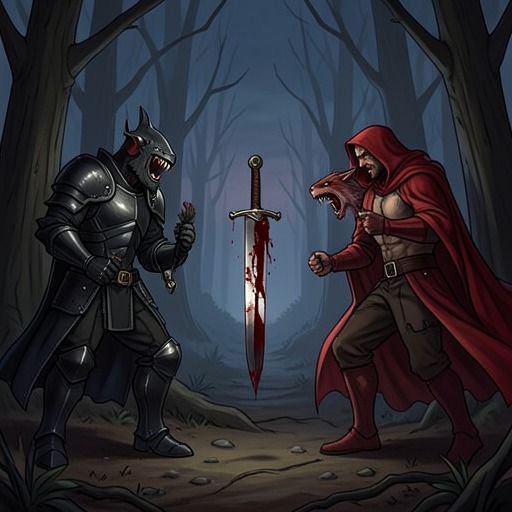
Rebeluna insurgency
The Vampire Prince’s BrideRebeluna insurgency is the self-proclaimed shifter rebellion against the vampire king and the most consequential organized resistance movement in the book’s vampire–shifter conflict. It is defined not merely by isolated attacks, but by a network capable of gathering shifters from various clans, killing vampire officials, striking tax convoys, cultivating support among human settlements, and directing military operations through the mysterious leader known as the Thunder. Its existence forces the vampire monarchy to treat resistance as both an intelligence problem and a struggle over political allegiance.
Origins and Political Purpose
Rebeluna emerges from opposition to vampire rule. The movement resists the vampire king “in any way possible,” and its membership extends across multiple shifter clans rather than representing a single local group. This breadth helps explain why the monarchy regards it as unusually dangerous: Rebeluna has been responsible for more vampire deaths than any other group during the preceding decade. Its resistance is therefore not a brief disturbance or a feud between neighboring communities, but a sustained challenge to the structure of vampire sovereignty.
The movement also operates in a political register beyond direct violence. Cleo suggests that the rebels may be collecting money to bribe lower-ranked vampires or donate to outlying human settlements, thereby turning those communities toward the shifter cause. Darius accepts that this would not be unprecedented. Rebeluna’s possible strategy thus combines armed resistance with influence-building: military pressure weakens the regime, while aid and financial support compete for the loyalty of populations living at the edges of vampire authority.
From Local Reports to Open Insurgency
The first reports available to Darius are ambiguous. Wolves have killed three dozen sheep, and a shepherdess has disappeared only a dozen leagues away. Gordon immediately asks whether the incidents indicate Rebeluna activity, but Darius initially rejects that interpretation. In his judgment, Rebeluna is organized and efficient; the attacks look more like the work of minor wolf groups pretending to be rebels without the courage to begin an open revolt. This distinction establishes an important contrast between spontaneous or opportunistic violence and a disciplined insurgency.
The political stakes become clearer when a small vampire envoy carrying Lord Virgil’s annual taxes is attacked. The convoy is transporting gold because Lord Virgil insists that this is safer, yet the attack demonstrates how vulnerable the monarchy’s financial circulation can be. Darius identifies the assault as consistent with Rebeluna’s methods, even while acknowledging that many other reports of shifters require investigation. The movement can threaten not only soldiers and officials but also the material systems that sustain aristocratic power.
The monarchy’s response is shaped by earlier losses. After Rebeluna assassinated the last colonel assigned to find it, the vampire king transferred the investigation to Darius. The assignment places Darius at the junction of military command and counterinsurgency intelligence: he must determine whether scattered attacks belong to the central movement, identify its hidden infrastructure, and prevent the rebellion from converting local discontent into a broader alliance.
Forest Camp and Military Escalation
Darius and his troops eventually obtain more than vague testimony. A witness has overheard two shifters discussing Rebeluna’s forest camp, and drones confirm that the camp exists. Darius recognizes that the information is probably a trap, but its value is too great to ignore. The decision draws him away from home for days or weeks and initiates a direct attempt to penetrate the insurgency’s hidden base.
The forest operation becomes a sustained engagement rather than a single raid. Darius leads half a dozen men from the north while three captains close in from the other directions. The surrounding elms, oaks, and Bosnian pines conceal the enemy’s movements, and the absence of any clear sound or scent underscores the difficulty of fighting an insurgency that controls its concealment. The operation is not simply a search for a visible army; it is a contest against an opponent able to make terrain, silence, and uncertainty part of its defense.
The fighting continues for nearly a full week. Darius suffers wounds from the claws and teeth of dozens of shifters, though his vampire body heals. The shifters then withdraw abruptly, an action that worries him precisely because it appears deliberate. Their retreat gives his troops time to reinforce their positions, but Darius interprets the pause as temporary and prepares to pursue them once helicopters deliver additional blood supplies. The logistics of the campaign are consequently tied to vampire biology: blood is not a background resource but a military necessity, and the arrival of blood determines when exhausted troops can resume the offensive.
The Thunder and the Wider Conflict
During the campaign, Darius learns that the shifters are taking orders from a figure called the Thunder. This revelation changes his understanding of the conflict. The problem is no longer simply Rebeluna’s local organization or the actions of independent rebel wolves; the insurgency is connected to a command structure with a leader whose location remains unknown. The Thunder’s hidden authority gives the rebellion a center of gravity even before the vampire forces can identify or reach it.
The movement’s attacks therefore create a pattern of escalation. It begins in the form of disputed incidents—livestock deaths, a missing shepherdess, and reports of wolves—but develops into attacks on vampire envoys, assassination of a senior investigator, coordinated forest operations, and obedience to a larger commander. The progression tests the vampire regime’s ability to distinguish rumor from strategy. Every apparently minor incident may be a local disturbance, a deliberate diversion, or part of a campaign whose purpose is visible only after the attacks are connected.
Consequences and Narrative Significance
Rebeluna insurgency transforms the book’s political landscape by making the relationship between vampires, shifters, and human settlements an active contest rather than a fixed hierarchy. Darius’s military response shows the coercive side of vampire rule, while Cleo’s proposed outreach program recognizes that military victory alone may not secure peripheral communities. The suggested aid to areas affected by recent earthquakes and flooding places humanitarian assistance beside counterinsurgency, revealing how governance, relief, propaganda, and allegiance become inseparable during rebellion.
The insurgency also drives a personal cost for Darius. Its investigation keeps him away from Cleo at a time when she is pregnant, and he deliberately puts knowledge of her pregnancy out of his mind while following the rebel trail. The rebellion thus reaches beyond battlefields: it interrupts domestic life, burdens the commander with divided loyalties, and makes the pursuit of political security compete with the obligations of marriage and family.
Most importantly, Rebeluna is presented as a movement capable of forcing recognition. Darius initially separates authentic organization from ineffectual acts of rebellion, but the evidence of the forest camp, the week-long assault, and the Thunder’s command proves that the resistance possesses coordination and endurance. The insurgency’s significance lies in this conversion of uncertainty into crisis. What appears at first to be scattered wolf violence becomes a structured challenge to vampire power, one that must be answered through intelligence, force, political outreach, and an eventual confrontation with the leadership behind the rebellion.