Rescue of the Human Cargo Ship
The Vampire Prince’s BrideThe Rescue of the Human Cargo Ship is the operation in which Tom and Lieutenant Sara O’Neill discover a vast cargo vessel filled with humans held in stasis and attempt to bring its survivors to the Human sanctuary. Its decisive significance lies in the way a recovery mission becomes an armed struggle: the humans are not merely lost passengers awaiting assistance, but evidence of a wider system of abduction and possible exploitation, while the United Species Corps treats the rescue as a threat rather than a humanitarian act.
Causes and Background
The operation grows out of Sara’s experience as a human abducted from Earth and awakened hundreds of thousands of years later in a galaxy where technological advancement has not eliminated brutality. She recognizes that the people in the cargo ship may have been taken by the same unknown forces that removed her from Earth. The ships containing humans share similar technology, making the possibility of a connected abduction network difficult to dismiss. The cargo vessel therefore carries both immediate victims and a possible explanation for Sara’s own past.
Tom’s personal position gives the mission unusual political force. He is not simply an independent rescuer: he identifies himself as the son of Zon, warlord protector of the Rouge Systems, and uses that family connection to deter a military attack. His relationship with Sara also changes the operation’s emotional stakes. During their earlier encounter, he tells her that his name is Tom, replacing the provisional identity under which she has known him with a personal truth. Their developing bond becomes inseparable from the practical question of whether either of them can trust the other in a hostile operation.
Discovery of the Cargo
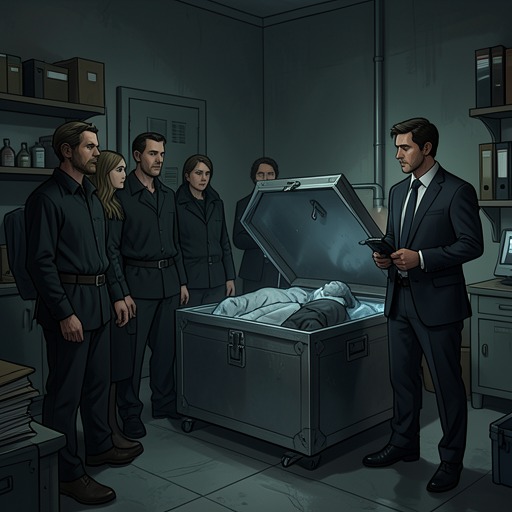
Tom docks his ship directly onto the cargo ship’s hull, clamping over a weapons port and cutting through to gain entry. Inside, the vessel is built from sharp, jutting crystalline structures that resemble stained glass, with a dim blue glow rising from stasis pods along an unusually wide corridor. In the nearest pod, Tom sees a human woman with closed eyes, overgrown matted hair, and skin resembling his mother’s. The image makes the cargo’s human identity unmistakable: these are not abstract biological specimens but people preserved in a state between life and death.
Reconnaissance estimates place the number of humans at at least six hundred. Tom and Sara cannot immediately determine how many are alive, because the stasis pods prevent decomposition and conceal the difference between living captives and bodies that have already died. Their rescue consequently begins under uncertainty. They must preserve the ship, secure the people inside it, and postpone the final accounting of survivors until the cargo reaches the Human sanctuary.
The ship also suggests the scale of the crime. Sara considers the possibilities of slave labor or human consumption, while Tom acknowledges that the available evidence is insufficient to identify the abductors conclusively. The uncertainty does not make the danger smaller. Instead, it places the humans within a larger economy of disappearance in which their bodies may have been treated as labor, merchandise, food, or valuable biological material.
Infiltration and Firefight
To move the cargo vessel without tearing it apart, Tom and Sara must place anchors at twelve strategic locations. They work quickly and initially in silence, moving through the cold corridors while their breath crystallizes in the air and sleeping faces surround them. The operation’s technical requirement becomes a moral pressure: every delay increases the chance that the captives will remain in danger, but every careless shot may damage the pods and kill the people they are trying to save.
The approach collapses when footsteps echo through the corridor. A voice announces that there is movement, and Tom and Sara hide on opposite sides among the stasis pods. Sara then steps out with her hands raised and identifies herself as Lieutenant Sara O’Neill of the United Species Corps. Her decision is both a calculated attempt to control the encounter and a declaration that she will not remain concealed while other humans are trapped around her.
The opposing force is led by Colonel Flanard, a figure familiar from Sara’s military life. He regards her as a good soldier who has forfeited that status by helping a dangerous criminal and implies that her expulsion from the Corps is already inevitable. The confrontation therefore joins personal betrayal to institutional conflict. Sara is not only defending the cargo; she is being judged by the organization that once defined her loyalty.
Tom responds by dropping his pack and firing into the corridor while using his body to shield Sara. She fires beneath his arm and guides him toward cover, producing a tightly coordinated defense rather than a solitary rescue. United Species Corps troops return fire from between the pods, placing the preserved humans directly in the line of danger. The rescuers must fight an enemy while refusing to lose sight of the vulnerable people enclosed around them.
Sara turns the balance with a device hidden in her bionic eye. She removes a small round object from the eye socket and throws it down the corridor; the resulting flash and high-pitched grating sound stun the attackers. The weapon is only a stun grenade, but its concealment allows Sara to exploit an expectation that a bionic eye is merely a replacement for damaged vision. She then plans to restrain the disabled troops and secure them while Tom completes the anchors. The operation thus depends equally on improvisation, bodily adaptation, and technical preparation.
Extraction and Consequences
After two further patrol encounters, Tom finishes setting the anchors and returns to his ship, where Sara takes the co-pilot’s chair. The remaining obstacle is the nearby United Species Corps vessel, which could destroy the rescue operation by opening fire. Tom answers through political intimidation rather than another firefight. He announces that he is Tom, son of Zon, and warns the soldiers that half of his father’s fleet is approaching.
The strategy works immediately. The colonel’s ship disappears within seconds, showing that Zon’s name carries enough military weight to override the Corps’ apparent authority. Tom activates the anchors, and the net locks onto the cargo ship. Because the power supply remains uninterrupted, the net holds, allowing him to set a course and tow the vessel away.
The rescue changes Sara’s understanding of Tom. She now sees that his claims about helping the humans and being Zon’s son were both true, even though her distrust had been reasonable. The operation also changes the meaning of their partnership: intimacy is no longer separate from action, because each has relied on the other under fire. Tom’s lineage provides the external protection that makes extraction possible, while Sara’s military training and bionic-eye grenade provide the immediate tactical advantage.
The larger aftermath remains politically unsettled. The United Species Corps does not behave as a neutral humanitarian authority, and the presence of Colonel Flanard shows that official institutions may pursue or obstruct the rescue of humans. The cargo ship is brought toward the Human sanctuary, but the operation cannot by itself identify the original abductors, determine the number of living survivors, or resolve the wider danger represented by the similar ships found elsewhere.
Narrative Significance
The action is structured as a rescue plot that repeatedly becomes a confrontation over who counts as a legitimate protector. The humans in the pods are physically suspended outside ordinary time and legal visibility; they cannot speak, testify, or defend themselves, while armed authorities claim the power to decide their fate. Tom and Sara challenge that arrangement by treating the captives as people whose rescue justifies disobedience, risk, and open conflict.
The operation also contrasts two forms of power. Flanard relies on military rank and the threat of sanctioned violence, whereas Tom relies on kinship-based deterrence and Sara relies on embodied ingenuity. Neither method is presented as sufficient alone. The ship can be saved only when technical skill, mutual trust, tactical courage, and political leverage converge.
Its emotional force comes from the collision between vast scale and intimate recognition. At least six hundred humans are reduced by the ship’s design to blue-lit faces behind crystalline walls, yet Sara’s reaction keeps the crisis personal because she may be looking at people taken through the same machinery that stole her own life. The rescue therefore becomes more than the recovery of a cargo. It is a refusal to accept humanity’s treatment as freight, evidence, or expendable material, and it advances the broader effort to establish a Human sanctuary where survivors can exist outside the systems that confined them.