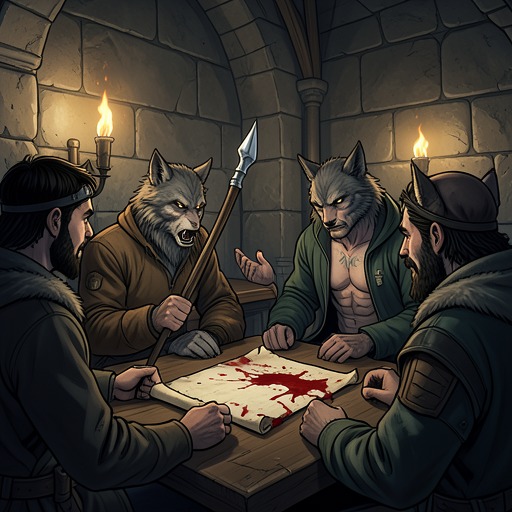
Roland Reveals Claire’s Pregnancy
The Vampire Prince’s BrideRoland Reveals Claire’s Pregnancy is the moment when Roland Davis interrupts Claire Doyle’s murder investigation to disclose that she is pregnant with his child. The revelation does more than add a personal complication to the case: it exposes the biological and social consequences of Roland’s werewolf identity, confirms that their brief encounter has produced a supernatural pregnancy, and forces Claire to confront a future she has not chosen or understood.
Causes and Background
Roland raises the subject while Claire is questioning him about Melissa Clarkson’s death. He knows that Claire’s work requires her to examine whether Melissa was targeted because of her connection to the werewolf community, and he initially tries to redirect the conversation toward what he considers more immediately important for Claire personally. His urgency comes from the fear that he might lose Claire before telling her that she is carrying his pup. The murder investigation therefore becomes the setting for a second, more intimate disclosure: evidence about violence against one woman is interrupted by news about the future of another.
The pregnancy is inseparable from the werewolf world Roland has concealed from Claire. His heightened senses have already identified the pregnancy through scent during the full moon, but Claire does not possess the knowledge needed to interpret that perception. The scene consequently places two incompatible systems of understanding side by side. Claire approaches events through investigation and evidence, while Roland recognizes bodily and supernatural signs that ordinary human reasoning cannot yet explain.
The Revelation
Roland states plainly that Claire is pregnant and then immediately clarifies that the child is his. The bluntness of the disclosure produces a physical shock: the color drains from Claire’s face, her eyes widen, and her heartbeat accelerates. Her reaction makes the revelation an embodied event rather than a mere exchange of information. Before Claire can decide what the news means, her body registers its danger and scale.
Claire challenges Roland’s certainty, asking how he could know. Roland explains that he could smell the pregnancy when the moon was up. The explanation is both intimate and alienating. It establishes a werewolf sensory capacity while reminding Claire that Roland has access to facts about her body that she cannot independently verify. The same supernatural perception that allows him to identify the pregnancy also intensifies the imbalance between them.
Roland is still naked and crouched before Claire when he tells her, but he pushes aside his embarrassment because his priority is to comfort her. He wants to tell her that she is his mate, yet he recognizes that doing so could frighten her further. This hesitation reveals that the disclosure is not a complete romantic confession. Roland gives Claire the pregnancy and the child’s paternity first, while withholding the larger claim implied by their mate bond.
The Child’s Inheritance
Claire asks whether the baby will be a werewolf. Roland confirms that it will. He explains that he was born a werewolf and that the condition appears to be dominant: one werewolf parent is enough for a child to inherit it. He also mentions that biting can inject or mutate the relevant genetic material, although the exact mechanism remains under investigation. His account combines inherited biology, supernatural transmission, and incomplete scientific knowledge rather than presenting lycanthropy as a simple curse.
Roland admits that reliable information about werewolf pregnancies is scarce. He identifies himself and Adam Buchan as the only individuals born since his father within the relevant family line, leaving very little established research. This lack of knowledge increases the stakes for Claire. She is not merely receiving news of a pregnancy; she is entering a medical and social situation in which the people around her possess limited information about the development of a werewolf child.
The revelation also connects Claire’s pregnancy to the broader pattern of cross-species reproduction in the book. Other storylines treat unusual pregnancies as objects of scientific, political, or exploitative interest: Lisa’s pregnancy is initially mistaken for a parasite before advanced imaging confirms an embryo, while Gemma’s child is described by the Science Board as a possible key to curing the Stlozyn disease. Against those plots, Roland’s disclosure is more private, but it raises the same question of who has authority over an extraordinary pregnancy and who bears its risks.
Relationships and Conflict
The event changes the relationship between Roland and Claire by turning an unresolved intimate encounter into a permanent biological connection. Roland is no longer only a suspect, informant, or supernatural source in Claire’s investigation. He becomes the father of her unborn child, while Claire becomes connected to the werewolf lineage through pregnancy. His phrase that the child is his is factually clarifying but emotionally inadequate; it cannot resolve Claire’s fear or explain what Roland expects from her.
The scene is structured around a pursuit-and-withdrawal tension. Roland pursues disclosure because silence might cost him Claire, yet he withdraws the declaration that she is his mate because he anticipates that the claim could overwhelm her. Claire, meanwhile, seeks information through direct questions, moving from disbelief about the pregnancy to concern about the child’s nature. Her questions show that she is not passively accepting Roland’s interpretation; she tests his claims and demands an account of how he knows and what the child will become.
This conflict is also ethical. Roland is trying to protect Claire and the unborn child, but the knowledge arrives through his private sensory access to her body rather than through a shared medical process. The narrative presents his concern as genuine while preserving Claire’s vulnerability: she must absorb the consequences of a supernatural pregnancy before she has been given a complete account of the supernatural society into which it places her.
Consequences and Narrative Significance
Roland’s revelation redirects the emotional center of the surrounding plot. Claire’s investigation into Melissa’s murder continues to matter, but it can no longer be separated from the possibility that Claire herself may become vulnerable because of her connection to Roland and the werewolf pack. The pregnancy creates a new stake in the investigation: the outcome may affect not only justice for Melissa but also Claire’s safety, Roland’s future, and the status of their unborn child.
The disclosure is a threshold between concealment and acknowledgment. Roland has already exposed enough of his nature for Claire to understand that he is not an ordinary man, yet the pregnancy forces him to articulate the hereditary consequences of that identity. His explanation that the baby will be a werewolf makes the child a living continuation of the pack’s bloodline and turns reproduction into a matter of succession, secrecy, and responsibility.
The scene’s bodily imagery links it to other revelations throughout the book. Sara’s bionic eyes can be removed and used as stun grenades, making the human body a site of concealed technology; Lisa’s medical scans reveal an embryo that initially appears monstrous and nonhuman; and Shay explains that Stlozyn bodies were engineered from human ancestors through emphasized genes and added DNA. Claire’s pregnancy likewise unsettles the boundary between human and nonhuman. Yet unlike a laboratory specimen or a technological device, the child is revealed within a relationship, and the immediate demand is not extraction or classification but a response to Claire’s fear.
Roland’s disclosure therefore functions as both plot reversal and moral test. He possesses knowledge that could be used to claim Claire, frighten her, or reduce her to the bearer of a werewolf heir. Instead, he hesitates over the language of mating and tries to comfort her, even though his explanation remains incomplete. The event ends without resolving Claire’s feelings or the future of the pregnancy. Its decisive consequence is that neither character can return to the earlier uncertainty: Claire now knows that she is pregnant, that Roland is the father, and that the child will inherit the werewolf condition.