Royal Fertility Succession Trial
The Vampire Prince’s BrideThe Royal Fertility Succession Trial is the Temadian method for choosing a king when a new queen is crowned. It transforms reproduction into a public test of legitimacy: the queen is placed with rival champions, and the man who fathers her child becomes king. In Cheryl’s case, however, the trial is not a neutral appeal to the Gods. It is a rigged succession mechanism designed to preserve the existing hierarchy while presenting political choice as sacred fate.
Institution and Ritual Setting
The trial grows out of Temadian history. The Temadians are a male-built society whose women disappeared in the distant past, leaving reproduction dependent for centuries on women seized from other systems. Although that custom has ended, the coronation still preserves its logic. The new queen must be a temple-slave acquired through trade with another species, while the king is selected through battles among male champions. The Gods are said to choose the survivor, and marriage to the queen completes his elevation to kingship.
Cheryl enters the process as a human taken from Earth as a baby and raised for the role of Temadian queen. Her preparation is controlled down to her clothing, food, hair, and expectations for the wedding night. Priest Quincy tells her that her future consists of luxury and producing beautiful, dark-blue children, making her body the central reproductive resource of the monarchy. The ceremony’s elevated platform reinforces the transformation: Quincy leads her from the temple, and the stone slab rises on hidden hover engines above a crowd chanting her name before carrying her to the palace. The spectacle gives the appearance of sacred elevation, but Cheryl remains subject to decisions made by priests and institutions.
The Trial’s Procedure and Stakes
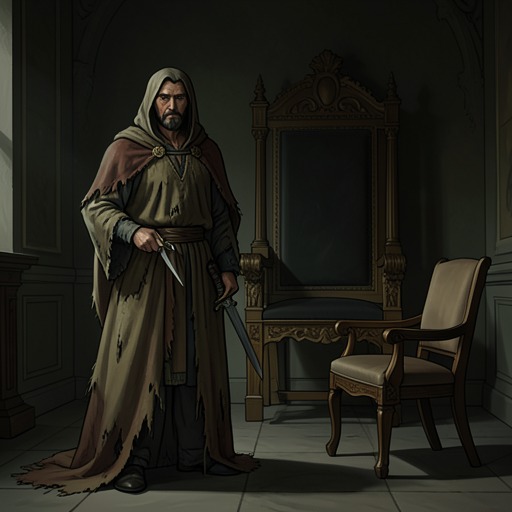
Cheryl expects to meet one king, rumored to be Bjorn, but finds two men waiting below the palace steps. Bjorn is a decorated champion associated with ceremonial nanite armor; Maskin is the larger, scarred Hero of the Apdratee invasion, visibly marked by the warrior-slave caste. The two men have fought each other for a day and a night until both collapsed from blood loss. Priest Quincy announces that the Gods have judged them equally worthy of the crown and transfers the decisive authority to Cheryl: she must choose which is more worthy of the queen.
Cheryl cannot accept the apparent alternatives. Her entire life has been arranged by others, yet she is suddenly required to make the one decision that will determine the kingdom’s ruler. When she says that the Gods should decide, Quincy supplies a supposedly divine solution. Cheryl and both Kings Presumptive are sent to the Shrine of Nethja, Goddess of fertility, where they must remain until the alignment of the four moons. If Cheryl becomes pregnant, the child’s father will be king. If she does not, both men will be executed and another king will be chosen.
The arrangement makes Cheryl’s pregnancy the evidence of divine judgment while imposing an immediate threat on all three participants. She is denied the wedding night she expected and confined for two months in a lunar shrine with two rivals encouraged to impregnate her. The trial’s reproductive requirement is therefore both intimate and political: the queen’s body is treated as the battlefield on which male status, royal succession, and religious legitimacy are decided. The stated alternatives are stark—one man’s paternity or the deaths of both men—but the institution also assumes that Cheryl’s consent is irrelevant.
The Hidden Rigging of Divine Choice
The trial’s central deception is revealed when Bjorn admits that its outcome was predetermined. Warrior-slaves are sterilized when separated from their families so that they cannot increase their numbers or build enough power to challenge the ruling houses. Maskin, despite his victories and his eligibility as a champion, can never father Cheryl’s child. The fertility trial thus disguises a caste restriction as the will of the Gods.
Bjorn recognizes that Quincy’s announcement effectively made him king from the beginning. The shrine was not a genuine contest between two equally capable candidates; it was a trap intended to make Maskin fail and then interpret that failure as supernatural punishment for rising above his station. Bjorn also confesses that he knew the truth and remained silent. His silence implicates even the candidate who benefits from the arrangement, showing how ritual authority survives through the cooperation of those protected by it as well as through the commands of its priests.
Maskin’s position exposes the contradiction most clearly. He has proved himself through tournaments and war, yet the system treats his reproductive capacity—not his courage, loyalty, or military achievement—as the final measure of whether he may rule. His body has been politically disabled in advance, and the trial converts that imposed disability into apparent evidence against his worthiness. The succession ritual therefore links biological control to social control: sterilization prevents rebellion, while the fertility test rationalizes exclusion after the fact.
Cheryl’s Reversal of the Choice
The trial does not end by confirming the institution’s intended result. After conflict and injury, Cheryl imposes her own rule on the relationship between the two candidates. She tells Bjorn and Maskin that if one of them is with her, the other must be as well; neither may be alone with her, and if they fight again, she will reject both of them. The declaration refuses the trial’s demand that she select one man and turns enforced rivalry into a condition of shared partnership.
Her decision also changes the meaning of succession. The institution assumes that a queen can be used to produce one king, but Cheryl makes her acceptance conditional on the recognition of both men. Her command is not merely romantic preference. It is a political intervention into a system that has always claimed the authority to decide for her. By controlling access to herself, she establishes the one form of power the trial had attempted to deny her: the power to define the terms under which kingship and reproduction can proceed.
Cheryl later confronts Quincy directly. When he invokes her status as a slave and insists that she must bow to a superior, she rejects the logic that makes obedience sacred. She argues that if a queen’s shedding of blood is criminal, then bloodshed must be criminal for everyone, and explains that she killed to defend herself and her kings. She also identifies the manipulation at the heart of the fertility test: Quincy knew warrior-slaves could not have children, so his supposed divine judgment was actually a means of choosing her king without allowing her a real choice.
That confrontation converts hidden knowledge into public accusation. Cheryl does not merely claim that the priest treated her unfairly; she exposes the contradiction between his universal language of divine law and the selective way he applies it. Her movement from the submissive temple woman Bjorn first encountered to the queen who walks through the warrior-slaves and takes Bjorn’s hand marks the trial’s decisive reversal. Sacred procedure has attempted to speak through her body, but she makes herself the speaker who interprets the procedure.
Broader Pattern of Fertility, Identity, and Belonging
The Royal Fertility Succession Trial belongs to a wider pattern in which reproduction determines social identity across the book’s worlds. Cheryl’s pregnancy would establish kingship; elsewhere, reproductive testing, mating, and pregnancy determine whether characters belong to a species, a royal line, or a community. The Shrine of Nethja’s fertility requirement therefore presents birth not as private family continuity but as public law.
The contrast with the Kinai Joining is revealing. Kenner explains that every twenty-five years, unmarried Kinai men and women between twenty and thirty spend the winter at the Rookery, where beastlings hatch and the Joining defines what the Kinai are. Both systems use a ritual threshold to assign social belonging, but the Temadian trial is imposed through confinement and unequal power, whereas the Joining is described as a guarded communal process whose secrets must be voluntarily protected by those admitted to it. The comparison makes clear that ritual can either integrate participants into a community or reproduce domination under sacred language.
The trial also anticipates the book’s recurring crossings between human, animal, and alien bodies. The technology that confirms pregnancy elsewhere can render an embryo as a strange mixture of tadpole and dinosaur, while Stlozyn ancestry is explained through human origins, intensified genes, added DNA, and shape-shifting capacity. Against that larger background, Cheryl’s trial is an especially restrictive use of biology: instead of treating bodily difference as a source of possibility, the Temadian order uses fertility and sterility to assign rank.
Narrative Significance
The trial’s most important irony is that it claims to surrender succession to the Gods while concentrating power in the priest who defines the test. Its sacred setting, four-moon timetable, royal platform, and threat of execution make the institution appear ancient and inevitable. Yet its result depends on concealed medical coercion, caste policy, and the priest’s interpretation. The ritual is therefore less a revelation of divine will than a performance that naturalizes political power.
Cheryl’s response does not erase the violence of the system, but it prevents the trial from delivering its intended conclusion. She identifies the manipulation, refuses the forced binary, and binds kingship to a relationship in which both Bjorn and Maskin must accept her conditions. The Royal Fertility Succession Trial consequently functions as both an institution of reproductive domination and the scene in which that domination is challenged: a ceremony designed to make Cheryl the instrument of succession becomes the occasion for her emergence as an agent of political choice.