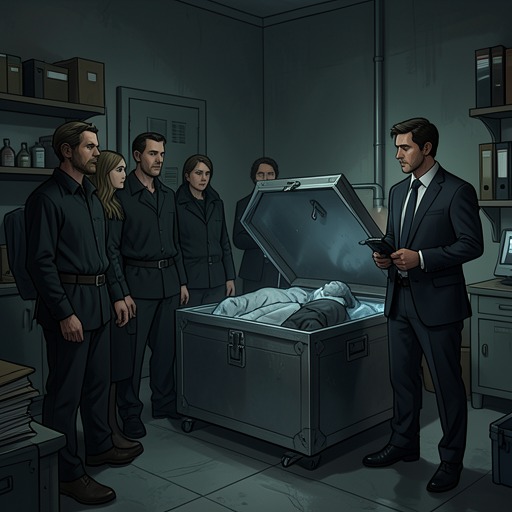
Ruziers Corporation’s Human Trafficking Plot
The Vampire Prince’s BrideRuziers Corporation’s Human Trafficking Plot is the decisive exposure of a commercial scheme disguised as humanitarian protection. What appears to be a plan to move endangered humans toward a sanctuary is revealed as a shipment whose value rests on the bodies, reproductive capacity, and legal vulnerability of its passengers. The revelation transforms the surrounding escape narrative from a question of safe transport into a confrontation with institutionalized human commodification.
Causes and Background
The plot develops around a shipment of humans whose destination is initially presented as a possible sanctuary. Tom has spoken of establishing protection for them, but the arrival of a tracker and the sudden change in Ruziers Corporation’s security arrangements unsettle that account. Rayo explains that Zon has learned of the shipment and is sending someone to collect it. Because Zon commands a large fleet, protects colonies, and is known as an advocate of human rights, Ruziers abandons stealth and assigns an escort to accompany Tom to the shipment site and back. The corporation also triples Tom’s retainer, making the increased payment a material sign that the cargo is more valuable and more dangerous than previously admitted.
Sara recognizes the contradiction before the corporation states it openly. If Ruziers fears that Zon will take the humans, and if Zon’s intervention is associated with human rights, then Ruziers is unlikely to be preparing the sanctuary Tom described. The supposed rescue has therefore been structured around concealment: the corporation uses the language of transport and protection while withholding the purpose that gives the shipment its extraordinary value.
What the Plot Reveals
Rayo identifies the humans’ commercial value in explicitly classificatory terms. They are not recognized as a sentient species, and they possess universal DNA, making them useful to buyers interested in biological experimentation and reproduction. The males are described as having value primarily for laboratories or private collections. The females can be sold under the Population Trade Act, a legal framework that gives trafficking the appearance of regulated commerce while enabling women to be treated as reproductive assets.
Sara immediately understands the practical meaning of that language. The law is not a neutral protection for a vulnerable population but a thin disguise for sexual enslavement. The women are reduced to breeding bodies, described in economic terms as if their ability to bear children were a product available for purchase. The plot’s central horror lies in this conversion of violence into paperwork: the corporation does not need to call the women slaves if legislation can authorize their sale.
The revelation also explains why the shipment commands such a high price and why Ruziers is willing to risk confrontation with Zon. The humans are not merely passengers requiring transport. They are inventory whose value is divided by sex, assigned to different markets, and protected by a legal structure that denies their personhood. Their universal DNA makes their bodies a resource, while their exclusion from sentient-species classification makes resistance easier to suppress.
Systems of Exchange and Control
The trafficking plot belongs to a wider pattern in which bodies, freedom, debt, and intimacy are treated as negotiable commodities. Elsewhere in the book, Killian attempts to save Danita by agreeing to buy her from the Lion, accepting a deadline of one month and an additional payment of two hundred and fifty thousand dollars. The arrangement is framed as protection, but its logic remains ownership: Danita’s safety depends on whether another man can pay the price assigned to her. Ruziers’ shipment enlarges the same structure from an individual ransom to an organized market.
The book repeatedly places bodily service inside financial calculations. Maribel accepts work as a vampire blood donor because she is being evicted, has lost her job, has had her car repossessed, and carries half a million dollars in debt after her boyfriend stole her identity. Her compensation is specified as ten thousand dollars per month, plus one hundred dollars per ounce of blood consumed, with further payment if feeding becomes sexual. This arrangement is not identical to Ruziers’ trafficking operation, but it clarifies the economic vocabulary through which the novel represents vulnerable bodies: need produces consent under pressure, and institutions turn intimate acts into priced services.
A similar logic appears in Sheridan’s intention to find a human woman to bear his child. His desire is expressed as a reproductive objective rather than as a mutual relationship, reinforcing the book’s recurring connection between human women and the biological continuation of powerful nonhuman societies. Ruziers’ plan makes that connection openly commercial. The corporation does not merely exploit individual desire; it organizes reproduction as a supply chain.
Labor, Administration, and Disguised Protection
Ruziers’ operation depends on layers of managed labor. Rayo and the other T’shav are assigned to escort Tom and the shipment after stealth is deemed impossible, while the increased retainer makes security itself part of the trafficking budget. The organization therefore presents exploitation through ordinary administrative forms: contracts, assignments, classifications, escorts, and statutory language. The appearance of procedure obscures the coercive destination of the process.
The contrast with other forms of assigned service in the book sharpens this point. Mack is recruited to care for Oliver, whose chaotic life requires a strict schedule covering food, bathing, calls to company boards, meals, snacks, and appointments with financial advisers and lawyers. That arrangement is demanding but legible as caretaking. Ruziers’ human shipment reveals the darker version of organized service, in which bodies are scheduled, transported, and allocated without the autonomy granted to persons.
The corporation’s secrecy is consequently not incidental. It is an operating method. Sara must perform boredom and flirtation while trying to learn what the shipment contains, because openly challenging the explanation would expose her before she knows the scale of the threat. Rayo’s casual assurance that the humans are worth more than Sara can imagine makes the cruelty more disturbing: the language of profit is delivered as routine business, not as an aberration.
Consequences and Narrative Significance
The revelation changes the meaning of Zon’s intervention. He is not simply a rival commander attempting to steal valuable cargo; his forces represent the possibility that the humans might be treated as people rather than as merchandise. Ruziers’ fear of him confirms that the corporation’s interests are incompatible with a genuine sanctuary. The conflict therefore becomes a contest between two forms of custody: corporate possession justified by law and military protection associated with human rights.
Sara’s response marks the moral turning point of the plot. Her anger rises as she realizes that the women are intended to become sex slaves and reproductive machines. She begins looking for a weapon, but Tom restrains her with a kiss before she can act. The scene juxtaposes political rage with involuntary physical desire, showing how quickly bodily intensity can interrupt deliberate resistance. That interruption does not erase the trafficking revelation; instead, it leaves the danger unresolved beneath the immediate intimacy.
The event also links the book’s supernatural romance economy to its broader critique of ownership. Grass necklaces, ransom payments, blood contracts, reproductive demands, and human shipments all place affection or survival beside exchange. The decisive difference is whether the body retains the power to choose. Ruziers’ plot is the clearest case in which that choice is systematically removed, and its supposed legal legitimacy exposes the political foundation of the world’s species hierarchy: humans can be exploited because the system first declares them less than fully sentient.
The plot’s significance extends beyond the individual shipment. It establishes why rescue, sanctuary, and human rights cannot be separated from economic power. A corporation can call trafficking protection, a law can call reproductive enslavement trade, and a payment can make captivity look like employment. By exposing those substitutions, Ruziers Corporation’s Human Trafficking Plot turns a hidden transport arrangement into a central indictment of a society that converts vulnerable people into inventory.