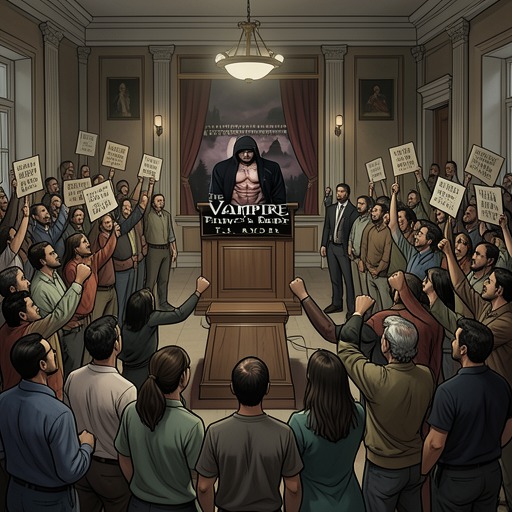
Self-Preservation Act
The Vampire Prince’s BrideThe Self-Preservation Act is a statutory protection for employers that becomes, in practice, a tool for excluding shifters from ordinary economic and civic life. By allowing a business to terminate anyone it considers a threat to safety, the Act makes the mere capacity to transform into an animal sufficient grounds for professional insecurity, even when no harmful act has occurred.
Legal Mechanism and Stated Rationale
The Act gives employers the right to fire a shifter if the employer believes that the person poses a danger to workplace safety. Its operative standard is therefore not proven misconduct but perceived threat. The law can be invoked against a person because of what that person is capable of becoming, making biological or supernatural difference itself a legally actionable risk.
This structure places shifters in a precarious position. There are no laws preventing them from taking jobs such as police work, yet there are also no laws protecting them from dismissal because they can turn into animals. The apparent permission to enter public employment is thus undercut by the employer's power to withdraw employment whenever a shifter's identity becomes known or is interpreted as dangerous.
Employment and the Cycle of Exclusion
Joseph Baker's experience illustrates the Act's practical reach. He is a shifter working as a police officer, and only his best friend and partner, Buck Harmon, knows his secret within the precinct. Joseph's employment is not plainly illegal, but it remains vulnerable because disclosure could allow an employer to characterize him as a safety threat.
The Act produces a self-reinforcing social trap. Known shifters can lose their jobs or be prevented from keeping them, after which they are treated as lazy people seeking government handouts. The law helps create the unemployment that is then used to justify contempt for the unemployed. In this sense, its institutional effect extends beyond individual dismissals: it manufactures the social evidence used to stigmatize the population it disadvantages.
Identity, Secrecy, and Perceived Threat
The Act also explains why shifter identity is handled as a dangerous secret. Maximillian Barnes tells Scarlett Brenan that only Vanessa and members of his mother's family know that he can transform into a gorilla. He fears that disclosure would cause people to leave him, spread the secret, or prompt a government authority to decide that he is a threat simply for existing. His wealth might protect him from public exposure, but it cannot guarantee protection from state power.
A similar boundary appears in the encounter between Bianca Jamison and Eric McKenna. After witnessing what Eric is, Bianca asks what he is but cannot bring herself to say the word aloud. Eric answers indirectly, recognizing that the truth is already understood even before it is named. The scene shows how the law's category of threat enters intimate life: knowledge of a shifter's identity changes the emotional conditions of the room, even before any official action is taken.
Wider Regime of Exceptional Control
The Self-Preservation Act belongs to a broader legal and institutional environment in which protection repeatedly becomes a justification for suspending ordinary rights. Senator Seth Fischer opposes the proposed Shifter Registry because he regards it as unconstitutional and as a possible step toward a Shifter Detainment Act. Ana Medina helps him rehearse his parliamentary speech, convinced that the registry would strip American citizens of hard-earned rights. Her position is summarized by the principle that people are people, regardless of whether they are shifters.
Other parts of the narrative show comparable systems governing bodies under the language of protection, order, or necessity. At Nethja's shrine, Cheryl is told that she and the two Kings Presumptive must remain there until the alignment of the four moons; her pregnancy will determine the king, while failure to conceive will lead to both candidates' deaths. The Fifth Cycle Festival, meanwhile, is described as an ancient contest in which men kill one another to become the God and gain control over a woman chosen as the Goddess; the United Species has banned it because the Goddess is often killed and eaten. These institutions differ from the employment law, but they share its underlying logic: a collective rule defines certain bodies as administrable risks or resources and then treats coercion as an acceptable means of preserving order.
Social and Narrative Significance
The Act's most important consequence is the conversion of difference into presumed danger. Cain Samson is publicly perceived as an extraordinarily successful hockey player, rich and handsome, while Michelle Handsworth senses that he is something more than human. Her supernatural perception reveals a hidden reality that ordinary social institutions cannot see, but the Act demonstrates what may happen once such hidden identity becomes visible to authority: employment, reputation, and security can all become conditional.
The law therefore makes secrecy a survival practice rather than a mere personal preference. It pressures shifters to conceal themselves, encourages employers and governments to treat disclosure as evidence of danger, and leaves allies such as Buck Harmon carrying private knowledge that may determine whether a colleague can remain safely employed. Against that structure, the opposition of Seth Fischer and Ana Medina frames equal citizenship as the necessary alternative. The Self-Preservation Act is significant not because it openly declares shifters outside society, but because it includes them only provisionally, allowing ordinary rights to be withdrawn whenever fear is translated into administrative judgment.