Shifter Secrecy and Human-Disclosure Rule
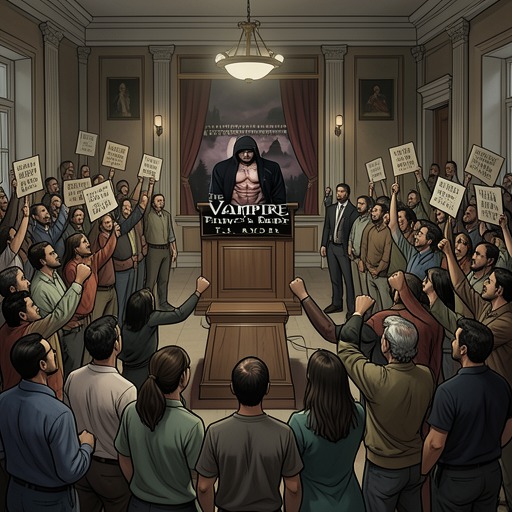
The Vampire Prince’s BrideThe Shifter Secrecy and Human-Disclosure Rule is a survival ethic for supernatural people living among humans or other species who may fear, exploit, study, or persecute them. Its central principle is selective disclosure: shifters generally conceal what they are, but a human intimate may be told when trust has been established and the consequences of continued secrecy would be more dangerous than the risk of exposure. The rule therefore treats identity as both private truth and communal security, making every revelation a negotiation between personal vulnerability and collective protection.
Definition and Purpose
The rule develops from the assumption that supernatural identity cannot safely be treated as ordinary personal information. Cain Samson’s nature is invisible to normal observers, although Michelle Handsworth can perceive the difference around him: she senses him before seeing him, smells smoke when he arrives, and recognizes that he is not an ordinary human. To everyone else, Cain appears to be a successful, wealthy, handsome hockey player. His concealment protects him from being categorized as a threat merely because of what he is.
The danger is stated most directly by Max. He explains that Vanessa and his mother’s family know that he can transform into a gorilla, but he has told no one else because a frightened person might leave and then reveal the secret to others. Even wealth might not protect him from a government that decided his existence made him dangerous. His fear establishes the rule’s practical logic: secrecy is not vanity or deception for its own sake, but a defensive response to stigma, institutional power, and the possibility that one disclosure could become public knowledge.
Disclosure and Trust
The rule does not impose absolute silence. In the guidance given to Harrod Ford, his grandfather says that choosing a partner from one’s own kind is preferable, but that, when a human relationship does occur, the better course is to tell the human if that person can be trusted. The standard is therefore relational rather than mechanical. A human partner must be assessed not only as a romantic companion but also as a potential custodian of dangerous knowledge.
Harrod’s revelation illustrates the emotional difficulty of that process. He is first told that his mother’s supposed delusions were true, that his father had been possessed, and finally that he and the rest of his family are werewolves, while his mother is not. The disclosure forces him to revise his understanding of his family and of his own body. His grandfather also explains that an Alpha’s bite can convert a human into a werewolf, adding another dimension to the rule: disclosure may involve not merely knowledge of an identity, but the possibility of bodily transformation and an altered future.
The rule also frames disclosure as an act requiring preparation. Before explaining the truth to Harrod, the speaker warns him that the information will be difficult to digest, asks him to listen, and gives him time to process it. This caution contrasts with revelations imposed through crisis. In Bianca Jamison’s case, a shifter enters carefully, positions his body so that he will not appear threatening, moves slowly, and waits while she processes what she has witnessed. When Bianca asks what he is, he answers indirectly, allowing her to recognize the truth at her own pace rather than forcing a label upon her.
Secrecy, Exposure, and Bodily Risk
The surrounding stories show why the rule has such severe stakes. Sara is human but conceals that fact behind a full-body blue tattoo and golden bionic eyes because humans are rare and valuable. If her captors perform deep scans, her DNA will expose her. Humans preserved in stasis pods during light-speed travel have appeared throughout the stars, but many have been placed in private collections or dissected by research companies rather than welcomed safely. Her concealment is thus a form of protection against commodification and scientific exploitation.
Other episodes make the same danger visible through invasive examination. Lisa is told that equipment has detected a lifeform attached to her uterine wall, feeding from her and changing her hormones. Gemma is abducted because she carries a child believed to be the key to curing the Stlozyn disease. A dragoness describes the child as a specimen and treats Gemma’s body as research material, while the Science Board pressures Shay to take steps toward a cure that could endanger Gemma and the fetus. These cases broaden the rule beyond shifter-human romance: hidden identity and selective disclosure operate within a world where bodies can be scanned, classified, claimed, and used by institutions.
The contrast between voluntary revelation and forced discovery is decisive. A trusted human may receive the truth as part of an emerging relationship, with time to respond. A scan, abduction, or hostile interrogation removes that choice from both sides. The rule’s ethical force lies in preserving agency: disclosure should occur because the shifter chooses a trustworthy recipient, not because an authority, device, or captor has converted identity into evidence.
Consequences for Relationships
The rule makes intimacy inseparable from risk. Max’s secrecy protects him from public exposure, but it also wounds Scarlett because she realizes that he had not planned to trust her with the truth. Their temporary arrangement was already expected to end after seven months, so his silence becomes evidence of emotional distance even while it remains rational self-protection. The episode shows the rule’s central paradox: concealment may preserve physical safety while undermining the trust that intimate relationships require.
Cain’s relationship with Michelle carries a related tension. Michelle can perceive that something is hidden behind Cain’s public identity, and that knowledge keeps her away from him even as he openly expresses attraction and presents himself as a successful human athlete. Her supernatural perception turns ordinary courtship into an encounter with concealed difference. The rule therefore affects not only the person keeping the secret but also the human who senses that the visible identity is incomplete.
Bianca’s response offers a more gradual model. After seeing the truth, she is nervous and fragile, and the shifter gives her physical space and time. His behavior recognizes that disclosure can produce fear even when it is not accompanied by aggression. The scene places responsibility on the supernatural person to manage the revelation ethically: concealment may be necessary, but once the truth is exposed, the human’s fear and right to process it must be respected.
Narrative and Social Significance
Across these episodes, the Shifter Secrecy and Human-Disclosure Rule exposes the social cost of being classified as other. Cain fears government suspicion; Max fears abandonment and public revelation; Harrod must reconstruct his family history; Bianca struggles to name what she has seen; and Sara hides her human DNA from a society that treats humans as rare commodities. The repeated pattern links private secrets to wider systems of stigma, surveillance, research, and bodily control.
The rule is consequently neither a simple command to hide nor a blanket endorsement of confession. It is a conditional practice shaped by trust, danger, consent, and power. Its most humane form asks a shifter to disclose carefully to a person capable of receiving the truth, while its harshest surrounding examples show what happens when identity is exposed without permission or when institutions claim the right to decide what another person’s body means. In this world, revealing the self is not merely a romantic gesture or a factual correction; it is a high-risk act of trust that can alter a relationship, a family, and the shifter’s place in society.