Shifter discrimination
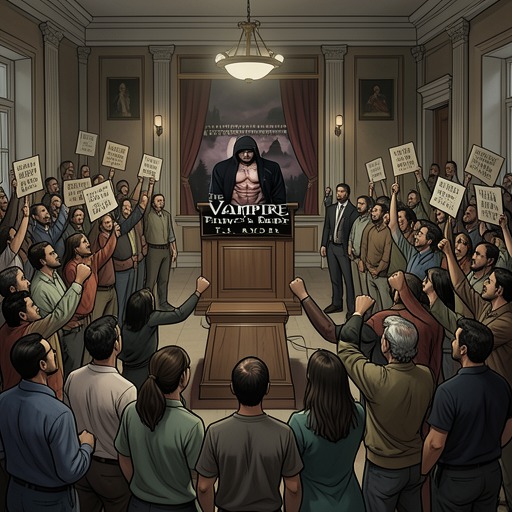
The Vampire Prince’s BrideShifter discrimination is a pervasive social condition rather than a single incident. It defines shifters as threats before their individual conduct can be considered, pressures them to conceal their identities, and turns ordinary spaces—restaurants, offices, hospitals, government chambers, and homes—into sites of surveillance and exclusion. The narrative’s central contrast is that shifters are repeatedly described as dangerous while humans subject them to insults, abandonment, coercion, institutional neglect, and violence.
Everyday Stigma and Public Hostility
The condition becomes visible to Destiny when she learns that Parker can change into a bear. A man at the neighboring restaurant table coughs conspicuously, mutters “Freak,” and glares at Parker. Destiny notices other diners staring or quickly looking away, suggesting that the insult is not an isolated lapse but part of a shared social atmosphere. Parker responds with practiced restraint, lifting a shoulder and explaining that not everyone is a fan. His claim that he is used to it gives the scene its quiet cruelty: discrimination has become routine enough for the target to anticipate and absorb it.
Destiny, however, has not yet learned to normalize the hostility. After apologizing for speaking loudly about Parker’s identity, she immediately rejects the expectation that she should remain silent. She puts down her fork and glares back at a woman who is watching them, then challenges the man who announces that he needs to find another restaurant. Her anger makes prejudice public instead of allowing it to remain a private gesture, and her response establishes solidarity as an active choice rather than passive tolerance.
The same prejudice enters intimate relationships through fear-based assumptions. Ava objects to Destiny dating Parker and the other man after learning that both are shifters. She warns that Destiny is dating “two guys who are highly dangerous” and imagines that their animal nature could make sexual refusal impossible. Destiny rejects the implication that transformation erases moral agency. She insists that being a shifter does not make someone a rapist and that shifters retain complete control over the change. The disagreement shows how discrimination operates through supposedly protective language: Ava presents her suspicion as concern for Destiny, but her argument reduces Parker and his companion to bodies presumed incapable of consent.
Workplace and Institutional Exclusion
At Destiny’s workplace, prejudice is expressed through hostility toward Parker’s presence. When he is introduced as Destiny’s bear boyfriend, Joshua jokes about calling game control to remove the “wild animals” from the office. His language converts a person into an intruding specimen, while his later remark that bears taste good when cooked makes the threat more explicit. Caleb goes further, declaring that shifters are a danger to society and should be kept in cages. The imagined cage reveals the political consequence of everyday insult: discrimination is not merely an attitude but a demand for confinement and social control.
Parker answers by questioning the assumptions beneath the hostility. He asks whether the men are afraid, curious, or simply convinced that shifters are strange and dangerous. When Caleb invokes reports of shifter attacks, Parker counters that the news he sees is filled with humans attacking one another as well as attacking shifters—with guns, knives, fists, and words. The comparison refuses the claim that violence belongs naturally to shifter bodies. It relocates danger from species identity to conduct, and it exposes the selective way public narratives assign blame.
The office confrontation also reveals that discrimination can be measured against an individual’s actual behavior. Parker points out that he and Destiny have behaved calmly, while Destiny has shown compassion and the ability to see beyond race and species. He argues that such qualities should be valuable in an employee, unless the workplace values racism, sexism, and specism instead. Joshua and Caleb retreat after this challenge, but their retreat does not erase the structure that produced the comments. The scene instead demonstrates how naming prejudice can interrupt its authority, even when institutional acceptance remains conditional.
Medical Discrimination and Bodily Risk
The hospital scene gives shifter discrimination its most immediate material consequence. After Parker is stabbed, Destiny drives him to the emergency room, runs inside for a nurse and wheelchair, and returns to find him speaking in grunts and stilted words while people stare. A nurse tells her that the hospital does not usually treat shifters because their bodies are different and supposedly require special care. The distinction is presented as a practical medical limitation, but in the emergency setting it functions as refusal of care while Parker is suffering a deep penetrating injury.
The institutional failure becomes unmistakable when one nurse identifies Parker’s trauma as requiring immediate treatment, yet the nurse behind the desk says that there is no one available to treat him. A second nurse finally pushes the wheelchair through the doors, finds a room, and begins gathering supplies. Parker’s survival therefore depends not on an equitable system but on an individual worker’s decision to act. The scene links social stigma to bodily vulnerability: the same identity that attracts insults in public can delay treatment when the shifter is injured, making discrimination a force capable of producing physical danger rather than merely expressing dislike.
Secrecy, Exposure, and Political Resistance
Because disclosure can lead to rejection or state suspicion, many shifters manage identity as a dangerous secret. Cain Samson is publicly seen as a wealthy, successful hockey player, but Michelle senses that he is something other than an ordinary human. Max similarly explains that only Vanessa and his mother’s family know he can turn into a gorilla. He fears that anyone else might leave, reveal the secret, or encourage the government to treat him as a threat simply because he exists. His secrecy is not evidence of shame alone; it is a survival strategy shaped by the anticipated consequences of exposure.
Other scenes show humans being endangered by species hierarchy and biological difference. Sara wakes in a cage made of flickering blue energy and fears being auctioned because she is human, a rare and valuable commodity. The Fifth Cycle Festival, an ancient competition in which men kill one another to become a god with control over a chosen goddess, has been banned by the United Species because the goddess was often killed and eaten. Gemma is later treated as a specimen when a dragoness declares that her impossible child could cure the Stlozyn disease and describes the pregnancy as research material. These episodes broaden the book’s critique beyond a simple human-versus-shifter division: bodies are repeatedly classified, valued, confined, or exploited according to what powerful institutions believe they can extract from them.
The political response to discrimination is represented by Ana Medina and Senator Seth Fischer. Ana records Fischer rehearsing a parliamentary speech opposing the proposed Shifter Registry because it is unconstitutional and threatens shifter lives. She understands the registry as a possible step toward a Shifter Detainment Act and refuses to accept the removal of citizens’ rights. Her conclusion that people are people places personhood above species classification and connects private solidarity with organized resistance.
Contradictions and Narrative Significance
The narrative repeatedly contrasts claims about shifter violence with concrete scenes of human prejudice. Parker is called an animal, threatened with confinement, and denied prompt medical care, yet he remains controlled and articulate while confronting his attackers. Destiny’s defense of him does not deny that shifters possess physical power; it denies that power determines character, consent, or civic worth. This distinction is crucial because it rejects both romantic idealization and species essentialism: Parker is not proven worthy by pretending he lacks an animal nature, but by demonstrating agency within it.
The recurring language of animals, cages, specimens, auctions, and consumption creates a shared vocabulary of dehumanization across separate storylines. A shifter may be mocked as a wild animal in an office, excluded from an emergency room, or forced to hide a gorilla or bear form from the public. Elsewhere, humans are purchased as blood sources, preserved in stasis, dissected by research companies, or selected for reproduction. The result is a world in which discrimination is sustained by institutions that convert difference into an excuse for possession or exclusion.
Shifter discrimination therefore serves as both a social condition and a structural test of relationships. Destiny’s choice to challenge the restaurant’s customers, defend Parker at work, and fight for his treatment demonstrates that allyship requires confrontation rather than abstract sympathy. Parker’s restraint exposes the long-term cost of living under suspicion, while Ana and Fischer show that resistance must also enter law and government. The state remains an unresolved pressure throughout these examples, but the narrative’s clearest argument is consistent: danger is not inherent in a shifter’s body, and the systems claiming to protect society can become the most immediate source of harm.