Stlozyn Informed-Consent Ethic
The Vampire Prince’s BrideStlozyn Informed-Consent Ethic is the principle that scientific research must respect the autonomy of those subjected to it, especially when they cannot reasonably understand or consent to the risks. In the conflict surrounding Gemma’s pregnancy, the ethic becomes more than a professional ideal: it is the line separating medicine from coercion, and the principle that Science Alpha Shay is prepared to defend against his own society’s emergency institutions.
Definition and Ethical Scope
Stlozyn science treats knowledge as public record, and concealment of research is described as blasphemous. That commitment to open knowledge, however, does not authorize every possible experiment. The informed-consent ethic places a limit on scientific access to bodies: a person, and especially a developing fetus, must not be used as experimental material merely because the resulting data might be valuable. Shay states the principle directly when he argues that experimenting on those unable to give reasonable understanding and consent is sacrilege against science itself.
The ethic therefore protects more than the publication of information. It distinguishes a community’s right to know from a researcher’s right to seize biological material. The difference becomes especially important because the requested material is not abstract data. Gemma carries a child that should not be possible among the Stlozyn, and the child’s developing DNA may possess unusual medical value. The child’s exceptional status makes the pregnancy scientifically important, but the ethic insists that unusual promise does not erase the subject’s moral standing.
Conflict with the Science Board
The principle is tested when Niqæsh reprimands Shay in the Science Board’s throne room. The Board has learned that his research may contain a cure for the disease ravaging the Stlozyn, yet it accuses him of refusing to take the steps needed to develop that cure. The disagreement is not about whether Shay’s findings matter. His work on Earth indicates that synthesized human DNA could form a vaccine for uninfected Stlozyn and prevent further infection. With more research, DNA taken from the child after birth might also help reverse the infertility afflicting his people.
Niqæsh nevertheless insists that DNA from a forming fetus would be more potent. Her argument turns the pregnancy into a resource whose value increases precisely because the fetus is vulnerable and cannot consent. The Board frames the demand as a population emergency: Stlozyn children are disappearing from the future, and delay could leave the people childless. Shay’s response rejects that consequentialist logic. The possibility of saving many lives does not permit the deliberate risk of killing what may be the only child he will ever have.
The Board escalates from professional pressure to institutional coercion. Wynon has requested custody of the pregnant human, and the Board has agreed that transferring Gemma is best for the Stlozyn. Shay is told that he must comply or lose his position. The threat reveals how the ethic is endangered: consent is not merely ignored by an individual researcher, but displaced by an authority that claims to speak for the survival of the entire species.
Shay’s Refusal and the Human Subject
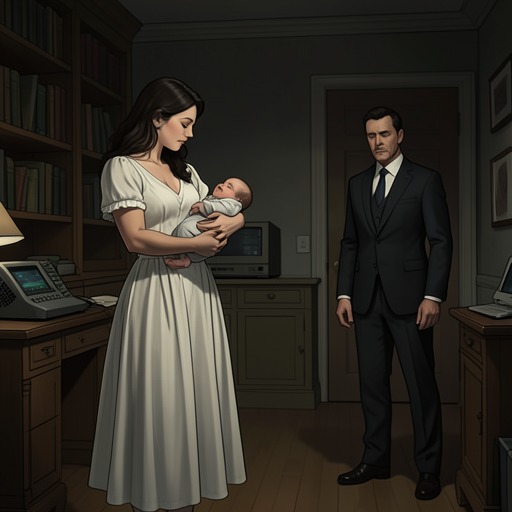
Shay identifies the fetus as his child and names the human carrying it as Gemma. That statement resists the Board’s attempt to reduce both of them to a specimen and a biological opportunity. His anger is expressed physically through clenched hands, smoldering fire, and the pressure of his dragon nature against his body, but his refusal remains an ethical decision rather than an uncontrolled outburst. He has promised Gemma that she will be safe, and he will not surrender either her or the child for experimentation.
His proposed alternative is significant. Rather than accept fetal extraction, Shay suggests a breeding program if children are truly the Board’s primary concern. The proposal is troubling in its own right because it treats reproduction as a collective solution, but within the immediate dispute it demonstrates that he is searching for a way to address the demographic crisis without exposing Gemma and the fetus to the specific danger of involuntary experimentation. The scene thus places competing forms of bodily governance beside one another: research extraction, reproductive planning, and personal protection.
Gemma’s own encounter with the dragoness exposes the human cost hidden behind institutional language. The dragoness tells her that the child is the key to curing the Stlozyn and describes Gemma’s body in terms of its usefulness during research, including its capacity to endure starvation. Gemma asks what will be done to her and receives the answer that whatever is necessary will be done. The language of specimen, custody, and necessary research converts a pregnant person into a container for a cure, exactly the kind of dehumanizing process the informed-consent ethic is meant to prevent.
Related Medical Power and Narrative Significance
Elsewhere, medical technology also reveals how easily bodily autonomy can be displaced by technical description. When Zon scans Lisa, the equipment identifies a lifeform attached to her uterine wall and feeding on her while altering her hormone production; the diagnosis is called a parasite. Lisa is not described as having understood or authorized the biological condition before it is interpreted through a scanner. In contrast with Shay’s explicit defense of consent, the diagnostic scene shows the power of instruments and specialist vocabulary to define what is happening inside a person before that person can make sense of it.
Sara’s awakening in a cage further clarifies the broader stakes of bodily control. She immediately checks that she is still wearing her uniform and infers that she has not been prepared for a slave auction. Her relief depends on the distinction between being held captive and being sexually displayed for sale, but neither condition represents meaningful consent. Together, these episodes place Stlozyn Informed-Consent Ethic within a wider narrative pattern in which bodies are scanned, classified, confined, purchased, or claimed by institutions and powerful individuals.
The rule’s most important consequence is that it makes Shay’s scientific achievement inseparable from his refusal to exploit the vulnerable. His research could produce a vaccine and perhaps a cure for Stlozyn infertility, but the story does not treat those benefits as automatic permission to sacrifice Gemma or their unborn child. Instead, the ethic forces the question of who bears the risk and who receives the benefit. By defending the child before birth and Gemma as a person rather than a specimen, Shay preserves the moral purpose of science even when the Science Board argues that survival itself should override consent.