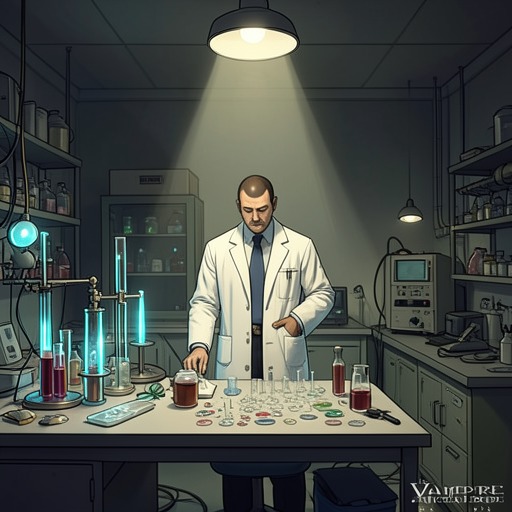
Stlozyn Scientific-Transparency Rule
The Vampire Prince’s BrideThe Stlozyn Scientific-Transparency Rule is the governing principle that scientific research must be openly shared among the Stlozyn rather than concealed by individual researchers. Its decisive importance lies in the contradiction it creates: a culture that treats knowledge as a collective resource can still turn that principle into coercive authority when research depends on another person’s body, pregnancy, or genetic material.
Definition and Social Authority
The rule is presented as a foundational Stlozyn norm through the claim that all science is public record. Niqæsh, speaking for the Science Board, describes concealment of knowledge as blasphemous. The language gives scientific disclosure a religious and disciplinary force: withholding research is not merely an administrative violation but an offense against the society’s shared worldview.
The rule also establishes a strong presumption that discoveries belong to the community. Shay has shared all of his research, yet the Science Board still considers his conduct suspect because he has not taken the further steps it demands toward developing a cure for the disease ravaging the Stlozyn population. The distinction between publishing knowledge and surrendering control over its practical use becomes central to the conflict.
Conflict with Consent and Medical Ethics
The rule reaches its most dangerous limit through Gemma’s pregnancy. Gemma is restrained and abducted by a dragoness who claims that the child she carries should not be possible and may hold the key to curing the Stlozyn disease. The research imperative therefore converts pregnancy into a scientific specimen and the unborn child into a communal resource. Gemma is not approached as a consenting participant; she is held in place, questioned, and described as a healthy specimen whose body can sustain the research.
The dragoness explicitly links the demand for experimentation to the transparency principle. She says that Shay’s research is already public and that hiding knowledge from others is blasphemous. Her reasoning treats the public status of research as permission to obtain whatever biological evidence might complete it. The rule thus fails to distinguish between access to information and access to a person.
Shay’s response supplies the counterargument. Before Gemma is taken, he understands that the Board may expect DNA to be extracted from the pregnancy at an early and precarious stage. He regards that demand as unethical because it would place both Gemma and his child in danger. His refusal does not reject scientific responsibility altogether: he has already shared his research. Instead, it rejects the idea that transparency overrides informed consent, bodily autonomy, and the duty to protect vulnerable subjects.
Institutional Enforcement and Its Limits
The Science Board embodies the rule as an institution of discipline. Its members sit in a throne room dressed in blue, the color associated with discipline, and summon Shay to account for his supposed failure. The setting makes scientific governance resemble political or religious judgment. Shay enters expecting reprimand without knowing what offense has been attributed to him, which shows how broad and uncertain the rule’s enforcement power has become.
Niqæsh’s accusation is framed as a public emergency: a cure may exist, the population is suffering, and Shay is allegedly refusing to take the necessary steps. Those stakes make the Board’s demand understandable as a collective response to disease, but they do not establish that the Board has the right to compel extraction of fetal DNA. The rule supplies a moral vocabulary for urgency while leaving unanswered who bears the physical risk and who has authority to consent.
The conflict also exposes an internal inconsistency. Stlozyn science is said to be transparent because knowledge should circulate freely, yet the Board’s response treats Shay’s personal decision about a dangerous procedure as if it were itself secret research. In practice, openness becomes compulsory cooperation. The principle protects communal access to findings but offers no evident safeguard against institutional appropriation of the bodies that produce those findings.
Broader Pattern of Classification and Disclosure
The rule belongs to a wider world in which hidden identities and bodies are repeatedly made subject to external inspection. Sara remains in danger because a scan could reveal that she is human rather than Aphrosian; her tattoo and golden bionic eyes disguise her appearance, but her DNA would expose her to a society where humans are rare commodities, held in private collections, or dissected by research companies. In that context, biological knowledge is never neutral. Classification determines whether a person is protected, imprisoned, auctioned, or studied.
Other encounters likewise show the social cost of forced disclosure. Cain Samson’s nonhuman nature is invisible to ordinary observers, while Michelle can perceive the aura and smoke associated with what he really is. Max explains that revealing his ability to turn into a gorilla could make people afraid, cause them to leave, and ultimately expose him to government suspicion. Bianca recognizes what Eric McKenna is without being able to say the word aloud. These cases contrast voluntary trust with compelled revelation and clarify why public knowledge can become a threat when institutions decide that every concealed fact belongs to them.
The same pressure appears in media and law. Crystal Scott uses a hostile broadcast to portray shifters as vile, instinct-driven creatures and questions whether a Bear detective can protect the public. A newspaper image labels Logan “The Alpha’s Secret Son,” turning concealed parentage into public scandal. At Sheridan’s palace, the Human-Vampire Relations Bureau acts on an anonymous complaint alleging that humans are being held and forced to donate blood. Across these situations, exposure is presented as investigation, journalism, public safety, or accountability, but the affected person or group bears the consequences of being defined by outsiders.
Narrative Significance
The Stlozyn Scientific-Transparency Rule gives the book’s science-fiction setting a clear institutional dilemma: communal knowledge can be emancipatory when it prevents research from becoming private property, yet oppressive when it erases the difference between information and consent. Gemma’s captivity makes that dilemma physical. Her pregnancy is scientifically valuable precisely because it is intimate, vulnerable, and difficult to reproduce, which makes the demand for access more invasive rather than more legitimate.
The rule therefore functions less as a simple defense of open science than as a test of whether a society can pursue collective survival without sacrificing individual agency. Shay’s refusal places ethical limits on the public-science ideal, while the Board’s demand reveals how easily a noble principle can become a mechanism of discipline. The surrounding stories reinforce the warning: once DNA, supernatural identity, parentage, or blood is treated as public property, disclosure can become the first step toward commodification, persecution, or experimentation.