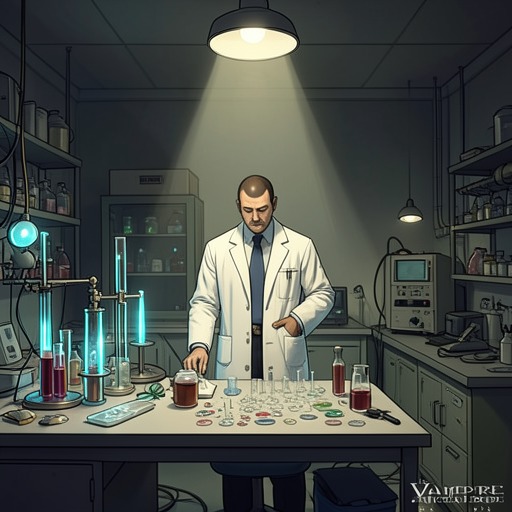
Stlozyn infertility disease
The Vampire Prince’s BrideStlozyn infertility disease is a hereditary illness that attacks the genetic material of the Stlozyn and steadily makes conception more difficult. Its importance extends beyond medicine: the disease threatens the survival of an entire species, turns reproduction into a political emergency, and makes the body of Gemma’s unborn child the contested site where collective survival confronts individual rights.
Nature and Species-Wide Threat
The disease is described as infecting Stlozyn genetic material and causing infertility. Shay, a Stlozyn scientist, believes that human DNA may contain the key to a cure. His concern is not theoretical. The illness is producing infertility rates severe enough that the Stlozyn could die out within only a handful of generations if no remedy is found. The disease therefore functions simultaneously as a biological condition, a demographic crisis, and a threat to the continuity of Stlozyn culture.
The illness also reshapes the meaning of pregnancy. Children are highly celebrated among the Stlozyn because conception is becoming increasingly difficult, so Gemma’s pregnancy carries an importance far beyond her private relationship with Shay. A healthy child represents hope for a population facing possible extinction, while the rarity of successful reproduction gives the Science Board a powerful justification for treating pregnancy as a resource to be studied and managed.
Human DNA and the Possible Cure
Shay’s research leads him to argue that human DNA can provide a cure for the disease. He explains that the Stlozyn’s ancestors were human beings taken from Earth several hundred years earlier. Their descendants were not simply modified; particular genes were made more pronounced, and additional DNA strands enabled them to shift shape. This history makes the human–Stlozyn relationship biologically significant: human DNA is not an entirely foreign material but part of the species’ own deep ancestry.
Gemma’s pregnancy appears to confirm the practical importance of that connection. Shay’s fertility tests show that his own genetic material should be too weak for him to father children because he has suffered from the disease. Yet the scans establish that the embryo Gemma carries is undeniably his and is developing healthily in its third month. The result gives Shay personal joy while also strengthening his belief that human and Stlozyn biology may be compatible enough to produce a path toward recovery.
The medical examination makes the crisis visible through technology. A doctor scans Gemma’s midsection and constructs a three-dimensional holographic image of her uterus and embryo. The developing child initially looks more like a mixture of a tadpole and a dinosaur than a human baby, but Gemma understands that it will develop into a child. The scene places advanced reproductive science beside an ordinary maternal recognition: the embryo is both an object of scientific observation and a developing person.
Scientific Emergency and Ethical Conflict
The disease creates the central conflict between Shay and the Stlozyn Science Board. Wynon argues that DNA should be extracted from the fetus because fetal material would be especially potent. She measures one fetus and one human life against the survival of the species, and further proposes using human women as sources of additional Stlozyn pregnancies. Her reasoning turns reproductive bodies into instruments of population policy and presents forced extraction as an acceptable response to extinction.
Shay refuses. Although he accepts that human DNA may help create a vaccine for uninfected Stlozyn, he rejects the proposal to endanger Gemma or the child by extracting fetal DNA during the early stages of pregnancy. He maintains that a synthesis of human DNA could protect those who have not yet contracted the disease and that DNA might be extracted from his child after birth, when doing so would pose no comparable risk. The distinction is crucial: the possible cure does not automatically authorize every method of obtaining it.
The Science Board treats Shay’s refusal as disciplinary misconduct. Niqæsh tells him that he possesses a potential cure but refuses to take the steps necessary to develop it. Shay understands that the Board wants access to the fetus, yet he insists that the child is his and that Gemma must be recognized by name rather than reduced to a biological category. He calls experimentation on a developing fetus without the possibility of meaningful consent a violation of the ethics of science itself.
Narrative Function and Significance
Stlozyn infertility disease converts a private pregnancy into a species-wide crisis. Gemma is not merely carrying Shay’s child; her pregnancy is presented as evidence that the genetic barrier produced by the disease may be overcome. At the same time, the very possibility of a cure exposes how quickly a population under threat can redefine vulnerable lives as raw material. The disease thus drives both the hope of renewal and the danger of reproductive exploitation.
Its significance is sharpened by the contrast between medical knowledge and moral judgment. The same scans that assure Shay that Gemma and the child are healthy also provide the Science Board with a reason to demand fetal research. The same human DNA that promises vaccination and perhaps reversal of infertility makes Gemma’s body politically valuable. The illness cannot be separated from the institutions built to fight it, because the emergency gives those institutions an argument for suspending ordinary protections.
The disease also unsettles fixed boundaries between human and alien, natural and technological, and individual and collective identity. The Stlozyn descend from humans, possess additional shapeshifting DNA, and can produce a healthy cross-species pregnancy despite the disease that should have left Shay infertile. In that structure, biological difference becomes a possible bridge rather than an absolute divide, while scientific progress becomes morally meaningful only when it protects the people whose bodies make that progress possible.