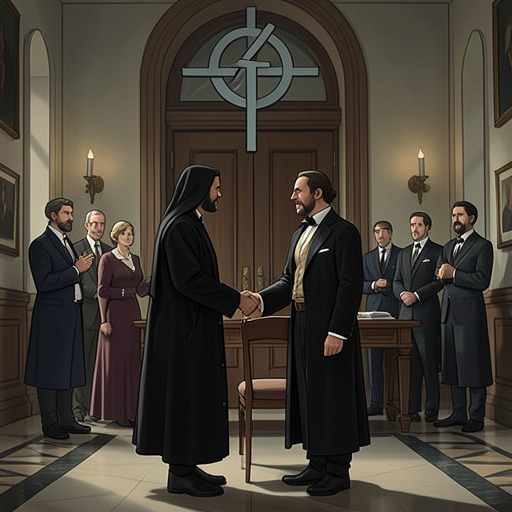
The Council Accepts Amelia as Alpha Female
The Vampire Prince’s BrideThe Council Accepts Amelia as Alpha Female is the decisive public recognition of Amelia as the human Alpha female and the completion of the triad formed with Xavier Knight and Timothy Pond. The council initially approaches her as a troubling exception to werewolf expectations, but Amelia turns the encounter into a test of whether pack unity can include a human woman as an equal participant rather than merely tolerate her as a substitute.
Causes and Background
Xavier Knight returns to the room with about a dozen old werewolves behind him, all visibly uneasy. Timothy Pond immediately tenses and rises, while Xavier and Timothy stand together as the two Alphas. Amelia does not remain at the edge of the confrontation. She takes her place beside them with her shoulders back and her head held high, physically presenting herself as part of their leadership before the council has granted that status.
The council’s spokesman explains that the elders have discussed whether to accept the two Alphas’ leadership or challenge it. Their central concern is not personal approval but the solidarity of the packs. The old man admits that the elders are unhappy about their Alphas mating with a human, yet they recognize that the alternative—allowing the packs to be torn apart—could be disastrous. He also acknowledges that his granddaughter Lucinda’s efforts to separate Amelia from the two Alphas threatened that wider unity. The political calculation is therefore clear: Amelia’s acceptance is initially framed as a compromise made to prevent division.
Amelia’s Challenge to the Council
The old man declares that a human female Alpha is preferable to destroying the alliance between the packs. Amelia rejects the condescending terms of that declaration. She objects to being discussed as though she were merely an object exchanged in a dispute between werewolves, and the council’s surprise shows how little it expects her to challenge its authority directly.
Amelia identifies the elders’ responsibility for Lucinda’s conduct. Lucinda did not invent her expectation of becoming Alpha female independently; the elders had told her since childhood that the position belonged to her. Amelia therefore refuses to let the council treat Lucinda’s actions as an isolated personal error while ignoring the tradition that produced them.
She then defines her own status. Amelia insists that she is not simply a human whom the Alphas have chosen instead of a werewolf. She is the completion of their Alpha triad, and she demands that the council stop speaking about her as though she were a temporary patch applied to a political problem. When the old man falls silent, Amelia adds a demand for an apology and establishes a continuing rule: from that day forward, the council must address her as a person present in the room rather than speaking over her.
Recognition and Admission
The confrontation changes when the old man asks whether Amelia is truly human. She confirms that she is, but makes the point that her humanity does not make her less worthy of being mated to the Alphas. The statement turns the council’s supposed objection into the basis of Amelia’s claim: she does not seek acceptance by denying her human identity, but by insisting that humanity cannot disqualify her from authority or partnership.
The old man finally says that he now understands and welcomes Amelia to the pack. The council’s decision is therefore both political and personal. It preserves the solidarity the elders value, but it also follows Amelia’s insistence that recognition must be extended to her as an equal Alpha rather than granted as reluctant mercy. Amelia responds graciously, privately judging that the Alphas’ earlier fight was enough to force the elders to reconsider the consequences of their position.
Consequences and Aftermath
The acceptance stabilizes the relationship between the two packs and confirms the Alpha triad as a legitimate leadership structure. Amelia’s role is no longer merely romantic or private; it becomes communal and political. The council must now account for a human woman within the pack hierarchy, while Xavier Knight and Timothy Pond stand beside her as joint Alphas rather than as men whose authority depends on excluding her.
The scene also prepares the next domestic and social negotiation. Once the council has accepted Amelia, the immediate remaining task is to introduce her two mates to her brother. The event consequently closes one dispute while opening the question of how Amelia’s human family will encounter the supernatural structure into which she has entered.
Narrative Significance
The council’s acceptance is a compact example of the book’s recurring movement from prescribed identity toward chosen belonging. Amelia is admitted because pack unity requires it, but the scene refuses to leave the matter at institutional convenience. Her speech forces the elders to confront the gendered and species-based assumptions behind their decision, and her insistence on being heard converts formal inclusion into an assertion of agency.
The event also places human and werewolf categories in productive tension. Amelia remains explicitly human; her authority does not depend on biological transformation. What changes is the community’s definition of who may occupy Alpha status and participate fully in a werewolf leadership bond. The council’s final welcome is therefore more than an acceptance of a mate. It is recognition that the pack’s future can be organized around solidarity across species boundaries, provided that the supposedly exceptional member is allowed to speak, negotiate, and claim her place herself.