The Nethja Fertility Trial
The Vampire Prince’s BrideThe Nethja Fertility Trial is the decisive succession ordeal in which Cheryl, instead of being presented to a single king, is sent to the Shrine of Nethja with Bjorn and Maskin so that pregnancy will determine Demante’s next ruler. What appears to be a sacred judgment is also a system of coercion: Cheryl’s body becomes the legal test of kingship, while the two men must suspend their rivalry long enough to compete for her consent and conceive an heir.
Causes and Sacred Setting
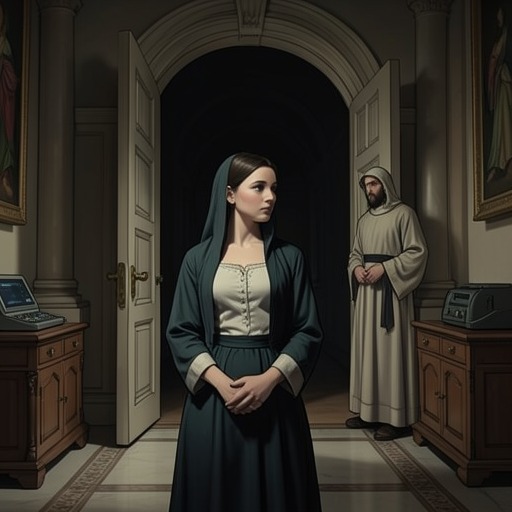
The trial begins when Cheryl reaches the end of her temple upbringing and is publicly transferred toward the palace. Priest Quincy leads her from the temple onto a stone platform fitted with hover engines. The platform rises above the chanting crowd and carries her from the temple steps to the palace, turning her departure into a spectacle of religious and political continuity. Cheryl expects to see one king waiting below, but two warriors stand there instead.
Quincy explains that the men fought each other for a day and a night until both collapsed from blood loss. The Gods have declared them equally worthy of the crown, so the unresolved question is not which warrior deserves kingship but which deserves the queen. Cheryl is commanded to choose, even though the temple has previously chosen everything for her, including what she wears and eats. The public ritual therefore exposes the contradiction at the center of her position: she is called a queen, yet she has been denied the practice of choosing.
The Two-Month Ordeal
Cheryl cannot immediately select either man. Her breathing becomes strained, her hands shake, and she tells Quincy that she cannot choose because the Gods, not she, decide who the king will be. Quincy converts that refusal into a new religious ruling. Cheryl and the two Kings Presumptive will be sent to the Shrine of Nethja, the Goddess of fertility, where they will remain until the alignment of the four moons.
The terms are absolute. If Cheryl becomes pregnant, the child’s father will become king. If she does not conceive, both men will be executed and a new king will be chosen. The announced test thus makes fertility a public instrument of succession and places Cheryl under an impossible burden: her survival, the men’s lives, and the kingdom’s political future are all made dependent on a pregnancy imposed by law and ritual.
The platform carries the three of them onward toward the shipyard. Cheryl understands that there will be no ordinary wedding night. Instead, she faces two months in a moon shrine with rival warriors whose formal objective is to impregnate her. The trial’s deadline also gives the contest a stark fatality: by its end, one or both men may be dead. The shrine is presented as sacred space, but its promised outcome is inseparable from sexual compulsion, political violence, and execution.
Bjorn, Maskin, and the Contest for Choice
For Maskin, the fertility trial is not merely a royal competition. Bjorn’s presence represents the final obstacle to his hopes for social change. Maskin believes that if Bjorn becomes king, warrior-slaves will continue to be taken from their mothers as infants and forced to live and die without beauty or choice. His urgency to impregnate Cheryl therefore joins personal ambition to opposition against the warrior-slave order.
Maskin tries to compete through a small handmade gift rather than through rank or spectacle. He braids Cheryl a grass necklace, one of the few crafts warrior-slaves know because rare periods of downtime allow them to make objects from available materials. Such necklaces express affection among the enslaved, although they are considered simple beside the sapphires given to higher ranks. Maskin hopes Cheryl will value the handmade necklace and the world it represents. He knows that if she does not, he has little with which to compete against Bjorn, and failure is not an option.
The trial temporarily places the rivals inside the same sacred and reproductive structure, but it does not erase their antagonism. Their struggle is measured not only by strength or royal legitimacy but by Cheryl’s response to each of them. This makes her attraction, trust, or refusal politically consequential even within a system that claims to let the Gods decide.
Cheryl’s Decision and the New Arrangement
After the men are healed and Cheryl has recovered enough to walk, she takes both of their hands and leads them silently toward her cabin. At the threshold, she stops the arrangement from becoming another decision made entirely over her head. Cheryl declares that she has made a choice: if one man has her, the other must have her as well, always together, and neither will be alone with her.
Her condition is also a prohibition against renewed violence. If Bjorn and Maskin fight each other again, they may as well kill one another, because Cheryl will reject both of them. Her hands tremble and her face is pale, but she straightens her shoulders, raises her chin, and delivers the rule with resolve before entering the cabin and shutting the door.
The two men remain rivals, yet Cheryl’s ultimatum changes the structure of the trial. Bjorn wants to strike Maskin but restrains himself because he understands the consequence of violating her terms. Maskin growls and follows when Bjorn walks away. Their immediate obedience does not abolish the contest, but it establishes Cheryl’s shared-partnership demand as the condition under which either man can remain a possible king and mate.
Consequences and Narrative Significance
The Nethja Fertility Trial converts a succession ceremony into a liminal passage between identities. Cheryl leaves the temple as a woman trained to obey, is displayed before a crowd as a queen, and then enters a shrine where her pregnancy will determine political legitimacy. The hover platform marks her physical separation from the temple, while the Shrine of Nethja becomes the threshold at which queen, prospective wife, and dynastic instrument are forced into the same role.
Its logic also exposes the instability of the old order. The Gods’ judgment produces two equally worthy kings rather than one unquestioned monarch; Quincy responds by transferring the unresolved political conflict into Cheryl’s body. Yet Cheryl’s refusal to select one warrior and her insistence that neither man be alone with her create a third possibility: the kingship and the intimate bond may be shared rather than resolved through the death of a rival.
The trial’s background is illuminated by the separate Kinai Joining tradition, in which every twenty-five years unmarried Kinai men and women between twenty and thirty spend the winter at the Rookery while beastlings hatch. Both practices connect adulthood, communal identity, reproduction, and controlled access to sacred knowledge, but the Nethja ordeal is distinguished by its immediate political stakes and its threat of execution. It is not simply a fertility rite; it is the mechanism through which Demante’s succession, Cheryl’s agency, Maskin’s reformist hopes, and Bjorn’s claim to the crown are forced into one dangerous test.