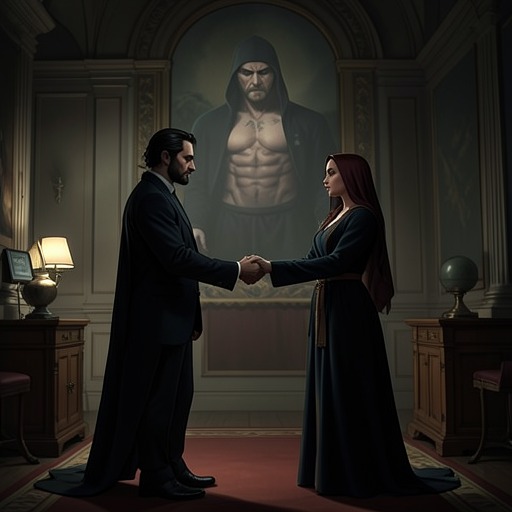
The Rejection of Ella by King Rezelith
The Vampire Prince’s BrideThe Rejection of Ella by King Rezelith is the confrontation in which a private revelation of true-mate destiny collides with the dynastic logic of the Rothgar throne. Darilth brings Ella before his father expecting recognition of the woman chosen by ancient magic, but King Rezelith refuses even to acknowledge her as a legitimate bride. His verdict places Ella’s humanity, albinism, and presumed infertility beneath the demands of succession, while forcing Darilth to choose between obedience to the crown and protection of his mate.
Setting and Circumstances
The encounter takes place in Rothgar Castle’s throne room, a vast, severe space of dark stone, heavy wooden doors, huge columns, and arched windows opening onto an ice-covered world. The physical coldness of the planet and the hall’s harsh architecture reinforce the emotional atmosphere of the royal court. King Rezelith sits on a dark-stone throne with guards arranged on both sides, making the meeting less a family conversation than a formal judgment before the machinery of power.
Darilth enters with Ella behind him and bows before his father, Lord Rezelith, the Elder of the Drakonaar. Beside the king stands Keralth, a younger man dressed in dark clothing resembling Darilth’s, accompanied by a beautiful but visibly drained woman. The arrangement places Darilth and Ella before an already established royal hierarchy and suggests that marriage, fertility, and dynastic presentation are matters watched by the court rather than private choices.
Darilth identifies Ella formally as the woman destined to be his bride and names her his true mate. His claim is not merely romantic. He explains that the Draco’s Eye responded to her, linking Ella to an ancient power that the royal family has awaited for centuries. The moment therefore carries two competing forms of legitimacy: Darilth invokes supernatural recognition, while Rezelith measures legitimacy through the court’s expectations of bloodline and heirs.
Rezelith’s Refusal
Rezelith responds to Ella’s presence with contempt. He reduces her first to her status as a human brought into the royal castle and then treats her visible difference as evidence of weakness. Darilth explains that a genetic condition makes Ella appear different from others of her kind, but the explanation does not soften the king’s judgment. Rezelith’s attention remains fixed on what Ella can supposedly provide the dynasty rather than on the bond Darilth has recognized.
The king states that Darilth needs a woman capable of giving him an heir and declares that Ella cannot fulfill that purpose. He calls her weak and says that he would prefer to see her work as a slave rather than accept her as Darilth’s bride. In this formulation, Ella is not treated as a person whose consent, identity, or relationship matters; she is classified according to usefulness to royal reproduction. The rejection thus exposes the court’s underlying equation of female worth with dynastic fertility.
Darilth tries to answer the accusation by insisting that Ella is his true mate and that the Draco’s Eye has responded to her. Rezelith cuts him off and refuses to treat the magical sign as decisive. He gives Darilth an ultimatum: keep Ella as a slave or kill her, return only after finding a suitable woman, and remain in exile until then. The order converts a father’s disapproval into a threat against Ella’s life and freedom, while making Darilth’s exile conditional on submission to the royal marriage system.
Conflict and Immediate Consequences
The central conflict is between Darilth’s recognition of a sacred or supernatural bond and Rezelith’s enforcement of political order. Darilth believes the Draco’s Eye has confirmed an ancient destiny that the royal house has awaited for centuries. Rezelith treats that confirmation as irrelevant when it conflicts with his standards for a suitable royal woman. The scene therefore produces a sharp value reversal: the revelation that should have elevated Ella instead exposes her to enslavement and death.
Darilth’s response is physical before it becomes openly revolutionary. His jaw clenches, his hands close into fists, and his knuckles turn white as he struggles against the humiliation inflicted on Ella. He knows his father is being unreasonable, but the king’s authority still controls the room. Darilth had brought Ella to be presented as his destined bride; she is instead publicly degraded and threatened with forced servitude.
Ella trembles and cries silently, her breathing becoming staggered. Her distress gives the royal dispute a direct human cost. The throne room is not only deciding a succession problem; it is subjecting a vulnerable outsider to a judgment she cannot control. Darilth sees her fear and understands that bringing her to the castle has exposed her to a cruelty he had underestimated. The scene’s decisive consequence is therefore both political and intimate: the royal family rejects the bond, and Darilth is forced to confront the danger of leaving Ella within his father’s power.
Role in the Larger Arc
The rejection establishes the conflict between Darilth and Rezelith as a struggle over who has the authority to define the future of Rothgar. Rezelith claims that royal continuity depends on a suitable woman who can produce an heir. Darilth’s experience suggests that continuity may instead depend on an older and less controllable form of legitimacy, one represented by the Draco’s Eye and the true-mate bond. The king’s refusal is therefore an attempt to preserve institutional control against a sign that could reorder the dynasty.
The event also places Ella in a threshold position. She has been brought from the human world into the Drakonaar royal sphere, but the court refuses to incorporate her. Rather than completing a passage into royal life, the presentation becomes a failed rite of admission: Darilth publicly names her as his bride, while Rezelith declares her unworthy of that identity and assigns her the status of a possible slave. The ceremony meant to secure belonging instead produces exclusion.
That contradiction gives the event its lasting narrative force. Ella’s difference is treated by Rezelith as a defect, while Darilth’s recognition of her treats it as compatible with, and perhaps bound to, the ancient magic of the royal line. The king’s rejection cannot erase the Draco’s Eye’s response, so it creates an unresolved opposition between official law and supernatural evidence. Darilth’s loyalty is consequently tested not by uncertainty about Ella, but by the demand that he deny what he knows.
Significance
The rejection dramatizes how royal systems convert bodies into political instruments. Rezelith’s concern with heirs makes Ella’s perceived inability to bear children more important to him than her relationship with Darilth or the ancient sign that identifies her as his mate. His judgment also shows how xenophobia and ableist contempt reinforce dynastic power: Ella is dismissed because she is human, visibly different, and presumed reproductively inadequate.
At the same time, the event distinguishes true recognition from institutional approval. Darilth’s declaration and the Draco’s Eye establish one kind of truth, but Rezelith’s throne can still deny its social consequences. The resulting fracture is the scene’s decisive significance: Ella may be Darilth’s true mate in the realm of destiny, yet the king’s refusal prevents that bond from being accepted in the realm of law. The royal dispute begins when those two realities cease to coincide.